
988368
Tue, Sep 22, 2026

Volume 23, Issue 4 (December 2025)
Iranian Rehabilitation Journal 2025, 23(4): 473-484 |
Back to browse issues page




Download citation:
BibTeX | RIS | EndNote | Medlars | ProCite | Reference Manager | RefWorks
Send citation to:


BibTeX | RIS | EndNote | Medlars | ProCite | Reference Manager | RefWorks
Send citation to:
Ahmadi S S, Teimourisangani M, Hozhabr M, Poormohammad A, Sobhani-Rad D. Understanding Cognitive and Linguistic Deficits in Aphasia Through Naming Reaction Time, Working Memory, and Executive Function. Iranian Rehabilitation Journal 2025; 23 (4) :473-484
URL: http://irj.uswr.ac.ir/article-1-2600-en.html
URL: http://irj.uswr.ac.ir/article-1-2600-en.html
Seyed Saeed Ahmadi1 

 , Mohyeddin Teimourisangani2 , Mahshid Hozhabr2 , Ahmad Poormohammad3 , Davood Sobhani-Rad *2
, Mohyeddin Teimourisangani2 , Mahshid Hozhabr2 , Ahmad Poormohammad3 , Davood Sobhani-Rad *2
1- Department of Communication Sciences and Disorders, University of South Carolina, Columbia, United States. & Department of Speech Therapy, School of Paramedical and Rehabilitation Sciences, Mashhad University of Medical Sciences, Mashhad, Iran.
2- Department of Speech Therapy, School of Paramedical and Rehabilitation Sciences, Mashhad University of Medical Sciences, Mashhad, Iran.
3- Elumind Centres for Brain Excellence, Vancouver, Canada.
2- Department of Speech Therapy, School of Paramedical and Rehabilitation Sciences, Mashhad University of Medical Sciences, Mashhad, Iran.
3- Elumind Centres for Brain Excellence, Vancouver, Canada.
Full-Text [PDF 972 kb]
(1251 Downloads)
| Abstract (HTML) (2302 Views)
Full-Text: (750 Views)
Introduction
Aphasia is a chronic acquired multimodal language disorder typically resulting from brain damage, especially stroke, which commonly reduces the quality of life (QoL). A total of 40% of stroke survivors experience aphasia, either alone or in combination with other impairments. It can impact all language domains, including phonology, morphology, syntax, semantics, and pragmatics, in both expression and reception, depending on the region of brain damage [1, 2]. However, traditionally aphasia is considered a language-based impairment, several studies have shown that people with aphasia (PWA) also have some deficits in cognitive skills, such as attention [3, 4], memory [5, 6], executive function [7, 8], working memory [5, 9] and processing speed [10].
The deficit in the ability to successfully retrieve and produce words is a fundamental characteristic of aphasia, called anomia or difficulty in naming. PWA encountered some degree of naming difficulty according to their type of aphasia. Naming is most assessed using standardized image-naming tests, in which PWA are asked to name images of items. Improving naming ability has been linked to better communication skills [11, 12]. Anomia can be analyzed from two perspectives: Accuracy and processing speed of word retrieval and production. At the same time, slower language processing is frequent in aphasia (may respond slowly) [13], most research and clinical practice focus on naming accuracy. Rapid automized naming (RAN) is defined as the ability to quickly and accurately name well-known visual stimuli as quickly as possible [14]. Studies have shown that the brain begins choosing a word within 200 ms of seeing a picture and finishes the retrieval process in 600 ms [15, 16]. Many parameters like the age of acquisition, word frequency, and word length can affect this time window [17, 18]. Reaction time or response time refers to the time that elapses between the onset or presentation of a stimulus and the occurrence of a specific response to that stimulus, which includes the ability to detect, process, and respond to the stimulus. Researchers believe that evaluating reaction time as a behavioral variable is a good indicator of the speed and efficiency of mental processes [19]. Studies have shown a delay in reaction time in PWA [10, 20].
Working memory is considered a capacity-limited system in which limited information can be stored, processed and manipulated for a finite time. In Baddeley’s revised multicomponent model of WM, the central executive serves as a supervisory system that controls attention, coordinates processing, and regulates information flow. It distributes attentional resources to three slave systems: The phonological loop, the visuospatial sketchpad, and the episodic buffer. The phonological loop maintains and practices spoken language. Visual and spatial data are stored in the visuospatial sketchpad. The episodic buffer functions as a unitary multimodal storage hub connecting the long-term memory, the visuospatial sketchpad, and the phonological loop [21-23]. Several studies have shown that PWA have deficits in the verbal, visual, and spatial aspects of working memory [24].
Executive function refers to the cognitive processes that enable individuals to plan, focus attention, remember instructions, and juggle multiple tasks successfully. These functions are crucial for goal-directed behavior and include skills, such as working memory, cognitive flexibility, and inhibitory control. These processes are essential for problem-solving and adaptive behavior [25]. Executive functions, primarily subserved by the prefrontal lobe [25], can be impaired in individuals with aphasia who have preserved prefrontal function [26]. Some studies have evaluated the executive functions in PWA and reported significantly lower performance levels than those without neurological disorders [3, 7, 26].
In 2017, Marinelli et al. examined 189 aphasic patients for language and cognitive status and found that the greater the language impairment, the greater the cognitive problems [27]. Other clinical studies on patients with aphasia indicate that focusing on cognitive therapy—particularly executive functions and verbal short-term memory—significantly enhances patient outcomes [28, 29]. In addition, research has demonstrated that targeted cognitive exercises can effectively increase working memory capacity [30, 31]. Furthermore, recent studies show that cognitive exercises have improved language skills in patients with neurological conditions [32, 33].
A deeper understanding of language processing and its relationship with other cognitive functions is essential for enhancing rehabilitation services [34]. Understanding the relationship between cognitive components and language abilities will enable therapists to design more effective rehabilitation strategies, ensuring that patients achieve optimal performance levels. This study aimed to explore these relationships in depth, providing insights that can enhance therapeutic interventions for individuals with language impairment.
Materials and Methods
This study was conducted on individuals with aphasia who sought evaluation and treatment at the speech therapy departments of hospitals affiliated with Mashhad University of Medical Sciences between February 2024 and June 2024. Twenty individuals with Broca’s aphasia, all diagnosed by the same neurologist to ensure consistency in diagnostic criteria, were included in the study. Additionally, 20 neurologically healthy individuals without any history of neurological disorders were selected as a control group, matched one-to-one with the aphasia group based on age, gender, and education level. The inclusion criteria for aphasic individuals included age>30 years, right-handedness, Broca’s aphasia resulting from ischemic stroke as diagnosed by a neurologist, single stroke, anterior lesion, monolingualism, and absence of progressive neurological or infectious diseases. The inclusion criteria for the control group included age >30 years, right-handedness, no history of neurological damage, and one-to-one matching with aphasic individuals based on age, gender, and education. The exclusion criteria included withdrawal from the evaluation, which may occur due to unforeseen circumstances or a participant’s unwillingness to continue. Participants were recruited using convenience sampling, and informed consent was obtained from all participants prior to their inclusion in the study.
This study aimed to assess the relationship between linguistic skills (rapid automized naming and reaction times to linguistic stimuli), non-linguistic skills (reaction times to non-linguistic stimuli), and cognitive skills (working memory and executive functions). A meeting was held among the research team to select appropriate tests, both standardized and informal, for evaluating these skills. The selected tests have established validity and reliability for use in people with PWA.
Procedure
General setup
All participants were individually evaluated in a quiet, distraction-free clinical room. The tasks were administered on a 27-inch AOC curved monitor (1920×1080 resolution, 240 Hz) controlled by a Windows 10 PC. The stimuli were presented, and the response times were recorded using DMDX, ensuring millisecond-level accuracy for the visual and auditory paradigms. A calibrated USB microphone detected vocal responses, and waveforms were manually performed offline to correct for false triggers (e.g. filled pauses). The button-press responses were captured using a keypad. Each participant completed all tasks in the same order, with short breaks between tasks to minimize fatigue.
Task 1: Persian aphasia diagnostic test
Participants’ linguistic abilities were assessed using the Persian aphasia diagnostic test, which has established validity and reliability in Persian [35]. The subtests included continuous speech, auditory comprehension, sentence comprehension, repetition, and naming. Scores for each subtest were recorded, and a final score was calculated.
Task 2: Non-linguistic reaction time (target detection)
Participants completed a visual target-detection task designed to measure non-linguistic processing speed. A target image was first shown for 1,500 ms as a cue. Following this, images were presented at fixed intervals (2 000 ms stimulus duration, 500 ms inter-stimulus interval). The participants were instructed to press a button as quickly as possible when the pre-cued target reappeared. Reaction time (RT) was measured from stimulus onset to button press. Incorrect or missed responses were coded separately and excluded from RT analysis.
Task 3: Linguistic reaction time (word and non-word detection)
Two linguistic reaction time subtasks were administered:
Picture–word matching. The participants were shown images of 10 target items. Subsequently, written words (targets or distractors) were presented for 1500 ms with a 5000 ms stimulus onset asynchrony. The participants pressed a button when the word matched the target image.
Word/non-word detection. A set of 20 letter strings (15 real words, 5 non-words) was presented. The participants pressed a button when they detected a non-word. The reaction time for correct responses was analyzed.
Task 4: Rapid automized naming
Rapid naming ability was assessed using 10 high-frequency monosyllabic Persian nouns, each represented by three images in different contexts. Context was manipulated to test whether environmental constraint facilitates lexical access in Broca’s aphasia:
High-context: Target shown in a rich, semantically supportive scene. Low-context: Target shown in a related but less informative environment. No-context: Target shown in isolation on a plain background.
This yielded 30 trials (10 items×3 contexts). Each image remained on screen until a response was made or a maximum of 4,500 ms elapsed. The participants were instructed to name the images aloud as quickly and accurately as possible. Vocal onset latencies were recorded; incorrect or late responses were excluded from Rapid automatized naming (RAN) analyses but retained for accuracy/error-type coding (semantic, phonological, neologism, circumlocution, no-response). Filled pauses were treated as invalid RTs and recoded as “no-response.”
Task 5: Executive function and central executive control
The central executive component of working memory was assessed using two tasks:
Color–word stroop task: Participants identified the ink color of incongruent color words. Ten incongruent items were presented; accuracy and RTs were recorded as indices of inhibitory control.
Wisconsin card sorting test (WCST-64, computerized version): Participants sorted 64 cards by rules that changed without warning. The software recorded the completed categories, perseverative and non-perseverative errors, and test duration, which is defined as the total wall-clock time from the first to the last response (not per-trial RT). This provided a measure of set-shifting ability.
The software for displaying tasks was developed using the Unity engine, allowing for multi-platform compatibility. The content presented on the monitor was culturally tailored to the Iranian population, minimizing the influence of cultural differences on test outcomes. In RT’s tasks, “speed” was defined as RT in milliseconds from stimulus onset to verified response onset (voice or button press). Shorter RTs indicated faster performance.
Data analysis
Data were analyzed using IBM SPSS statistics software, version 18. Normality tests were conducted to determine whether parametric or non-parametric methods should be used. Subsequently, mean comparisons were made between the two groups. Finally, Pearson correlation tests were used to analyze the relationship between rapid automized naming, reaction times, working memory, and executive functions. All study procedures were conducted with the informed consent of participants, who were free to withdraw at any stage. The evaluations were conducted free of charge, and confidentiality was ensured throughout the process. The research team committed to not sharing any personal data without participant consent.
Results
We conducted a comparative analysis involving 20 individuals diagnosed with Broca’s aphasia and 20 neurologically typical controls with no history of neurological disorders. Table 1 presents a comprehensive summary of the demographic characteristics of both groups and details their performance on various cognitive and linguistic assessments.

Descriptive analysis
The neurologically healthy individuals outperformed the PWA group in rapid automized naming tasks, with a 16-point difference in accuracy, and demonstrated faster naming speeds across images with high, low, and no context. Both groups exhibited slower in tasks with less visual detail, but faster in highly detailed contexts. In cognitive reaction time tasks, the PWA group’s reaction time was slower by approximately 2 seconds compared to the neurologically healthy group (a significant difference is observed between two groups [P<0.001]), with similar trends in linguistic tasks. Performance in the color-word test and the WCST showed significant differences (P<0.001 for all tasks except for Wisconsin preservation error (WPE) (P=0.003) and Wisconsin maintain failures (WMF) (P=0.013), with aphasic patients scoring lower and having more errors in cognitive flexibility tasks. No significant differences in age or education level were observed between individuals with aphasia and neurologically healthy individuals.
Inferential analysis
The results indicates significant differences between individuals with aphasia and those without neurological damage in several cognitive and linguistic tasks. Specifically, there are significant differences in:
RAN
The mean RAN scores across high-, low-, and no-detail contexts significantly differed between the two groups (P<0.001 for all).
Non-linguistic and linguistic reaction times
Significant differences were observed in reaction times for non-linguistic and linguistic tasks, including word-finding and non-word detection (P<0.001).
Color-word
Significant differences were observed in the accuracy of the color-word task among the two groups (P<0.001).
WCST
Significant differences in the average completion time, number of categories completed, and number of errors in preservation. Significant differences were also observed in the average number of correct and incorrect responses, the number of attempts to complete the first pattern, and failures to maintain a sequence (P<0.001 for all tasks except for WPE (P=0.003) and WMF (P=0.013).
Figure 1 presents the results of the Pearson correlation analysis for all research variables, illustrating the relationships between them. RAN showed significant correlations with most variables. However, the speed of RAN in both high-context and low-context conditions correlated with each other (P=0.003, r=0.634). In contrast, the speed of RAN in the no-context condition was associated with both educational level (P=0.044, r=-0.454) and reaction time accuracy in non-linguistic tasks (P=0.048, r=0.447). Reaction time in non-linguistic tasks also correlated with reaction time in linguistic tasks (P<0.001, r=0.865) and completion time in the WCST (P<0.001, r=-0.724).
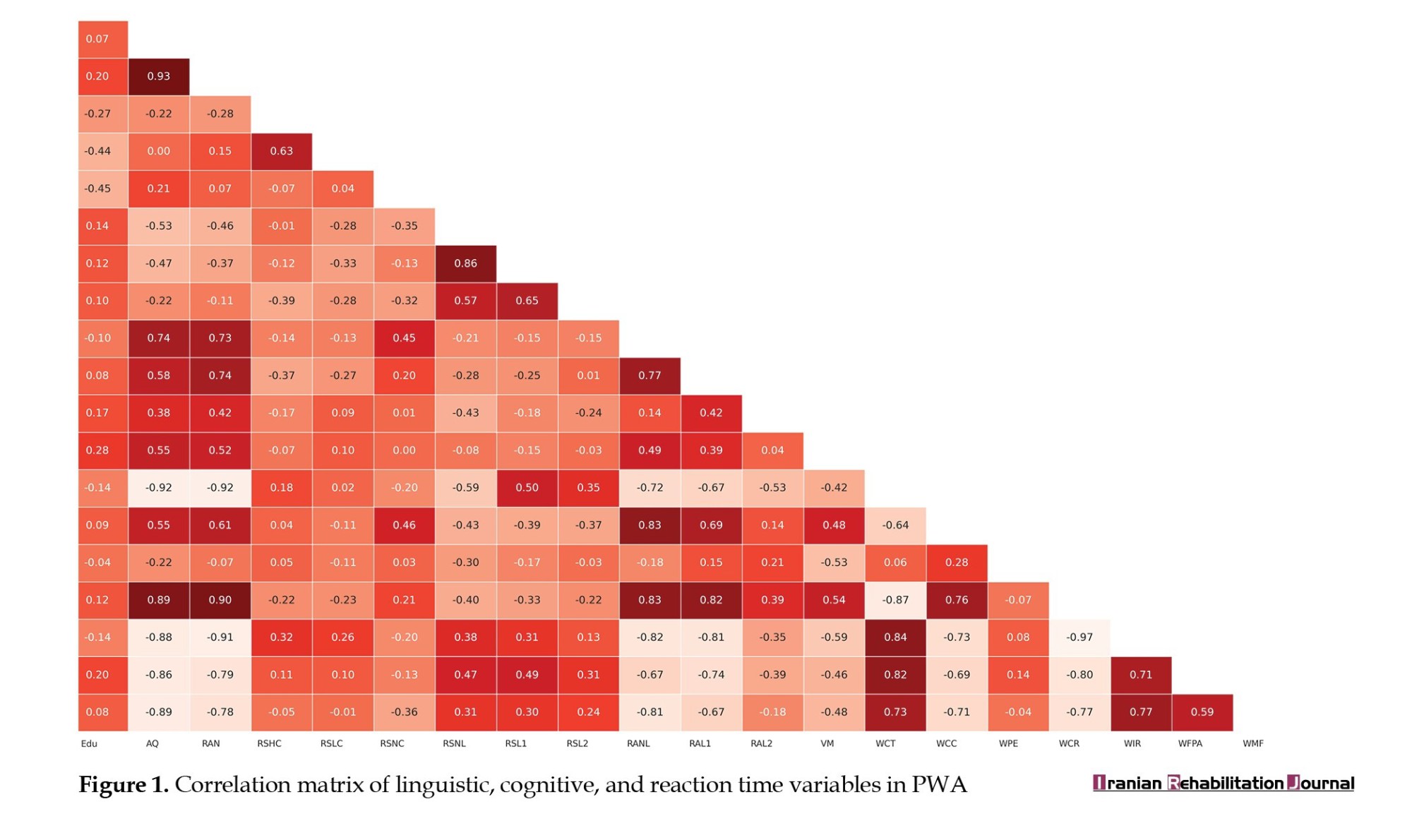
Furthermore, reaction times for the first linguistic task (word-finding) were significantly correlated with those for the second linguistic task (non-word-finding) (P=0.002, r=0.654). Accuracy in reaction time during non-linguistic tasks was correlated with reaction time accuracy in the first linguistic task (P<0.001, r=0.765), age, and all WCST parameters, except for the WCST perseverance error. Reaction time accuracy in non-linguistic tasks is also independently associated with working memory (P=0.030, r=0.486). Conversely, reaction time accuracy in second linguistic tasks (non-word-finding) correlated only with the WCST completion time (P=0.015, r=-0.534).
In addition to RAN, working memory correlates solely with reaction time accuracy in non-linguistic tasks. Except for the WCST perseverance error, other parameters of the Wisconsin test correlated with most of the other variables in the study.
Discussion
The comparison of RAN, RT, working memory, and executive function between individuals with aphasia and those without neurological impairment revealed significant differences across all four components. This indicates that all these components are impaired in individuals with aphasia, which aligns with previous studies [3, 7, 10, 13, 20, 24, 26, 36].
Our study also demonstrated a direct and positive correlation between working memory, executive functions, and rapid automized naming, such that an increase or decrease in one could lead to corresponding changes in the others. Additionally, examining the relationship between these three components and reaction time showed that the relationship varied depending on the type of stimulus (cognitive or linguistic). When the stimulus was cognitive, there was no significant relationship between reaction time and working memory; however, a direct and positive relationship was observed with rapid automized naming and executive function.
The lack of a significant relationship between reaction time (specifically, in non-linguistic tasks) and working memory may be because reaction time tasks with cognitive stimuli do not heavily rely on the temporary storage or manipulation of information, which is central to working memory [5]. In contrast, the positive relationship with RAN suggests that both tasks engage similar processes of quick retrieval from long-term memory, making individuals who excel in RAN faster at responding to cognitive stimuli. Additionally, the direct relationship with executive functions highlights the role of cognitive flexibility, inhibition, and attention control, which are essential for efficiently managing and responding to complex tasks involving cognitive stimuli [25]. One possible explanation is that executive deficits in aphasia may arise indirectly from disrupted fronto-temporal connectivity, reduced efficiency of domain-general control networks, or compensatory overreliance on preserved prefrontal mechanisms.
When the linguistic stimulus involved words, the positive correlation between reaction time and RAN suggests that both rely on the ability to quickly retrieve and process verbal information from long-term memory. Similarly, the positive relationship with executive functions indicates the involvement of cognitive skills, such as attention control, inhibition, and flexibility, which are crucial for efficiently responding to linguistic tasks. However, the lack of correlation with working memory implies that these tasks did not demand significant temporary storage or manipulation of information, highlighting a lesser role for working memory in this context compared to RAN and executive function [37].
Lastly, if the linguistic stimulus involved non-words, no significant relationship was found between reaction time and any of the three components: Rapid automized naming, working memory, or executive function.
Our findings revealed a significant disparity in RAN scores between individuals with aphasia and their neurotypical counterparts, underscoring the substantial impact of aphasia on language processing. Notably, the lack of correlation between RAN and educational attainment and inverse relationship with age is particularly noteworthy. This suggests that as individuals age, their capacity for rapid naming may diminish, potentially due to age-related cognitive decline affecting language processing abilities [38]. These findings resonate with observations that individuals with aphasia often take significantly longer to retrieve words compared to their neurotypical peers, and this slower language processing may manifest as prolonged response times during word retrieval tasks [12]. Our results are consistent with these observations and reinforce the notion that aphasia significantly impairs the efficiency of language production.
In examining the context-dependent nature of RAN, we observed that naming performance improved in a rich visual context, which aligns with previous studies [39, 40]. These studies corroborate our finding that context is crucial in facilitating naming accuracy and speed. The enhancement of naming performance in richly detailed contexts emphasizes the importance of environmental cues in supporting individuals with aphasia during naming. This is particularly relevant given the complexity of the naming process, which involves intricate interactions between visual recognition, memory retrieval, and language production.
Despite the clear positive relationship between RAN and cognitive skills, such as working memory and executive function, it is crucial to note that our study found no significant correlation between RAN and reaction time. This raises questions about the temporal dimensions of these variables, suggesting that while RAN reflects an individual’s capacity to retrieve words rapidly, it may not directly translate into quicker reaction times in linguistic tasks. The nature of how these variables are measured—RAN as a unitless score and reaction time in seconds—may contribute to this discrepancy. Additionally, motor impairments associated with aphasia may further complicate the relationship between RAN and reaction times, indicating that further research is necessary to elucidate these dynamics.
Our examination of reaction times in cognitive and linguistic tasks revealed distinct relationships with various demographic and cognitive variables. In line with previous research [41, 42], our study demonstrated that PWAs exhibit delayed reaction times during linguistic tasks, which is attributed to an impaired word retrieval process. This delay results in overall slower task performance. Interestingly, while we found an inverse correlation between reaction time and AQ scores, suggesting that higher linguistic functioning correlates with faster reaction times, the second linguistic stimulus (non-word recognition) exhibited no significant relationship with the measured variables. This distinction may arise from the nature of the tasks, as our focus on recognizing non-words diverged from other studies that explored reading [43], indicating a need for a nuanced exploration of linguistic processing in individuals with aphasia.
Regarding working memory, our findings reflect a complex interplay between cognitive functions and naming performance. While we established a positive relationship between working memory and accuracy in cognitive tasks, its connection to rapid automized naming was more intricate, with a negative correlation observed in highly detailed contexts. This suggests that individuals may rely more heavily on their working memory to process and retrieve information in less-structured environments. Our results also align with previous literature, which emphasizes the role of working memory in semantic and phonological processing during the naming process [22, 44], suggesting avenues for further investigation.
Finally, our findings on the Wisconsin test illustrated the pronounced deficits in executive functions among individuals with aphasia. The significant differences across all test components reinforce the notion that cognitive impairments are associated with broader cognitive difficulties. Our results indicate that while education and age do not significantly correlate with performance on the Wisconsin test, age does influence test duration and cognitive difficulties, suggesting that aging may exacerbate cognitive decline in individuals with aphasia.
Conclusion
This study sheds light on the complex relationships between cognitive functions—such as working memory and executive function—and linguistic abilities, particularly RAN, in individuals with aphasia. The results clearly demonstrate that PWA face significant challenges in naming tasks, especially when visual context is limited, and they also exhibit slower reaction times in both linguistic and non-linguistic tasks.
Importantly, the findings indicate that performance on cognitive measures and naming tasks tended to vary, suggesting an association between these domains. However, the absence of a direct correlation between RAN and reaction time suggests that these processes involve separate underlying mechanisms.
These results underscore the importance of considering linguistic and cognitive domains when examining aphasia. Although this study highlights this relationship, it does not establish causation or therapeutic effects. Future research, especially studies incorporating intervention designs, is required to determine how these relationships may inform rehabilitation approaches.
Limitations
Despite the insights gained, this study has several limitations. The cultural specificity of the tasks, tailored to Persian-speaking populations, may limit the generalizability of results to other linguistic or cultural groups. Additionally, the reliance on standardized tasks may not fully capture the complexities of real-world cognitive-linguistic functioning. Motor impairments commonly associated with aphasia could also have influenced reaction time performance, potentially confounding the results. Finally, the study’s cross-sectional design limits the ability to infer causality between cognitive and linguistic deficits, necessitating longitudinal research for deeper insights.
Future directions
Future research should focus on longitudinal studies to explore the causality between cognitive deficits and language impairments in aphasia. Investigating the efficacy of integrated cognitive-linguistic rehabilitation programs can provide actionable insights for improving therapeutic outcomes. Additionally, expanding the cultural and linguistic scope of the study by including non-Persian-speaking populations could enhance the generalizability of the findings. Further exploration of the neural correlates of reaction time and naming speed using advanced imaging techniques could shed light on the underlying mechanisms. Examining age-related variations in cognitive and linguistic deficits may also provide valuable perspectives for tailoring interventions.
Ethical Considerations
Compliance with ethical guidelines
This study was approved by the Ethics Committee of Mashhad University of Medical Sciences, Mashhad, Iran (Code: IR.MUMS.MEDICAL.REC.1402.243). All participants provided written informed consent prior to participation, and the study was conducted in accordance with the principles of the Declaration of Helsinki.
Funding
This study was financially supported by Mashhad University of Medical Sciences, Mashhad, Iran (Grant No.: 4021900).
Authors' contributions
All authors contributed to the design, implementation, and writing of all parts of the study.
Conflict of interest
The authors declared no conflict of interest.
Acknowledgments
The authors extend their deepest gratitude to the participants and their families for their cooperation and willingness to contribute to this study. They also thank the Mashhad University of Medical Sciences for their financial and logistical support. Special appreciation is given to the Speech Therapy Department and neurologists facilitating participant recruitment. Finally, they acknowledge the linguist and software developers efforts to ensure the study’s methodological rigor and cultural relevance.
References
Aphasia is a chronic acquired multimodal language disorder typically resulting from brain damage, especially stroke, which commonly reduces the quality of life (QoL). A total of 40% of stroke survivors experience aphasia, either alone or in combination with other impairments. It can impact all language domains, including phonology, morphology, syntax, semantics, and pragmatics, in both expression and reception, depending on the region of brain damage [1, 2]. However, traditionally aphasia is considered a language-based impairment, several studies have shown that people with aphasia (PWA) also have some deficits in cognitive skills, such as attention [3, 4], memory [5, 6], executive function [7, 8], working memory [5, 9] and processing speed [10].
The deficit in the ability to successfully retrieve and produce words is a fundamental characteristic of aphasia, called anomia or difficulty in naming. PWA encountered some degree of naming difficulty according to their type of aphasia. Naming is most assessed using standardized image-naming tests, in which PWA are asked to name images of items. Improving naming ability has been linked to better communication skills [11, 12]. Anomia can be analyzed from two perspectives: Accuracy and processing speed of word retrieval and production. At the same time, slower language processing is frequent in aphasia (may respond slowly) [13], most research and clinical practice focus on naming accuracy. Rapid automized naming (RAN) is defined as the ability to quickly and accurately name well-known visual stimuli as quickly as possible [14]. Studies have shown that the brain begins choosing a word within 200 ms of seeing a picture and finishes the retrieval process in 600 ms [15, 16]. Many parameters like the age of acquisition, word frequency, and word length can affect this time window [17, 18]. Reaction time or response time refers to the time that elapses between the onset or presentation of a stimulus and the occurrence of a specific response to that stimulus, which includes the ability to detect, process, and respond to the stimulus. Researchers believe that evaluating reaction time as a behavioral variable is a good indicator of the speed and efficiency of mental processes [19]. Studies have shown a delay in reaction time in PWA [10, 20].
Working memory is considered a capacity-limited system in which limited information can be stored, processed and manipulated for a finite time. In Baddeley’s revised multicomponent model of WM, the central executive serves as a supervisory system that controls attention, coordinates processing, and regulates information flow. It distributes attentional resources to three slave systems: The phonological loop, the visuospatial sketchpad, and the episodic buffer. The phonological loop maintains and practices spoken language. Visual and spatial data are stored in the visuospatial sketchpad. The episodic buffer functions as a unitary multimodal storage hub connecting the long-term memory, the visuospatial sketchpad, and the phonological loop [21-23]. Several studies have shown that PWA have deficits in the verbal, visual, and spatial aspects of working memory [24].
Executive function refers to the cognitive processes that enable individuals to plan, focus attention, remember instructions, and juggle multiple tasks successfully. These functions are crucial for goal-directed behavior and include skills, such as working memory, cognitive flexibility, and inhibitory control. These processes are essential for problem-solving and adaptive behavior [25]. Executive functions, primarily subserved by the prefrontal lobe [25], can be impaired in individuals with aphasia who have preserved prefrontal function [26]. Some studies have evaluated the executive functions in PWA and reported significantly lower performance levels than those without neurological disorders [3, 7, 26].
In 2017, Marinelli et al. examined 189 aphasic patients for language and cognitive status and found that the greater the language impairment, the greater the cognitive problems [27]. Other clinical studies on patients with aphasia indicate that focusing on cognitive therapy—particularly executive functions and verbal short-term memory—significantly enhances patient outcomes [28, 29]. In addition, research has demonstrated that targeted cognitive exercises can effectively increase working memory capacity [30, 31]. Furthermore, recent studies show that cognitive exercises have improved language skills in patients with neurological conditions [32, 33].
A deeper understanding of language processing and its relationship with other cognitive functions is essential for enhancing rehabilitation services [34]. Understanding the relationship between cognitive components and language abilities will enable therapists to design more effective rehabilitation strategies, ensuring that patients achieve optimal performance levels. This study aimed to explore these relationships in depth, providing insights that can enhance therapeutic interventions for individuals with language impairment.
Materials and Methods
This study was conducted on individuals with aphasia who sought evaluation and treatment at the speech therapy departments of hospitals affiliated with Mashhad University of Medical Sciences between February 2024 and June 2024. Twenty individuals with Broca’s aphasia, all diagnosed by the same neurologist to ensure consistency in diagnostic criteria, were included in the study. Additionally, 20 neurologically healthy individuals without any history of neurological disorders were selected as a control group, matched one-to-one with the aphasia group based on age, gender, and education level. The inclusion criteria for aphasic individuals included age>30 years, right-handedness, Broca’s aphasia resulting from ischemic stroke as diagnosed by a neurologist, single stroke, anterior lesion, monolingualism, and absence of progressive neurological or infectious diseases. The inclusion criteria for the control group included age >30 years, right-handedness, no history of neurological damage, and one-to-one matching with aphasic individuals based on age, gender, and education. The exclusion criteria included withdrawal from the evaluation, which may occur due to unforeseen circumstances or a participant’s unwillingness to continue. Participants were recruited using convenience sampling, and informed consent was obtained from all participants prior to their inclusion in the study.
This study aimed to assess the relationship between linguistic skills (rapid automized naming and reaction times to linguistic stimuli), non-linguistic skills (reaction times to non-linguistic stimuli), and cognitive skills (working memory and executive functions). A meeting was held among the research team to select appropriate tests, both standardized and informal, for evaluating these skills. The selected tests have established validity and reliability for use in people with PWA.
Procedure
General setup
All participants were individually evaluated in a quiet, distraction-free clinical room. The tasks were administered on a 27-inch AOC curved monitor (1920×1080 resolution, 240 Hz) controlled by a Windows 10 PC. The stimuli were presented, and the response times were recorded using DMDX, ensuring millisecond-level accuracy for the visual and auditory paradigms. A calibrated USB microphone detected vocal responses, and waveforms were manually performed offline to correct for false triggers (e.g. filled pauses). The button-press responses were captured using a keypad. Each participant completed all tasks in the same order, with short breaks between tasks to minimize fatigue.
Task 1: Persian aphasia diagnostic test
Participants’ linguistic abilities were assessed using the Persian aphasia diagnostic test, which has established validity and reliability in Persian [35]. The subtests included continuous speech, auditory comprehension, sentence comprehension, repetition, and naming. Scores for each subtest were recorded, and a final score was calculated.
Task 2: Non-linguistic reaction time (target detection)
Participants completed a visual target-detection task designed to measure non-linguistic processing speed. A target image was first shown for 1,500 ms as a cue. Following this, images were presented at fixed intervals (2 000 ms stimulus duration, 500 ms inter-stimulus interval). The participants were instructed to press a button as quickly as possible when the pre-cued target reappeared. Reaction time (RT) was measured from stimulus onset to button press. Incorrect or missed responses were coded separately and excluded from RT analysis.
Task 3: Linguistic reaction time (word and non-word detection)
Two linguistic reaction time subtasks were administered:
Picture–word matching. The participants were shown images of 10 target items. Subsequently, written words (targets or distractors) were presented for 1500 ms with a 5000 ms stimulus onset asynchrony. The participants pressed a button when the word matched the target image.
Word/non-word detection. A set of 20 letter strings (15 real words, 5 non-words) was presented. The participants pressed a button when they detected a non-word. The reaction time for correct responses was analyzed.
Task 4: Rapid automized naming
Rapid naming ability was assessed using 10 high-frequency monosyllabic Persian nouns, each represented by three images in different contexts. Context was manipulated to test whether environmental constraint facilitates lexical access in Broca’s aphasia:
High-context: Target shown in a rich, semantically supportive scene. Low-context: Target shown in a related but less informative environment. No-context: Target shown in isolation on a plain background.
This yielded 30 trials (10 items×3 contexts). Each image remained on screen until a response was made or a maximum of 4,500 ms elapsed. The participants were instructed to name the images aloud as quickly and accurately as possible. Vocal onset latencies were recorded; incorrect or late responses were excluded from Rapid automatized naming (RAN) analyses but retained for accuracy/error-type coding (semantic, phonological, neologism, circumlocution, no-response). Filled pauses were treated as invalid RTs and recoded as “no-response.”
Task 5: Executive function and central executive control
The central executive component of working memory was assessed using two tasks:
Color–word stroop task: Participants identified the ink color of incongruent color words. Ten incongruent items were presented; accuracy and RTs were recorded as indices of inhibitory control.
Wisconsin card sorting test (WCST-64, computerized version): Participants sorted 64 cards by rules that changed without warning. The software recorded the completed categories, perseverative and non-perseverative errors, and test duration, which is defined as the total wall-clock time from the first to the last response (not per-trial RT). This provided a measure of set-shifting ability.
The software for displaying tasks was developed using the Unity engine, allowing for multi-platform compatibility. The content presented on the monitor was culturally tailored to the Iranian population, minimizing the influence of cultural differences on test outcomes. In RT’s tasks, “speed” was defined as RT in milliseconds from stimulus onset to verified response onset (voice or button press). Shorter RTs indicated faster performance.
Data analysis
Data were analyzed using IBM SPSS statistics software, version 18. Normality tests were conducted to determine whether parametric or non-parametric methods should be used. Subsequently, mean comparisons were made between the two groups. Finally, Pearson correlation tests were used to analyze the relationship between rapid automized naming, reaction times, working memory, and executive functions. All study procedures were conducted with the informed consent of participants, who were free to withdraw at any stage. The evaluations were conducted free of charge, and confidentiality was ensured throughout the process. The research team committed to not sharing any personal data without participant consent.
Results
We conducted a comparative analysis involving 20 individuals diagnosed with Broca’s aphasia and 20 neurologically typical controls with no history of neurological disorders. Table 1 presents a comprehensive summary of the demographic characteristics of both groups and details their performance on various cognitive and linguistic assessments.
Descriptive analysis
The neurologically healthy individuals outperformed the PWA group in rapid automized naming tasks, with a 16-point difference in accuracy, and demonstrated faster naming speeds across images with high, low, and no context. Both groups exhibited slower in tasks with less visual detail, but faster in highly detailed contexts. In cognitive reaction time tasks, the PWA group’s reaction time was slower by approximately 2 seconds compared to the neurologically healthy group (a significant difference is observed between two groups [P<0.001]), with similar trends in linguistic tasks. Performance in the color-word test and the WCST showed significant differences (P<0.001 for all tasks except for Wisconsin preservation error (WPE) (P=0.003) and Wisconsin maintain failures (WMF) (P=0.013), with aphasic patients scoring lower and having more errors in cognitive flexibility tasks. No significant differences in age or education level were observed between individuals with aphasia and neurologically healthy individuals.
Inferential analysis
The results indicates significant differences between individuals with aphasia and those without neurological damage in several cognitive and linguistic tasks. Specifically, there are significant differences in:
RAN
The mean RAN scores across high-, low-, and no-detail contexts significantly differed between the two groups (P<0.001 for all).
Non-linguistic and linguistic reaction times
Significant differences were observed in reaction times for non-linguistic and linguistic tasks, including word-finding and non-word detection (P<0.001).
Color-word
Significant differences were observed in the accuracy of the color-word task among the two groups (P<0.001).
WCST
Significant differences in the average completion time, number of categories completed, and number of errors in preservation. Significant differences were also observed in the average number of correct and incorrect responses, the number of attempts to complete the first pattern, and failures to maintain a sequence (P<0.001 for all tasks except for WPE (P=0.003) and WMF (P=0.013).
Figure 1 presents the results of the Pearson correlation analysis for all research variables, illustrating the relationships between them. RAN showed significant correlations with most variables. However, the speed of RAN in both high-context and low-context conditions correlated with each other (P=0.003, r=0.634). In contrast, the speed of RAN in the no-context condition was associated with both educational level (P=0.044, r=-0.454) and reaction time accuracy in non-linguistic tasks (P=0.048, r=0.447). Reaction time in non-linguistic tasks also correlated with reaction time in linguistic tasks (P<0.001, r=0.865) and completion time in the WCST (P<0.001, r=-0.724).
Furthermore, reaction times for the first linguistic task (word-finding) were significantly correlated with those for the second linguistic task (non-word-finding) (P=0.002, r=0.654). Accuracy in reaction time during non-linguistic tasks was correlated with reaction time accuracy in the first linguistic task (P<0.001, r=0.765), age, and all WCST parameters, except for the WCST perseverance error. Reaction time accuracy in non-linguistic tasks is also independently associated with working memory (P=0.030, r=0.486). Conversely, reaction time accuracy in second linguistic tasks (non-word-finding) correlated only with the WCST completion time (P=0.015, r=-0.534).
In addition to RAN, working memory correlates solely with reaction time accuracy in non-linguistic tasks. Except for the WCST perseverance error, other parameters of the Wisconsin test correlated with most of the other variables in the study.
Discussion
The comparison of RAN, RT, working memory, and executive function between individuals with aphasia and those without neurological impairment revealed significant differences across all four components. This indicates that all these components are impaired in individuals with aphasia, which aligns with previous studies [3, 7, 10, 13, 20, 24, 26, 36].
Our study also demonstrated a direct and positive correlation between working memory, executive functions, and rapid automized naming, such that an increase or decrease in one could lead to corresponding changes in the others. Additionally, examining the relationship between these three components and reaction time showed that the relationship varied depending on the type of stimulus (cognitive or linguistic). When the stimulus was cognitive, there was no significant relationship between reaction time and working memory; however, a direct and positive relationship was observed with rapid automized naming and executive function.
The lack of a significant relationship between reaction time (specifically, in non-linguistic tasks) and working memory may be because reaction time tasks with cognitive stimuli do not heavily rely on the temporary storage or manipulation of information, which is central to working memory [5]. In contrast, the positive relationship with RAN suggests that both tasks engage similar processes of quick retrieval from long-term memory, making individuals who excel in RAN faster at responding to cognitive stimuli. Additionally, the direct relationship with executive functions highlights the role of cognitive flexibility, inhibition, and attention control, which are essential for efficiently managing and responding to complex tasks involving cognitive stimuli [25]. One possible explanation is that executive deficits in aphasia may arise indirectly from disrupted fronto-temporal connectivity, reduced efficiency of domain-general control networks, or compensatory overreliance on preserved prefrontal mechanisms.
When the linguistic stimulus involved words, the positive correlation between reaction time and RAN suggests that both rely on the ability to quickly retrieve and process verbal information from long-term memory. Similarly, the positive relationship with executive functions indicates the involvement of cognitive skills, such as attention control, inhibition, and flexibility, which are crucial for efficiently responding to linguistic tasks. However, the lack of correlation with working memory implies that these tasks did not demand significant temporary storage or manipulation of information, highlighting a lesser role for working memory in this context compared to RAN and executive function [37].
Lastly, if the linguistic stimulus involved non-words, no significant relationship was found between reaction time and any of the three components: Rapid automized naming, working memory, or executive function.
Our findings revealed a significant disparity in RAN scores between individuals with aphasia and their neurotypical counterparts, underscoring the substantial impact of aphasia on language processing. Notably, the lack of correlation between RAN and educational attainment and inverse relationship with age is particularly noteworthy. This suggests that as individuals age, their capacity for rapid naming may diminish, potentially due to age-related cognitive decline affecting language processing abilities [38]. These findings resonate with observations that individuals with aphasia often take significantly longer to retrieve words compared to their neurotypical peers, and this slower language processing may manifest as prolonged response times during word retrieval tasks [12]. Our results are consistent with these observations and reinforce the notion that aphasia significantly impairs the efficiency of language production.
In examining the context-dependent nature of RAN, we observed that naming performance improved in a rich visual context, which aligns with previous studies [39, 40]. These studies corroborate our finding that context is crucial in facilitating naming accuracy and speed. The enhancement of naming performance in richly detailed contexts emphasizes the importance of environmental cues in supporting individuals with aphasia during naming. This is particularly relevant given the complexity of the naming process, which involves intricate interactions between visual recognition, memory retrieval, and language production.
Despite the clear positive relationship between RAN and cognitive skills, such as working memory and executive function, it is crucial to note that our study found no significant correlation between RAN and reaction time. This raises questions about the temporal dimensions of these variables, suggesting that while RAN reflects an individual’s capacity to retrieve words rapidly, it may not directly translate into quicker reaction times in linguistic tasks. The nature of how these variables are measured—RAN as a unitless score and reaction time in seconds—may contribute to this discrepancy. Additionally, motor impairments associated with aphasia may further complicate the relationship between RAN and reaction times, indicating that further research is necessary to elucidate these dynamics.
Our examination of reaction times in cognitive and linguistic tasks revealed distinct relationships with various demographic and cognitive variables. In line with previous research [41, 42], our study demonstrated that PWAs exhibit delayed reaction times during linguistic tasks, which is attributed to an impaired word retrieval process. This delay results in overall slower task performance. Interestingly, while we found an inverse correlation between reaction time and AQ scores, suggesting that higher linguistic functioning correlates with faster reaction times, the second linguistic stimulus (non-word recognition) exhibited no significant relationship with the measured variables. This distinction may arise from the nature of the tasks, as our focus on recognizing non-words diverged from other studies that explored reading [43], indicating a need for a nuanced exploration of linguistic processing in individuals with aphasia.
Regarding working memory, our findings reflect a complex interplay between cognitive functions and naming performance. While we established a positive relationship between working memory and accuracy in cognitive tasks, its connection to rapid automized naming was more intricate, with a negative correlation observed in highly detailed contexts. This suggests that individuals may rely more heavily on their working memory to process and retrieve information in less-structured environments. Our results also align with previous literature, which emphasizes the role of working memory in semantic and phonological processing during the naming process [22, 44], suggesting avenues for further investigation.
Finally, our findings on the Wisconsin test illustrated the pronounced deficits in executive functions among individuals with aphasia. The significant differences across all test components reinforce the notion that cognitive impairments are associated with broader cognitive difficulties. Our results indicate that while education and age do not significantly correlate with performance on the Wisconsin test, age does influence test duration and cognitive difficulties, suggesting that aging may exacerbate cognitive decline in individuals with aphasia.
Conclusion
This study sheds light on the complex relationships between cognitive functions—such as working memory and executive function—and linguistic abilities, particularly RAN, in individuals with aphasia. The results clearly demonstrate that PWA face significant challenges in naming tasks, especially when visual context is limited, and they also exhibit slower reaction times in both linguistic and non-linguistic tasks.
Importantly, the findings indicate that performance on cognitive measures and naming tasks tended to vary, suggesting an association between these domains. However, the absence of a direct correlation between RAN and reaction time suggests that these processes involve separate underlying mechanisms.
These results underscore the importance of considering linguistic and cognitive domains when examining aphasia. Although this study highlights this relationship, it does not establish causation or therapeutic effects. Future research, especially studies incorporating intervention designs, is required to determine how these relationships may inform rehabilitation approaches.
Limitations
Despite the insights gained, this study has several limitations. The cultural specificity of the tasks, tailored to Persian-speaking populations, may limit the generalizability of results to other linguistic or cultural groups. Additionally, the reliance on standardized tasks may not fully capture the complexities of real-world cognitive-linguistic functioning. Motor impairments commonly associated with aphasia could also have influenced reaction time performance, potentially confounding the results. Finally, the study’s cross-sectional design limits the ability to infer causality between cognitive and linguistic deficits, necessitating longitudinal research for deeper insights.
Future directions
Future research should focus on longitudinal studies to explore the causality between cognitive deficits and language impairments in aphasia. Investigating the efficacy of integrated cognitive-linguistic rehabilitation programs can provide actionable insights for improving therapeutic outcomes. Additionally, expanding the cultural and linguistic scope of the study by including non-Persian-speaking populations could enhance the generalizability of the findings. Further exploration of the neural correlates of reaction time and naming speed using advanced imaging techniques could shed light on the underlying mechanisms. Examining age-related variations in cognitive and linguistic deficits may also provide valuable perspectives for tailoring interventions.
Ethical Considerations
Compliance with ethical guidelines
This study was approved by the Ethics Committee of Mashhad University of Medical Sciences, Mashhad, Iran (Code: IR.MUMS.MEDICAL.REC.1402.243). All participants provided written informed consent prior to participation, and the study was conducted in accordance with the principles of the Declaration of Helsinki.
Funding
This study was financially supported by Mashhad University of Medical Sciences, Mashhad, Iran (Grant No.: 4021900).
Authors' contributions
All authors contributed to the design, implementation, and writing of all parts of the study.
Conflict of interest
The authors declared no conflict of interest.
Acknowledgments
The authors extend their deepest gratitude to the participants and their families for their cooperation and willingness to contribute to this study. They also thank the Mashhad University of Medical Sciences for their financial and logistical support. Special appreciation is given to the Speech Therapy Department and neurologists facilitating participant recruitment. Finally, they acknowledge the linguist and software developers efforts to ensure the study’s methodological rigor and cultural relevance.
References
- Lee H, Lee Y, Choi H, Pyun SB. Community integration and quality of life in aphasia after stroke. Yonsei Medical Journal. 2015; 56(6):1694-702. [DOI:10.3349/ymj.2015.56.6.1694] [PMID]
- Mitchell C, Gittins M, Tyson S, Vail A, Conroy P, Paley L, et al. Prevalence of aphasia and dysarthria among inpatient stroke survivors: describing the population, therapy provision and outcomes on discharge. Aphasiology. 2021; 35(7):950-60. [DOI:10.1080/02687038.2020.1759772]
- Murray LL. Attention and other cognitive deficits in aphasia: Presence and relation to language and communication measures. American Journal of Speech-Language Pathology. 2012; 21(2):S51-64. [DOI:10.1044/1058-0360(2012/11-0067)]
- Villard S, Kiran S. Between-session and within-session intra-individual variability in attention in aphasia. Neuropsychologia. 2018; 109:95-106. [DOI:10.1016/j.neuropsychologia.2017.12.005] [PMID]
- Wright HH, Shisler RJ. Working memory in aphasia: theory, measures, and clinical implications. American Journal of Speech-Language Pathology. 2005; 14(2):107-18. [DOI:10.1044/1058-0360(2005/012)] [PMID]
- Varkanitsa M, Caplan D. On the association between memory capacity and sentence comprehension: Insights from a systematic review and meta-analysis of the aphasia literature. Journal of Neurolinguistics. 2018; 48:4-25. [DOI:10.1016/j.jneuroling.2018.03.003]
- Purdy M. Executive function ability in persons with aphasia. Aphasiology. 2010; 16(4-6):549-57. [DOI:10.1080/02687030244000176]
- Meier EL, Kelly CR, Goldberg EB, Hillis AE. Executive control deficits and lesion correlates in acute left hemisphere stroke survivors with and without aphasia. Brain Imaging and Behavior. 2022; 16(2):868-77. [DOI:10.1007/s11682-021-00580-y] [PMID]
- Majerus S. Working memory treatment in aphasia: A theoretical and quantitative review. Journal of Neurolinguistics. 2018; 48:157-75. [DOI:10.1016/j.jneuroling.2017.12.001]
- Faroqi-Shah Y, Gehman M. The Role of Processing Speed and Cognitive Control on Word Retrieval in Aging and Aphasia. Journal of Speech, Language, and Hearing Research. 2021; 64(3):949-64. [DOI:10.1044/2020_JSLHR-20-00326] [PMID]
- Carragher M, Conroy P, Sage K, Wilkinson R. Can impairment-focused therapy change the everyday conversations of people with aphasia? A review of the literature and future directions. Aphasiology. 2012; 26(7):895-916. [DOI:10.1080/02687038.2012.676164]
- Herbert R, Hickin J, Howard D, Osborne F, Best W. Do picture‐naming tests provide a valid assessment of lexical retrieval in conversation in aphasia? Aphasiology. 2008;22(2):184-203. [DOI:10.1080/02687030701262613]
- Galletta EE, Goral M. Response time inconsistencies in object and action naming in anomic aphasia. American Journal of Speech-Language Pathology. 2018; 27(1S):477-84. [DOI:10.1044/2017_AJSLP-16-0168] [PMID]
- Araújo S, Reis A, Petersson KM, Faísca L. Rapid automatized naming and reading performance: A meta-analysis. Journal of Educational Psychology. 2015; 107(3):868. [DOI:10.1037/edu0000006]
- Strijkers K, Costa A. Riding the lexical speedway: A critical review on the time course of lexical selection in speech production. Frontiers in Psychology. 2011; 2:356. [DOI:10.3389/fpsyg.2011.00356] [PMID]
- Indefrey P. The spatial and temporal signatures of word production components: A critical update. Frontiers in Psychology. 2011; 2:255. [DOI:10.3389/fpsyg.2011.00255] [PMID]
- Bonin P, Chalard M, Méot A, Fayol M. The determinants of spoken and written picture naming latencies. British Journal of Psychology. 2002; 93(1):89-114. [DOI:10.1348/000712602162463] [PMID]
- Szekely A, D’Amico S, Devescovi A, Federmeier K, Herron D, Iyer G, et al. Timed action and object naming. Cortex. 2005; 41(1):7-25. [DOI:10.1016/S0010-9452(08)70174-6] [PMID]
- Draheim C, Mashburn CA, Martin JD, Engle RW. Reaction time in differential and developmental research: A review and commentary on the problems and alternatives. Psychological Bulletin. 2019; 145(5):508-35. [DOI:10.1037/bul0000192] [PMID]
- Cistola G, Peiró-Lilja A, Cámbara G, van der Meulen I, Farrús M. Influence of TTS systems performance on reaction times in people with aphasia. Applied Sciences. 2021; 11(23):11320. [DOI:10.3390/app112311320]
- Baddeley A. The episodic buffer: A new component of working memory? Trends in Cognitive Sciences. 2000; 4(11):417-23. [DOI:10.1016/S1364-6613(00)01538-2] [PMID]
- Baddeley A. Working memory, thought, and action. Oxford: Oxford University Press; 2007. [DOI:10.1093/acprof:oso/9780198528012.001.0001]
- Baddeley A. Working memory: Looking back and looking forward. Nature Reviews Neuroscience. 2003; 4(10):829-39. [DOI:10.1038/nrn1201] [PMID]
- Potagas C, Kasselimis D, Evdokimidis I. Short-term and working memory impairments in aphasia. Neuropsychologia. 2011; 49(10):2874-8. [DOI:10.1016/j.neuropsychologia.2011.06.013] [PMID]
- Diamond A. Executive Functions. Annual Review of Psychology. 2013; 64(Volume 64, 2013):135-68. [DOI:10.1146/annurev-psych-113011-143750] [PMID]
- Fonseca J, Ferreira JJ, Pavão Martins I. Cognitive performance in aphasia due to stroke: A systematic review. International Journal on Disability and Human Development. 2017; 16(2):127-39. [DOI:10.1515/ijdhd-2016-0011]
- Marinelli CV, Spaccavento S, Craca A, Marangolo P, Angelelli P. Different cognitive profiles of patients with severe aphasia. Behavioural Neurology. 2017; 2017:3875954. [DOI:10.1155/2017/3875954] [PMID]
- Lacey EH, Skipper-Kallal LM, Xing S, Fama ME, Turkeltaub PE. Mapping common aphasia assessments to underlying cognitive processes and their neural substrates. Neurorehabilitation and Neural Repair. 2017; 31(5):442-50. [DOI:10.1177/1545968316688797] [PMID]
- Schumacher R, Bruehl S, Halai AD, Lambon Ralph MA. The verbal, non-verbal and structural bases of functional communication abilities in aphasia. Brain Communications. 2020; 2(2):fcaa118. [DOI:10.1093/braincomms/fcaa118] [PMID]
- Melby-Lervåg M, Hulme C. Is working memory training effective? A meta-analytic review. Developmental Psychology. 2013; 49(2):270-91. [DOI:10.1037/a0028228] [PMID]
- Finc K, Bonna K, He X, Lydon-Staley DM, Kühn S, Duch W, et al. Dynamic reconfiguration of functional brain networks during working memory training. Nature Communications. 2020; 11(1):2435. [DOI:10.1038/s41467-020-15631-z]
- Kranou-Economidou D, Kambanaros M. Combining intermittent theta burst stimulation (iTBS) with computerized working memory training to improve language abilities in chronic aphasia: A pilot case study. Aphasiology. 2022; 36(1):51-75. [DOI:10.1080/02687038.2020.1852165]
- Lee MS, Kim BS. Effects of working memory intervention on language production by individuals with dementia. Neuropsychological Rehabilitation. 2021; 31(10):1557-81. [DOI:10.1080/09602011.2020.1789479] [PMID]
- Akkad H, Hope TMH, Howland C, Ondobaka S, Pappa K, Nardo D, et al. Mapping spoken language and cognitive deficits in post-stroke aphasia. NeuroImage. Clinical. 2023; 39:103452. [DOI:10.1016/j.nicl.2023.103452] [PMID]
- Nilipour R, Pourshahbaz A, Ghoreyshi ZS. Reliability and validity of bedside version of Persian WAB (P-WAB-1). Basic and Clinical Neuroscience. 2014; 5(4):253-8. [PMID]
- Neto B, Emília Santos M. Language after aphasia: Only a matter of speed processing? Aphasiology. 2012; 26(11):1352-61. [DOI:10.1080/02687038.2012.672023]
- Cancer A, Antonietti A. Rapid Automatized Naming, Verbal Working Memory, and Rhythm Discrimination as Predictors of Reading in Italian Undergraduate Students with and without Dyslexia. Brain Sciences. 2018; 8(5):87. [DOI:10.3390/brainsci8050087] [PMID]
- Murman DL. The Impact of Age on Cognition. Seminars in Hearing. 2015; 36(3):111-21. [DOI:10.1055/s-0035-1555115] [PMID]
- Hatfield FM, Howard D, Barber J, Jones C, Morton J. Object naming in aphasics--the lack of effect of context or realism. Neuropsychologia. 1977; 15(6):717-27. [DOI:10.1016/0028-3932(77)90001-X] [PMID]
- Williams SE, Canter GJ. The influence of situational context on naming performance in aphasic syndromes. Brain and Language. 1982; 17(1):92-106. [DOI:10.1016/0093-934X(82)90007-4] [PMID]
- Dell GS, Schwartz MF, Nozari N, Faseyitan O, Branch Coslett H. Voxel-based lesion-parameter mapping: Identifying the neural correlates of a computational model of word production. Cognition. 2013; 128(3):380-96. [DOI:10.1016/j.cognition.2013.05.007] [PMID]
- Ueno T, Saito S, Rogers TT, Lambon Ralph MA. Lichtheim 2: synthesizing aphasia and the neural basis of language in a neurocomputational model of the dual dorsal-ventral language pathways. Neuron. 2011; 72(2):385-96. [DOI:10.1016/j.neuron.2011.09.013] [PMID]
- Dowhaniuk M, Dixon M, Roy E, Black S. The use of reaction time measures to evaluate nonword reading in primary progressive aphasia. Brain and Cognition. 2000; 43(1-3):168-72. [PMID]
- Minkina I, Salis C, Martin N. Short-term and working memory deficits in aphasia: Current issues in theory, evidence, and treatment. Journal of Neurolinguistics. 2018; 48:103. [DOI:10.1016/j.jneuroling.2018.07.001]
Article type: Original Research Articles |
Subject:
Speech therapy
Received: 2025/08/16 | Accepted: 2025/09/18 | Published: 2025/12/1
Received: 2025/08/16 | Accepted: 2025/09/18 | Published: 2025/12/1
Send email to the article author

Copyright © The Author(s);
This is an open access article distributed under the terms of the Creative Commons Attribution-NonCommercial 4.0 (CC-By-NC 4.0), which permits use, distribution, and reproduction in any medium, provided the original work is properly cited and is not used for commercial purposes.
Contact Information
