
988368
Wed, Oct 7, 2026

Volume 24, Issue 2 (June 2026)
Iranian Rehabilitation Journal 2026, 24(2): 219-230 |
Back to browse issues page




Download citation:
BibTeX | RIS | EndNote | Medlars | ProCite | Reference Manager | RefWorks
Send citation to:


BibTeX | RIS | EndNote | Medlars | ProCite | Reference Manager | RefWorks
Send citation to:
Julianti H P, Hadisaputro S, Susanto H, Tulaar A B M, Hermawan A S P. Correlation Between Pain, Disability, Psychological Distress, and Quality of Life in Patients With Low Back Pain. Iranian Rehabilitation Journal 2026; 24 (2) :219-230
URL: http://irj.uswr.ac.ir/article-1-2631-en.html
URL: http://irj.uswr.ac.ir/article-1-2631-en.html
Hari Peni Julianti *1  , Soeharyo Hadisaputro2 , Hardhono Susanto2 , Angela Bibiana Maria Tulaar3 , Amanda Surya Putri Hermawan4
, Soeharyo Hadisaputro2 , Hardhono Susanto2 , Angela Bibiana Maria Tulaar3 , Amanda Surya Putri Hermawan4
1- Department of Physical Medicine and Rehabilitation, Faculty of Medicine, Diponegoro University, Tembalang, Indonesia.
2- Department of Medical and Health, Faculty of Medicine, Diponegoro University, Diponegoro University, Tembalang, Indonesia.
3- Department of Physical Medicine and Rehabilitation, Faculty of Medicine, University of Indonesia, Kota Depok, Indonesia.
4- Department of Medicine, Faculty of Medicine, Diponegoro University, Diponegoro University, Tembalang, Indonesia.
2- Department of Medical and Health, Faculty of Medicine, Diponegoro University, Diponegoro University, Tembalang, Indonesia.
3- Department of Physical Medicine and Rehabilitation, Faculty of Medicine, University of Indonesia, Kota Depok, Indonesia.
4- Department of Medicine, Faculty of Medicine, Diponegoro University, Diponegoro University, Tembalang, Indonesia.
Full-Text [PDF 587 kb]
(222 Downloads)
| Abstract (HTML) (2432 Views)
Full-Text: (149 Views)
Introduction
Low back pain (LBP) accounts for the majority of the global burden of musculoskeletal diseases and is the primary cause of disability [1]. The pain is located at the back of the body, stretching from the lower ribs to the horizontal crease between the buttocks. It also includes lower extremity pain caused by a low back condition, whether or not trunk pain is present [2]. In 2020, a remarkable 619 million individuals globally experienced the distressing condition of LBP, and it is projected that by 2050, this figure will escalate to 843 million [3]. A recent study conducted in 2021 in Indonesia showed that middle-aged individuals, notably those aged 40 to 50, commonly experience LBP (44.29%) [4]. Nevertheless, it can affect individuals of all age groups within the community, regardless of gender and race, and their quality of life [5, 6].
The etiology of LBP is multifactorial and broadly categorized into degenerative and non-degenerative causes. Degenerative LBP—previously referred to as nonspecific LBP—is commonly attributed to structural deterioration involving intervertebral discs, facet joints, and supporting ligaments, often accompanied by regional or global spinal misalignment. In contrast, non-degenerative LBP encompasses pathologies such as trauma, infection, tumors, and inflammatory conditions, which require thorough diagnostic evaluation. Pain mechanisms may be nociceptive, neuropathic, or nociplastic, reflecting complex neurophysiological processes. Additionally, psychosocial factors—including depression, anxiety, and maladaptive pain behaviors—play a significant role in amplifying pain perception and disability, thereby complicating diagnosis and management [7].
In some studies, LBP has been shown to affect the individuals’ quality of life (QoL). QoL refers to the well-being experienced by individuals and groups, encompassing both good and negative aspects of life [8]. The reduced quality of life can also lead to a higher financial burden on a country’s healthcare system in direct and indirect costs [9]. CLBP not only affects physical well-being but also has an adverse impact on MH [10].
The intensity of their pain influences the QoL of an individual with LBP. A prior study conducted in Indonesia demonstrated a strong and statistically significant inverse correlation between the level of pain and the QoL among patients suffering from LBP, particularly in the RP aspect [11]. In addition, separate studies in Iran revealed a notable association between the degree of pain and almost all domains of SF-36 [12]. Pain intensity was reported to be experienced more frequently in older adult patients [13]. Pain intensity was identified as one of the independent variables that substantially impacted LBP individuals’ impairment [14].
As evidenced in prior studies, a correlation is observed between pain intensity and disability in patients with CLBP [15]. such as severe pain, physical inac, and disability, negatively impact patients’ QoL. A longitudinal study discovered that pain severity and disability have a statistically significant negative correlation with health-related quality of life (HRQoL). A study conducted in Turkey found a moderate and statistically significant link between functional status and kinesiophobia (fear of movement). People who experience LBP and have a fear of movement are more likely to develop limitations in their physical functioning (PF) [16]. Additionally, higher pain intensity and disability also have a statistically significant positive correlation with societal and healthcare expenditures [17]. The visual analog scale (VAS) and oswestry disability index (ODI) are frequently used to assess pain intensity and degree of disability, respectively. These assessments are highly reliable and encompass inquiries about the severity of lower back pain and the nine most prevalent everyday tasks [13].
Furthermore, common psychological distress, including anxiety, depression, and stress-related disorders, can contribute to adverse effects on daily performance as well as exacerbate LBP, and is more likely to increase within older adults [18]. we examined the relationships between LBP and four physical and MH conditions (psychological distress, insomnia, mobility limitations, and self-rated health. It has been demonstrated in a prior study that LBP patients who have high depression and anxiety levels frequently refrain from engaging in activities that they previously enjoyed, such as housework, sports, and social interaction, which results in disability-related symptoms [14]. CLBP is inherently stressful, especially among women, and when combined with depression, they form two sets of symptoms that have a negative impact on each other [19].
Despite the high prevalence of LBP and its multifaceted consequences, research exploring the pain intensity, physical disability, depression, anxiety, and stress on patients’ QoL remains limited and underrepresented. Hence, researchers sought to undertake a study to determine the correlation between the severity of pain, level of disability, and psychological distress (including depression, anxiety, and stress) on the HRQoL of individuals with LBP.
Materials and Methods
Study design and setting
An analytic observational study with a cross-sectional design was conducted at William Booth Hospital, Semarang City, from May to June 2024. Respondents were patients who visited the medical rehabilitation clinic and met the inclusion criteria, such as being 18 years or older, suffering from LBP, being able to communicate well, and being willing to become respondents by completing and signing informed consent forms.
A priori sample size estimation was conducted using the standard formula for a two-tailed correlation analysis, with the significance level (α) set at 0.05 and statistical power fixed at 0.80. Based on the Fisher z transformation, a sample of approximately 47 participants was required to detect a medium-to-large effect size (r=0.40). To accommodate potential non-response and unusable cases, an anticipated attrition rate of 10% was incorporated, yielding a minimum required sample size of 53 participants. A total of 74 participants were ultimately included in the final analysis. This sample size provided sufficient statistical power to detect moderate-to-large correlations (r≥0.35–0.40), although the ability to reliably detect small effect sizes (r≈0.20–0.30) remained limited.
Variables and data collection
The independent variables (X) in this study included pain intensity, degree of disability, depression, anxiety, and stress. Meanwhile, the dependent variable (Y) was HRQoL. Data were collected through direct interviews.
Sociodemographic
To determine the respondents’ characteristics, we collected sociodemographic-related data, including age, gender, and education level. Age was categorized as adult (≥18-59 years old) and older adults (≥60 years old). The participants’ education level was defined as “low” if the last education was elementary school or no school, “moderate” for junior or senior high school graduates, and “high” for diploma or higher graduates.
Pain intensity
Pain intensity was measured using a 10-cm VAS, where 0 indicated no pain, and 10 indicated the worst imaginable pain. The VAS was analyzed as a continuous variable.
Disability degree
The degree of disability was measured using the ODI questionnaire. Ten items were assessed, including pain intensity, personal care, lifting, walking, sitting, standing, sleeping, sex life, social life, and traveling. Each item has a score of 0-5. The total score is then divided by 50 (maximum score) and multiplied by 100 to produce a percentage of the degree of disability [20].
ODI percentages range from 0% (no disability) to 100% (bed-bound or maximum disability), and are interpreted as mild disability if 0-20%; moderate disability if 21-40%; severe disability if 41-60%; crippled if 61-80%; and bed-bound if 81-100% [21].
Depression, anxiety, and stress degree
Three psychological distresses (depression, anxiety, and stress) were measured using the depression anxiety stress scales-42 translated into Bahasa Indonesia [22]. Each of the three scales consisted of 14 question items, [23] where each item has 4 rating scales on a Likert scale (0 to 4) [24]. All answers on each scale are then summed and interpreted based on cut off [25].
HRQoL
With a Cronbach’s α value exceeding 0.76, this questionnaire is suitable for assessing patients’ HRQoL [26]. Respondents’ QoL data were measured using the Indonesian version of the short form 36v1 questionnaire (SF-36 version 1) [27]. All question items including the question “Compared to one year ago, how would you rate your general health (GH) today?” (self-reported health transition item) were used to assess eight QoL domains: PF, bodily pain (BP), role-physical (RP), GH, vitality (VT), social functioning (SF), role-emotional (RE), and mental health (MH). The eight QoL domains were then summarized into two component scales: The physical component summary (PCS) and the mental component summary (MCS). Each of the eight domains and two-component scales was scored from 0 to 100, with higher scores indicating better health status.
Data analysis
Descriptive analysis was used to determine the sociodemographic characteristics, pain intensity, severity of disability, psychological distress (depression, anxiety, and stress), and QoL of the study participants. Descriptive statistics were presented as Mean±SD for continuous variables and frequencies for categorical variables. Data normality was tested using the Kolmogorov-Smirnov test, and was considered normally distributed if P>0.05. Bivariate analysis was performed using Pearson’s correlation or Spearman’s correlation test to determine the correlation between variables X and Y. The significance was set at P<0.05 with 95% confidence interval (CI).
Results
Table 1 presents the participants’ sociodemographic characteristics, pain level, disability degree, and psychological distress (depression, anxiety, and stress level).
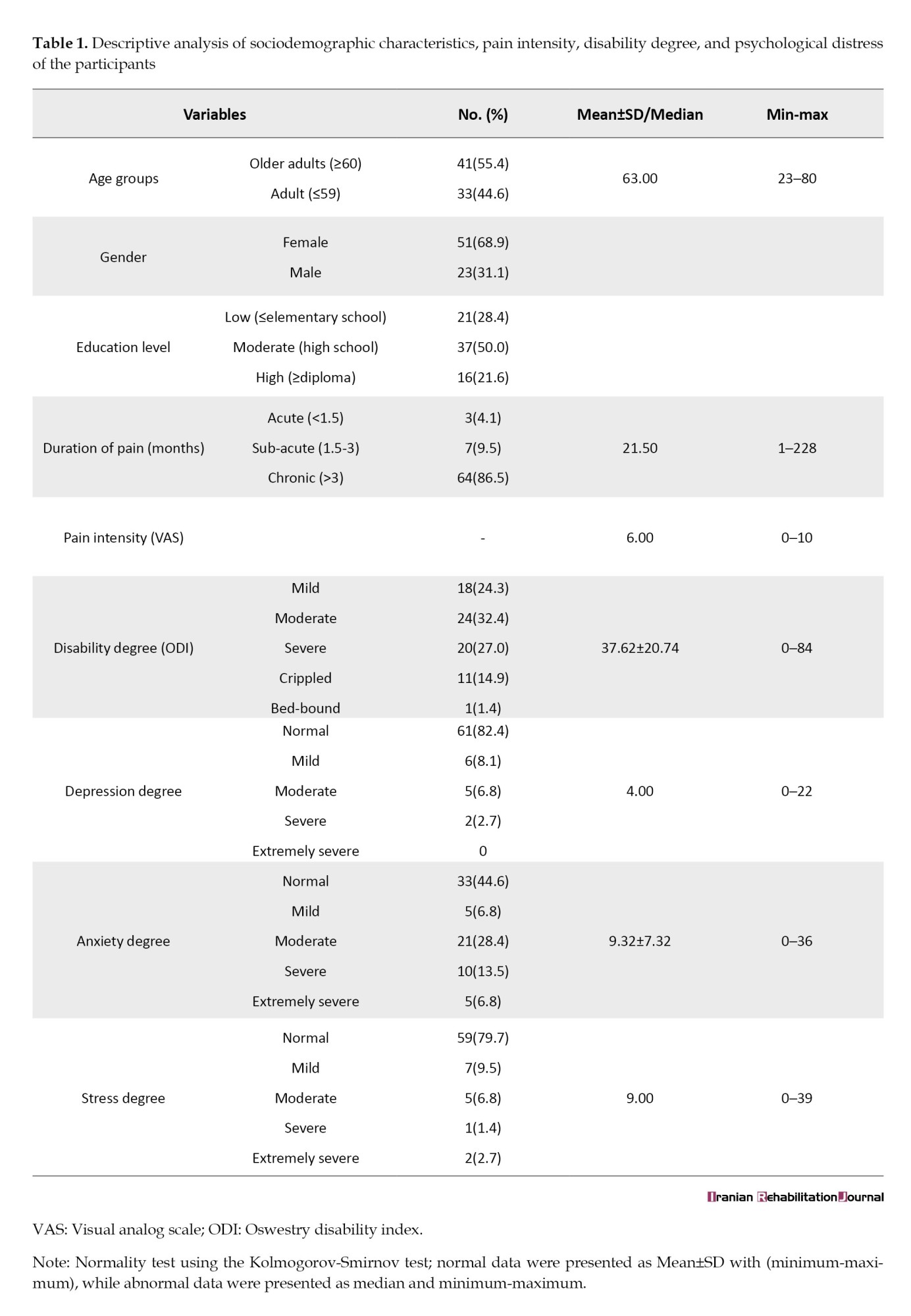
As many as 74 participants in this study were between 23 and 80 years old; more than half (55.4%) were older adults, and most were female (68.9%). Half (50%) had moderate education levels (junior and senior high school), about 28.4% had low education levels, and the rest had high education levels (21.6%). The majority of the respondents (86.5%) experienced chronic pain (more than three months).
The median VAS score was 6 (range 0–10), reflecting a generally elevated level of perceived pain among participants. Most respondents (32.4%) experienced moderate disability, and only one person (1.4%) was bed-bound and used a wheelchair everywhere. More respondents in this study did not experience psychological distress, with 82.4% not experiencing depression, 79.7% not experiencing stress, and 44.6% not experiencing anxiety; however, about 28.4% experienced moderate anxiety.
Table 2 presents the descriptive statistics of the eight SF-36 domains and the two component summaries.
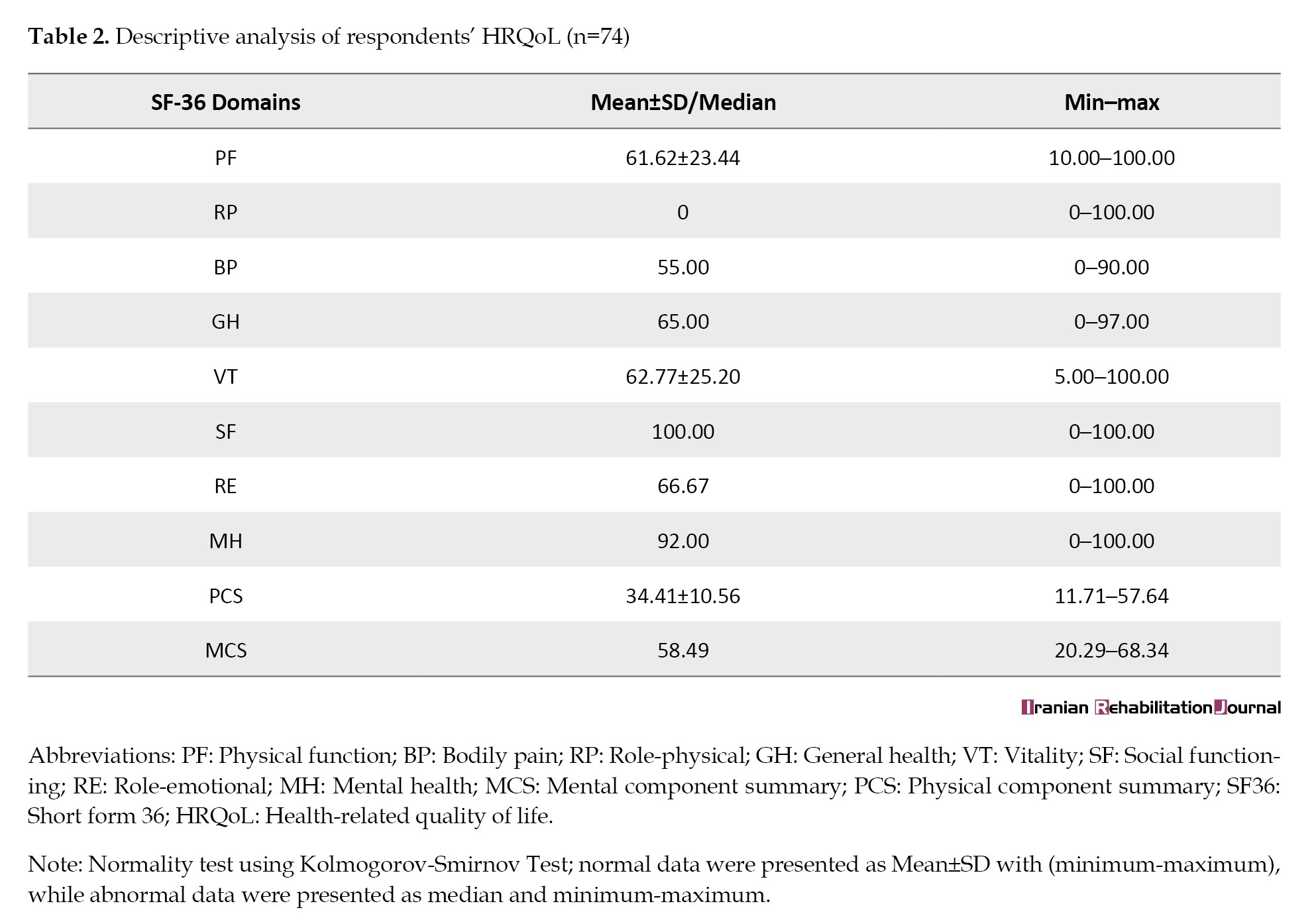
Normality was tested using the Kolmogorov–Smirnov test. Variables that were normally distributed are presented as Mean±SD with minimum–maximum values, while non-normally distributed variables are presented as median (minimum–maximum).
Among all SF-36 domains, the PF domain showed a mean score of 61.62±23.44 (10.00–100.00), indicating moderate limitations in daily activities. The RP domain had a median score of 0.00 (0.00–100.00), suggesting that more than half of the respondents experienced substantial physical role restriction.
For other domains, the BP and GH medians were 55.00 (0.00–90.00) and 65.00 (0.00–97.00), respectively, showing that most participants perceived moderate physical well-being. The VT domain showed a mean of 62.77±25.20 (5.00–100.00), reflecting fair energy and enthusiasm.
The SF, RE, and MH domains presented relatively high scores, with medians of 100.00 (0.00–100.00), 66.67 (0.00–100.00), and 92.00 (0.00–100.00), indicating that emotional and social aspects of QoL were less affected compared to the physical domains.
Regarding component summaries, the PCS had a mean score of 34.41±10.56 (11.71–57.64), whereas the MCS had a median of 58.49 (20.29–68.34). Overall, these findings suggest that LBP predominantly affected respondents’ physical rather than mental HRQoL.
Table 3 summarizes the correlations between pain intensity, disability, and psychological distress with the domains and components of HRQoL (SF-36).
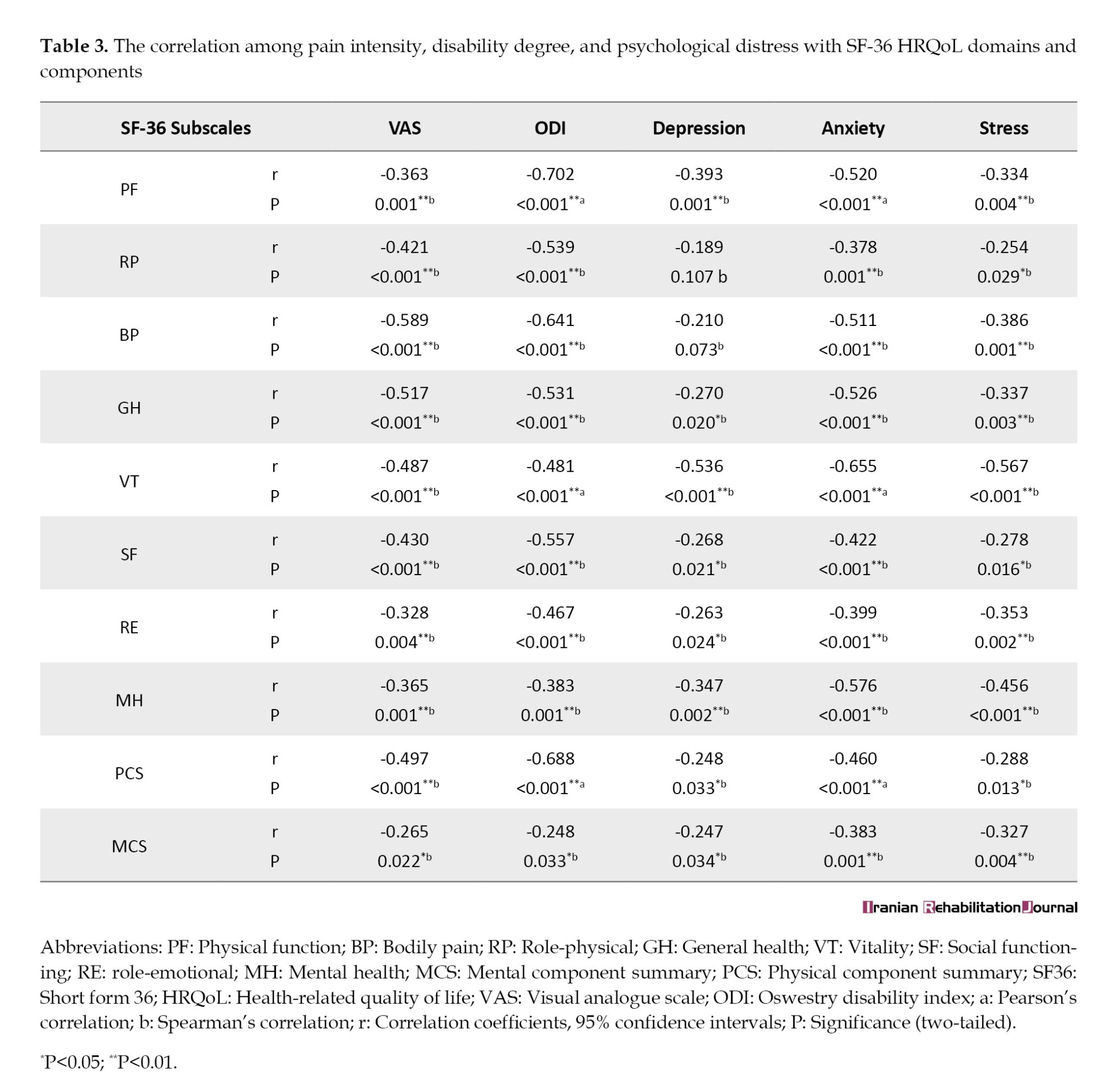
Correlation analyses were conducted using either Pearson’s or Spearman’s correlation tests, according to data normality.
The VAS score showed significant negative correlations with all SF-36 domains and components (ρ=-0.265 to -0.589, P<0.05), indicating that higher pain levels were associated with poorer QoL, particularly in BP (ρ=-0.589, P<0.001) and GH (ρ=-0.517, P<0.001).
ODI demonstrated strong negative correlations with physical domains, especially PF (r=-0.702, P<0.001) and PCS (r=-0.688, P<0.001), both tested using Pearson’s correlation. Moderate correlations were also found with VT (r=-0.481, P<0.001) and SF (ρ=-0.557, P=0.021), suggesting that higher disability levels corresponded with reduced physical health and VT.
Among psychological factors, anxiety and stress showed the strongest negative relationships with several SF-36 domains. Notably, anxiety correlated significantly with PF (r=-0.520, P<0.001), VT (r=-0.655, P<0.001), and PCS (r=-0.460, P=0.004). All were analyzed using Pearson’s correlation. Depression and stress were also significantly associated with lower scores in multiple domains, including RE, MH, and VT (ρ=-0.347 to -0.467, P<0.01).
Overall, these findings indicate that greater pain intensity, disability, and psychological distress significantly impair both the physical and mental components of HRQoL among individuals with LBP.
Discussion
The findings of this study demonstrated that pain intensity, disability, and psychological distress were significantly correlated with HRQoL among patients with LBP. Pain intensity showed moderate negative associations with several HRQoL domains, particularly BP and GH, while disability exhibited the strongest correlations, most notably with PF and the PCS. Psychological distress, including depression, anxiety, and stress, also contributed to reduced HRQoL, with anxiety and depression most strongly linked to VT and MH domains.
Sociodemographic characteristics
Our findings revealed that LBP was more prevalent among older adults (55.4%) and females (68.9%), which aligns with a comprehensive review conducted by de Souza et al. [28] Our results also match those of a meta-analysis that indicated a higher prevalence of LBP among individuals with moderate education levels, compared to those with low or high education levels [29]. One possible explanation for this is that individuals with moderate and low education levels are often exposed to different workloads and job responsibilities than those with higher education. This is evident from the job distribution among individuals with lower-middle education levels, where many are housewives or retirees. A study conducted in India found that approximately 83% of rural housewives experienced recent episodes of pain, chronic pain, and restrictions in their daily activities in the past year [30]. According to research by Nugraha et al. housewives suffering from LBP typically have a high school education and often engage in prolonged periods of standing or squatting for more than 8 hours per day while performing housework [31]. This position exerts greater pressure on the intervertebral discs, causing the muscles to work harder to maintain support in the lower back [32]. In contrast, LBP among older adults may be attributed to extended periods of sitting and poor posture [33]. Retired participants in our study reported spending most of their time indoors engaged in activities such as watching TV, napping, or interacting with their grandchildren.
Correlation between pain intensity and HRQoL
The present study found that greater pain intensity was associated with lower QoL among patients with LBP. Although the strength of the association varied across SF-36 domains, the relationship was consistently negative, indicating that higher levels of pain were accompanied by declines in both physical and psychosocial well-being. These findings suggest that pain remains a central factor influencing patients’ daily functioning and perceived health status.
This result aligns with the understanding that pain not only limits physical activity but also disrupts sleep, concentration, and mood, ultimately leading to a decline in overall life satisfaction. The diminished GH perception observed in this study likely reflects the cumulative burden of chronic discomfort, restricted mobility, and the emotional strain due to persistent pain.
Comparable findings have been reported in several studies. Research conducted in Indonesia showed that increased pain intensity significantly reduced functional and RP capacities among patients with lumbar herniation [11]. Similarly, a study in Iran demonstrated that pain intensity was inversely related to nearly all dimensions of the SF-36 QoL instrument, confirming that pain affects multiple domains of human functioning [12]. A clinical investigation conducted at Dr. Wahidin Sudirohusodo Hospital in Indonesia also found similar results, indicating a strong correlation between pain intensity and functional capacity in individuals with LBP [34]. From a psychological standpoint, our findings are consistent with prior evidence that chronic pain heightens emotional distress. Rapti et al. reported that individuals with prolonged pain tend to develop depression and anxiety, which exacerbate their perception of pain and further diminish their QoL [35]. Likewise, Dueñas et al. highlighted that chronic pain can adversely impact social participation and increase dependence on others, contributing to a broader decline in life quality [36].
Correlation between disability and HRQoL
In our study, the level of disability was found to be significantly correlated with all aspects of QoL. The analysis revealed a strong correlation between the level of disability and both the PF domain and the PCS. According to previous studies, the severity of disability is related to the increased pain experienced by patients, which in turn also affects their QoL, particularly physical quality [37]. Another study also mentioned that ODI has a significant negative relationship with PCS and MCS, reinforcing the idea that disability affects multiple dimensions of health status [38]. Pain-related disability may also be linked to the occurrence of catastrophic thinking in those suffering from CLBP. This refers to their tendency to have a fear of adverse events that could potentially happen or an inability to cease thinking about the terrible pain they may endure [39].
Correlation between psychological distress (depression, anxiety, and stress) and HRQoL
The present study also identified a significant relationship between psychological distress, comprising depression, anxiety, and stress, with the QoL of patients with LBP. Although the strength of association varied, the general trend indicated that higher levels of emotional disturbance were accompanied by lower scores in both physical and MH domains. These findings suggest that psychological well-being plays a crucial role in determining how patients perceive and manage their pain and disability.
The relationship between psychological distress and HRQoL can be explained through the interaction between emotional and physiological factors. Chronic pain often activates the hypothalamic–pituitary–adrenal axis and heightens muscle tension, leading to increased fatigue and irritability. Over time, these effects may lower motivation for physical activity and impair coping ability, thereby worsening pain perception and overall functioning. This is consistent with the study by Sirbu et al. which reported that depression and anxiety were among the strongest predictors of disability in CLBP patients, surpassing even some physical factors [14].
Our finding that anxiety had a notable association with VT and MH domains is consistent with the report by Taylor et al. who found that LBP in older adults was frequently accompanied by psychological distress that reduced both mental and physical health outcomes.18 Similarly, Sangoli and Hussain observed that CLBP often triggers a reciprocal relationship between pain and emotional disturbances, where depression and anxiety exacerbate pain perception and contribute to persistent symptoms [19].
Moreover, the coexistence of depression, anxiety, and stress can diminish social interaction and increase dependence on others, leading to reduced life satisfaction. Azfar et al. found that a significant proportion of LBP patients experienced mild to severe psychological distress, which negatively affected treatment outcomes and functional recovery [40]. However, most participants in our study did not exhibit high levels of distress, possibly due to the predominance of older adults, who may have developed better acceptance and coping mechanisms toward chronic pain. This observation aligns with Wettstein et al. who reported that older patients tend to appraise chronic pain as a natural part of aging, leading to less emotional reactivity despite persistent discomfort [41].
Health transition of the respondents
A significant proportion of patients with LBP at William Booth Hospital in Semarang City reported an improvement in their health compared to one year ago ("somewhat better now than one year ago"). This may be related to the duration of discomfort experienced by patients, with the majority (86.5%) reporting persistent LBP. According to Dutmer et al. long-term therapy of chronic patients resulted in positive changes in pain levels, level of disability, and overall QoL [42]. Regrettably, the current study did not collect data regarding the length of time the patient received treatment. Therefore, it is impossible to determine whether the improved health transition is associated with age, disease duration, or treatment duration. Dutmer et al. also noted the lack of studies on this topic, making it difficult to definitively determine whether the observed improvement in the patients' health quality is directly linked to the treatment administered [42].
Future research and clinical implications
Future research should include data collection and analysis of the treatment length for each patient, and increase the sample size to increase the power and strength of correlations. Future researchers can use other methodologies, such as randomized controlled trials, to decrease bias and increase the generalizability of the findings.
The results of this study highlight the multifactorial nature of HRQoL impairment in LBP, increasing the importance of addressing both physical and psychological dimensions in the management of patients with LBP.
Conclusion
This study reveals a significant negative correlation between pain intensity, disability levels, and psychological distress (including depression, anxiety, and stress) and the QoL of patients with LBP. Both pain and disability primarily impact the physical aspects of QoL, while psychological factors have a more pronounced association with MH domains. Notably, disability showed a strong correlation with PF and PCS, while psychological distress was strongly associated with VT and MH. These findings highlight the importance of a multidimensional approach to managing LBP. This approach should integrate pain relief, physical rehabilitation, and psychological support to improve the overall well-being of patients.
Limitations
This study has several limitations, including purposive sampling (increasing selection bias, limiting generalizability), a cross-sectional design, and respondents (n=74) only providing adequate power to detect moderate-to-large correlations, while power remained limited for small effects.
Ethical Considerations
Compliance with ethical guidelines
This study was approved by the Ethics Committee of the Faculty of Medicine, Diponegoro University, Tembalang, Indonesia (Code:42/EC/KEPK/FK-UNDIP/IV/2024) and adhered to the principles outlined in the Declaration of Helsinki. The authors also obtained clearance from William Booth Hospital in Semarang. The informed consent form was attached to the front page of the questionnaire and must be signed by the patient as a form of approval before filling out the research questionnaire.
Funding
This research did not receive any grant from funding agencies in the public, commercial, or non-profit sectors.
Authors' contributions
Methodology, review and editing: Hari Peni Julianti, Soeharyo Hadisaputro, Hardhono Susanto, Angela Bibiana Maria Tulaar; Investigation and writing the original draft: Hari Peni Julianti, Amanda Surya Putri Hermawan; Funding acquisition: Hari Peni Julianti; Supervision: Soeharyo Hadisaputro, Hardhono Susanto, Angela Bibiana Maria Tulaar; Conceptualization: All authors.
Conflict of interest
The authors declared no conflict of interest.
Low back pain (LBP) accounts for the majority of the global burden of musculoskeletal diseases and is the primary cause of disability [1]. The pain is located at the back of the body, stretching from the lower ribs to the horizontal crease between the buttocks. It also includes lower extremity pain caused by a low back condition, whether or not trunk pain is present [2]. In 2020, a remarkable 619 million individuals globally experienced the distressing condition of LBP, and it is projected that by 2050, this figure will escalate to 843 million [3]. A recent study conducted in 2021 in Indonesia showed that middle-aged individuals, notably those aged 40 to 50, commonly experience LBP (44.29%) [4]. Nevertheless, it can affect individuals of all age groups within the community, regardless of gender and race, and their quality of life [5, 6].
The etiology of LBP is multifactorial and broadly categorized into degenerative and non-degenerative causes. Degenerative LBP—previously referred to as nonspecific LBP—is commonly attributed to structural deterioration involving intervertebral discs, facet joints, and supporting ligaments, often accompanied by regional or global spinal misalignment. In contrast, non-degenerative LBP encompasses pathologies such as trauma, infection, tumors, and inflammatory conditions, which require thorough diagnostic evaluation. Pain mechanisms may be nociceptive, neuropathic, or nociplastic, reflecting complex neurophysiological processes. Additionally, psychosocial factors—including depression, anxiety, and maladaptive pain behaviors—play a significant role in amplifying pain perception and disability, thereby complicating diagnosis and management [7].
In some studies, LBP has been shown to affect the individuals’ quality of life (QoL). QoL refers to the well-being experienced by individuals and groups, encompassing both good and negative aspects of life [8]. The reduced quality of life can also lead to a higher financial burden on a country’s healthcare system in direct and indirect costs [9]. CLBP not only affects physical well-being but also has an adverse impact on MH [10].
The intensity of their pain influences the QoL of an individual with LBP. A prior study conducted in Indonesia demonstrated a strong and statistically significant inverse correlation between the level of pain and the QoL among patients suffering from LBP, particularly in the RP aspect [11]. In addition, separate studies in Iran revealed a notable association between the degree of pain and almost all domains of SF-36 [12]. Pain intensity was reported to be experienced more frequently in older adult patients [13]. Pain intensity was identified as one of the independent variables that substantially impacted LBP individuals’ impairment [14].
As evidenced in prior studies, a correlation is observed between pain intensity and disability in patients with CLBP [15]. such as severe pain, physical inac, and disability, negatively impact patients’ QoL. A longitudinal study discovered that pain severity and disability have a statistically significant negative correlation with health-related quality of life (HRQoL). A study conducted in Turkey found a moderate and statistically significant link between functional status and kinesiophobia (fear of movement). People who experience LBP and have a fear of movement are more likely to develop limitations in their physical functioning (PF) [16]. Additionally, higher pain intensity and disability also have a statistically significant positive correlation with societal and healthcare expenditures [17]. The visual analog scale (VAS) and oswestry disability index (ODI) are frequently used to assess pain intensity and degree of disability, respectively. These assessments are highly reliable and encompass inquiries about the severity of lower back pain and the nine most prevalent everyday tasks [13].
Furthermore, common psychological distress, including anxiety, depression, and stress-related disorders, can contribute to adverse effects on daily performance as well as exacerbate LBP, and is more likely to increase within older adults [18]. we examined the relationships between LBP and four physical and MH conditions (psychological distress, insomnia, mobility limitations, and self-rated health. It has been demonstrated in a prior study that LBP patients who have high depression and anxiety levels frequently refrain from engaging in activities that they previously enjoyed, such as housework, sports, and social interaction, which results in disability-related symptoms [14]. CLBP is inherently stressful, especially among women, and when combined with depression, they form two sets of symptoms that have a negative impact on each other [19].
Despite the high prevalence of LBP and its multifaceted consequences, research exploring the pain intensity, physical disability, depression, anxiety, and stress on patients’ QoL remains limited and underrepresented. Hence, researchers sought to undertake a study to determine the correlation between the severity of pain, level of disability, and psychological distress (including depression, anxiety, and stress) on the HRQoL of individuals with LBP.
Materials and Methods
Study design and setting
An analytic observational study with a cross-sectional design was conducted at William Booth Hospital, Semarang City, from May to June 2024. Respondents were patients who visited the medical rehabilitation clinic and met the inclusion criteria, such as being 18 years or older, suffering from LBP, being able to communicate well, and being willing to become respondents by completing and signing informed consent forms.
A priori sample size estimation was conducted using the standard formula for a two-tailed correlation analysis, with the significance level (α) set at 0.05 and statistical power fixed at 0.80. Based on the Fisher z transformation, a sample of approximately 47 participants was required to detect a medium-to-large effect size (r=0.40). To accommodate potential non-response and unusable cases, an anticipated attrition rate of 10% was incorporated, yielding a minimum required sample size of 53 participants. A total of 74 participants were ultimately included in the final analysis. This sample size provided sufficient statistical power to detect moderate-to-large correlations (r≥0.35–0.40), although the ability to reliably detect small effect sizes (r≈0.20–0.30) remained limited.
Variables and data collection
The independent variables (X) in this study included pain intensity, degree of disability, depression, anxiety, and stress. Meanwhile, the dependent variable (Y) was HRQoL. Data were collected through direct interviews.
Sociodemographic
To determine the respondents’ characteristics, we collected sociodemographic-related data, including age, gender, and education level. Age was categorized as adult (≥18-59 years old) and older adults (≥60 years old). The participants’ education level was defined as “low” if the last education was elementary school or no school, “moderate” for junior or senior high school graduates, and “high” for diploma or higher graduates.
Pain intensity
Pain intensity was measured using a 10-cm VAS, where 0 indicated no pain, and 10 indicated the worst imaginable pain. The VAS was analyzed as a continuous variable.
Disability degree
The degree of disability was measured using the ODI questionnaire. Ten items were assessed, including pain intensity, personal care, lifting, walking, sitting, standing, sleeping, sex life, social life, and traveling. Each item has a score of 0-5. The total score is then divided by 50 (maximum score) and multiplied by 100 to produce a percentage of the degree of disability [20].
ODI percentages range from 0% (no disability) to 100% (bed-bound or maximum disability), and are interpreted as mild disability if 0-20%; moderate disability if 21-40%; severe disability if 41-60%; crippled if 61-80%; and bed-bound if 81-100% [21].
Depression, anxiety, and stress degree
Three psychological distresses (depression, anxiety, and stress) were measured using the depression anxiety stress scales-42 translated into Bahasa Indonesia [22]. Each of the three scales consisted of 14 question items, [23] where each item has 4 rating scales on a Likert scale (0 to 4) [24]. All answers on each scale are then summed and interpreted based on cut off [25].
HRQoL
With a Cronbach’s α value exceeding 0.76, this questionnaire is suitable for assessing patients’ HRQoL [26]. Respondents’ QoL data were measured using the Indonesian version of the short form 36v1 questionnaire (SF-36 version 1) [27]. All question items including the question “Compared to one year ago, how would you rate your general health (GH) today?” (self-reported health transition item) were used to assess eight QoL domains: PF, bodily pain (BP), role-physical (RP), GH, vitality (VT), social functioning (SF), role-emotional (RE), and mental health (MH). The eight QoL domains were then summarized into two component scales: The physical component summary (PCS) and the mental component summary (MCS). Each of the eight domains and two-component scales was scored from 0 to 100, with higher scores indicating better health status.
Data analysis
Descriptive analysis was used to determine the sociodemographic characteristics, pain intensity, severity of disability, psychological distress (depression, anxiety, and stress), and QoL of the study participants. Descriptive statistics were presented as Mean±SD for continuous variables and frequencies for categorical variables. Data normality was tested using the Kolmogorov-Smirnov test, and was considered normally distributed if P>0.05. Bivariate analysis was performed using Pearson’s correlation or Spearman’s correlation test to determine the correlation between variables X and Y. The significance was set at P<0.05 with 95% confidence interval (CI).
Results
Table 1 presents the participants’ sociodemographic characteristics, pain level, disability degree, and psychological distress (depression, anxiety, and stress level).
As many as 74 participants in this study were between 23 and 80 years old; more than half (55.4%) were older adults, and most were female (68.9%). Half (50%) had moderate education levels (junior and senior high school), about 28.4% had low education levels, and the rest had high education levels (21.6%). The majority of the respondents (86.5%) experienced chronic pain (more than three months).
The median VAS score was 6 (range 0–10), reflecting a generally elevated level of perceived pain among participants. Most respondents (32.4%) experienced moderate disability, and only one person (1.4%) was bed-bound and used a wheelchair everywhere. More respondents in this study did not experience psychological distress, with 82.4% not experiencing depression, 79.7% not experiencing stress, and 44.6% not experiencing anxiety; however, about 28.4% experienced moderate anxiety.
Table 2 presents the descriptive statistics of the eight SF-36 domains and the two component summaries.
Normality was tested using the Kolmogorov–Smirnov test. Variables that were normally distributed are presented as Mean±SD with minimum–maximum values, while non-normally distributed variables are presented as median (minimum–maximum).
Among all SF-36 domains, the PF domain showed a mean score of 61.62±23.44 (10.00–100.00), indicating moderate limitations in daily activities. The RP domain had a median score of 0.00 (0.00–100.00), suggesting that more than half of the respondents experienced substantial physical role restriction.
For other domains, the BP and GH medians were 55.00 (0.00–90.00) and 65.00 (0.00–97.00), respectively, showing that most participants perceived moderate physical well-being. The VT domain showed a mean of 62.77±25.20 (5.00–100.00), reflecting fair energy and enthusiasm.
The SF, RE, and MH domains presented relatively high scores, with medians of 100.00 (0.00–100.00), 66.67 (0.00–100.00), and 92.00 (0.00–100.00), indicating that emotional and social aspects of QoL were less affected compared to the physical domains.
Regarding component summaries, the PCS had a mean score of 34.41±10.56 (11.71–57.64), whereas the MCS had a median of 58.49 (20.29–68.34). Overall, these findings suggest that LBP predominantly affected respondents’ physical rather than mental HRQoL.
Table 3 summarizes the correlations between pain intensity, disability, and psychological distress with the domains and components of HRQoL (SF-36).
Correlation analyses were conducted using either Pearson’s or Spearman’s correlation tests, according to data normality.
The VAS score showed significant negative correlations with all SF-36 domains and components (ρ=-0.265 to -0.589, P<0.05), indicating that higher pain levels were associated with poorer QoL, particularly in BP (ρ=-0.589, P<0.001) and GH (ρ=-0.517, P<0.001).
ODI demonstrated strong negative correlations with physical domains, especially PF (r=-0.702, P<0.001) and PCS (r=-0.688, P<0.001), both tested using Pearson’s correlation. Moderate correlations were also found with VT (r=-0.481, P<0.001) and SF (ρ=-0.557, P=0.021), suggesting that higher disability levels corresponded with reduced physical health and VT.
Among psychological factors, anxiety and stress showed the strongest negative relationships with several SF-36 domains. Notably, anxiety correlated significantly with PF (r=-0.520, P<0.001), VT (r=-0.655, P<0.001), and PCS (r=-0.460, P=0.004). All were analyzed using Pearson’s correlation. Depression and stress were also significantly associated with lower scores in multiple domains, including RE, MH, and VT (ρ=-0.347 to -0.467, P<0.01).
Overall, these findings indicate that greater pain intensity, disability, and psychological distress significantly impair both the physical and mental components of HRQoL among individuals with LBP.
Discussion
The findings of this study demonstrated that pain intensity, disability, and psychological distress were significantly correlated with HRQoL among patients with LBP. Pain intensity showed moderate negative associations with several HRQoL domains, particularly BP and GH, while disability exhibited the strongest correlations, most notably with PF and the PCS. Psychological distress, including depression, anxiety, and stress, also contributed to reduced HRQoL, with anxiety and depression most strongly linked to VT and MH domains.
Sociodemographic characteristics
Our findings revealed that LBP was more prevalent among older adults (55.4%) and females (68.9%), which aligns with a comprehensive review conducted by de Souza et al. [28] Our results also match those of a meta-analysis that indicated a higher prevalence of LBP among individuals with moderate education levels, compared to those with low or high education levels [29]. One possible explanation for this is that individuals with moderate and low education levels are often exposed to different workloads and job responsibilities than those with higher education. This is evident from the job distribution among individuals with lower-middle education levels, where many are housewives or retirees. A study conducted in India found that approximately 83% of rural housewives experienced recent episodes of pain, chronic pain, and restrictions in their daily activities in the past year [30]. According to research by Nugraha et al. housewives suffering from LBP typically have a high school education and often engage in prolonged periods of standing or squatting for more than 8 hours per day while performing housework [31]. This position exerts greater pressure on the intervertebral discs, causing the muscles to work harder to maintain support in the lower back [32]. In contrast, LBP among older adults may be attributed to extended periods of sitting and poor posture [33]. Retired participants in our study reported spending most of their time indoors engaged in activities such as watching TV, napping, or interacting with their grandchildren.
Correlation between pain intensity and HRQoL
The present study found that greater pain intensity was associated with lower QoL among patients with LBP. Although the strength of the association varied across SF-36 domains, the relationship was consistently negative, indicating that higher levels of pain were accompanied by declines in both physical and psychosocial well-being. These findings suggest that pain remains a central factor influencing patients’ daily functioning and perceived health status.
This result aligns with the understanding that pain not only limits physical activity but also disrupts sleep, concentration, and mood, ultimately leading to a decline in overall life satisfaction. The diminished GH perception observed in this study likely reflects the cumulative burden of chronic discomfort, restricted mobility, and the emotional strain due to persistent pain.
Comparable findings have been reported in several studies. Research conducted in Indonesia showed that increased pain intensity significantly reduced functional and RP capacities among patients with lumbar herniation [11]. Similarly, a study in Iran demonstrated that pain intensity was inversely related to nearly all dimensions of the SF-36 QoL instrument, confirming that pain affects multiple domains of human functioning [12]. A clinical investigation conducted at Dr. Wahidin Sudirohusodo Hospital in Indonesia also found similar results, indicating a strong correlation between pain intensity and functional capacity in individuals with LBP [34]. From a psychological standpoint, our findings are consistent with prior evidence that chronic pain heightens emotional distress. Rapti et al. reported that individuals with prolonged pain tend to develop depression and anxiety, which exacerbate their perception of pain and further diminish their QoL [35]. Likewise, Dueñas et al. highlighted that chronic pain can adversely impact social participation and increase dependence on others, contributing to a broader decline in life quality [36].
Correlation between disability and HRQoL
In our study, the level of disability was found to be significantly correlated with all aspects of QoL. The analysis revealed a strong correlation between the level of disability and both the PF domain and the PCS. According to previous studies, the severity of disability is related to the increased pain experienced by patients, which in turn also affects their QoL, particularly physical quality [37]. Another study also mentioned that ODI has a significant negative relationship with PCS and MCS, reinforcing the idea that disability affects multiple dimensions of health status [38]. Pain-related disability may also be linked to the occurrence of catastrophic thinking in those suffering from CLBP. This refers to their tendency to have a fear of adverse events that could potentially happen or an inability to cease thinking about the terrible pain they may endure [39].
Correlation between psychological distress (depression, anxiety, and stress) and HRQoL
The present study also identified a significant relationship between psychological distress, comprising depression, anxiety, and stress, with the QoL of patients with LBP. Although the strength of association varied, the general trend indicated that higher levels of emotional disturbance were accompanied by lower scores in both physical and MH domains. These findings suggest that psychological well-being plays a crucial role in determining how patients perceive and manage their pain and disability.
The relationship between psychological distress and HRQoL can be explained through the interaction between emotional and physiological factors. Chronic pain often activates the hypothalamic–pituitary–adrenal axis and heightens muscle tension, leading to increased fatigue and irritability. Over time, these effects may lower motivation for physical activity and impair coping ability, thereby worsening pain perception and overall functioning. This is consistent with the study by Sirbu et al. which reported that depression and anxiety were among the strongest predictors of disability in CLBP patients, surpassing even some physical factors [14].
Our finding that anxiety had a notable association with VT and MH domains is consistent with the report by Taylor et al. who found that LBP in older adults was frequently accompanied by psychological distress that reduced both mental and physical health outcomes.18 Similarly, Sangoli and Hussain observed that CLBP often triggers a reciprocal relationship between pain and emotional disturbances, where depression and anxiety exacerbate pain perception and contribute to persistent symptoms [19].
Moreover, the coexistence of depression, anxiety, and stress can diminish social interaction and increase dependence on others, leading to reduced life satisfaction. Azfar et al. found that a significant proportion of LBP patients experienced mild to severe psychological distress, which negatively affected treatment outcomes and functional recovery [40]. However, most participants in our study did not exhibit high levels of distress, possibly due to the predominance of older adults, who may have developed better acceptance and coping mechanisms toward chronic pain. This observation aligns with Wettstein et al. who reported that older patients tend to appraise chronic pain as a natural part of aging, leading to less emotional reactivity despite persistent discomfort [41].
Health transition of the respondents
A significant proportion of patients with LBP at William Booth Hospital in Semarang City reported an improvement in their health compared to one year ago ("somewhat better now than one year ago"). This may be related to the duration of discomfort experienced by patients, with the majority (86.5%) reporting persistent LBP. According to Dutmer et al. long-term therapy of chronic patients resulted in positive changes in pain levels, level of disability, and overall QoL [42]. Regrettably, the current study did not collect data regarding the length of time the patient received treatment. Therefore, it is impossible to determine whether the improved health transition is associated with age, disease duration, or treatment duration. Dutmer et al. also noted the lack of studies on this topic, making it difficult to definitively determine whether the observed improvement in the patients' health quality is directly linked to the treatment administered [42].
Future research and clinical implications
Future research should include data collection and analysis of the treatment length for each patient, and increase the sample size to increase the power and strength of correlations. Future researchers can use other methodologies, such as randomized controlled trials, to decrease bias and increase the generalizability of the findings.
The results of this study highlight the multifactorial nature of HRQoL impairment in LBP, increasing the importance of addressing both physical and psychological dimensions in the management of patients with LBP.
Conclusion
This study reveals a significant negative correlation between pain intensity, disability levels, and psychological distress (including depression, anxiety, and stress) and the QoL of patients with LBP. Both pain and disability primarily impact the physical aspects of QoL, while psychological factors have a more pronounced association with MH domains. Notably, disability showed a strong correlation with PF and PCS, while psychological distress was strongly associated with VT and MH. These findings highlight the importance of a multidimensional approach to managing LBP. This approach should integrate pain relief, physical rehabilitation, and psychological support to improve the overall well-being of patients.
Limitations
This study has several limitations, including purposive sampling (increasing selection bias, limiting generalizability), a cross-sectional design, and respondents (n=74) only providing adequate power to detect moderate-to-large correlations, while power remained limited for small effects.
Ethical Considerations
Compliance with ethical guidelines
This study was approved by the Ethics Committee of the Faculty of Medicine, Diponegoro University, Tembalang, Indonesia (Code:42/EC/KEPK/FK-UNDIP/IV/2024) and adhered to the principles outlined in the Declaration of Helsinki. The authors also obtained clearance from William Booth Hospital in Semarang. The informed consent form was attached to the front page of the questionnaire and must be signed by the patient as a form of approval before filling out the research questionnaire.
Funding
This research did not receive any grant from funding agencies in the public, commercial, or non-profit sectors.
Authors' contributions
Methodology, review and editing: Hari Peni Julianti, Soeharyo Hadisaputro, Hardhono Susanto, Angela Bibiana Maria Tulaar; Investigation and writing the original draft: Hari Peni Julianti, Amanda Surya Putri Hermawan; Funding acquisition: Hari Peni Julianti; Supervision: Soeharyo Hadisaputro, Hardhono Susanto, Angela Bibiana Maria Tulaar; Conceptualization: All authors.
Conflict of interest
The authors declared no conflict of interest.
References
- World Health Organization. Low Back Pain. Geneva: WHO; 2023. [Link]
- Chiodo AE, Lead, Bhat SN, Harrison R Van, Shumer GD, Wasserman RA, et al. Low back pain. Ann Arbor: Michigan Medicine University of Michigan; 2020. [Link]
- The Lancet Rheumatology. The global epidemic of low back pain. The Lancet. Rheumatology. 2023; 5(6):e305. [DOI:10.1016/S2665-9913(23)00133-9 ] [PMID]
- Makkiyah FA, Sinaga TA, Khairunnisa N. A study from a highly populated country: Risk factors associated with lower back pain in middle-aged adults. Journal of Korean Neurosurgical Society. 2023; 66(2):190-8. [DOI:10.3340/jkns.2021.0278 ] [PMID]
- Novy TC, Fonda G, Suwadi A. Cases, prevalence and treatment of low back pain at Bandung Pain Rehab. Indonesian Journal of Physical Medicine and Rehabilitation. 2023; 12(01):52-60. [DOI:10.36803/indojpmr.v12i01.338 ]
- Potaczek T, Jasiewicz B. How back pain influences daily activities and quality of life: Incidence of back pain related to age. Journal of Children's Orthopaedics. 2023; 17(6):505-11. [DOI:10.1177/18632521231215855 ] [PMID ]
- Farley T, Stokke J, Goyal K, DeMicco R. Chronic Low Back Pain: History, Symptoms, Pain Mechanisms, and Treatment. Life . 2024; 14(7):812. [DOI:10.3390/life14070812] [PMID]
- Kazemi SS, Panahi R, Rafighi M. Low back pain intensity and quality of life among patients referred to a pain clinic in Iran. International Journal of Musculoskeletal Pain Prevention. 2021; 6(4):595-600. [DOI:10.52547/ijmpp.6.4.595 ]
- Bosman MHMA, Weerts ZZRM, Snijkers JTW, Vork L, Mujagic Z, Masclee AAM, et al. The socioeconomic impact of irritable bowel syndrome: An analysis of direct and indirect health care costs. Clinical Gastroenterology and Hepatology . 2023; 21(10):2660-9. [DOI:10.1016/j.cgh.2023.01.017 ] [PMID]
- Amesiya R, Nyati M, Waiswa G, Mwaka ES. Health-related quality of life in patients with low back pain in a low resource setting: A cross-sectional study at a tertiary hospital in Uganda. African Health Sciences. 2023; 23(1):565-74. [DOI:10.4314/ahs.v23i1.59 ] [PMID]
- Wicaksono RB, Gunarto U, Ardi Wicaksono M. Correlation of pain intensity and health-related quality of life in lumbar herniated nucleus pulposus in RSUD Prof. Dr. Margono Soekarjo. Mandala of Health: AScientific Journal. 2021; 14(2):83-91. [DOI:10.20884/1.mandala.2021.14.2.1591 ]
- Gupta S, Bansal T, Kashyap A, Sural S, Kumar V. Correlation of short form 36 health survey with other relevant clinical scores in patients with degenerative lumbar spinal stenosis. Journal of Orthopaedic Diseases and Traumatology. 2023; 6(2):132-6. [DOI:10.4103/jodp.jodp_57_22 ]
- Vučković SH, Vegar-Zubović S, Milišić L, Kristić S, Beganović A, Dervišević L, et al. Correlation of MRI findings with ODI and VAS score in patients with lower back ain. The Open Neuroimaging Journal. 2023; 16(1):1-10. [DOI:10.2174/18743129-v16-230911-2022-4 ]
- Sirbu E, Onofrei RR, Szasz S, Susan M. Predictors of disability in patients with chronic low back pain. Archives of Medical Science. 2023; 19(1):94-100. [DOI:10.5114/aoms.2020.97057] [PMID]
- Ekediegwu EC, Onwukike CV, Onyeso OK. Pain intensity, physical activity, quality of life, and disability in patients with mechanical low back pain: A cross-sectional study. Bulletin of Faculty of Physical Therapy. 2024; 29(1):1-9. [DOI:10.1186/s43161-023-00167-2 ]
- Seid AA, Demirdel E. Correlation between pain, functional status, kinesiophobia and quality of life in patients with non-specific chronic low back pain. Annals of Chronic Diseases. 2023; 4(1):1007. [Link]
- Mutubuki EN, Beljon Y, Maas ET, Huygen FJPM, Ostelo RWJG, van Tulder MW, et al. The longitudinal relationships between pain severity and disability versus health-related quality of life and costs among chronic low back pain patients. Quality of Life Research. 2020; 29(1):275-87. [DOI:10.1007/s11136-019-02302-w ] [PMID]
- Taylor JL, Regier NG, Li Q, Liu M, Szanton SL, Skolasky RL. The impact of low back pain and vigorous activity on mental and physical health outcomes in older adults with arthritis. Frontiers in Pain Research. 2022; 3:886985. [DOI:10.3389/fpain.2022.886985] [PMID]
- Sangoli S, Hussain MM. Evaluation of psychological factors in chronic low back pain of North Karnataka population. International Journal of Academic Medicine and Pharmacy. 2023; 5(6):1166-8. [Link]
- El-Hady AO, El Molla SS, Elwan SI, Ibrahim RA. Evaluation of health related quality of life with the use of Oswestry disability index in degenerative discogenic low back pain. Egyptian Rheumatology and Rehabilitation. 2023; 50(4):1-9. [DOI:10.1186/s43166-022-00166-6 ]
- Tonosu J, Takeshita K, Hara N, Matsudaira K, Kato S, Masuda K, et al. The normative score and the cut-off value of the Oswestry Disability Index (ODI). European Spine Journal. 2012; 21(8):1596-602. [DOI:10.1007/s00586-012-2173-7] [PMID]
- Psychology Foundation of Australia. DASS Translations. Kensington: UNSW; 2023. [Link]
- Nieuwenhuijsen K, Boer AG, Verbeek JH, Blonk RW, van Dijk FJ. The Depression Anxiety Stress Scales (DASS): Detecting anxiety disorder and depression in employees absent from work because of mental health problems. Occupational and Environmental Medicine. 2003; 60(Supplement 1):i77-82. [DOI:10.1136/oem.60.suppl_1.i77 ] [PMID]
- Lovibond SH. Manual for the Depression Anxiety Stress Scales. 2nd ed. Sydney: Psychology Foundation of Australia; 1995. [Link]
- Irajpour A, Hashemi MS, Abazari P, Shahidi S, Fayazi M. The effects of peer support on depression, anxiety, and stress among patients receiving hemodialysis. Iranian Red Crescent Medical Journal. 2018; 20(S1):e66321. [Link]
- Járomi M, Szilágyi B, Velényi A, Leidecker E, Raposa BL, Hock M, et al. Assessment of health-related quality of life and patient’s knowledge in chronic non-specific low back pain. BMC Public Health. 2021; 21(Suppl 1):1479. [DOI:10.1186/s12889-020-09506-7] [PMID]
- Salim S, Yamin M, Alwi I, Setiati S. Validity and reliability of the Indonesian version of SF-36 quality of life questionnaire on patients with permanent pacemakers. Acta medica Indonesiana. 2017; 49(1):10-6. [PMID]
- de Souza IMB, Sakaguchi TF, Yuan SLK, Matsutani LA, do Espírito-Santo AS, Pereira CAB, et al. Prevalence of low back pain in the elderly population: A systematic review. Clinics. 2019; 74:e789. [DOI:10.6061/clinics/2019/e789 ] [PMID]
- Batista AA de S, Henschke N, Oliveira VC. Prevalence of low back pain in different educational levels: A systematic review. Fisioterapia em Movimento. 2017; 30(suppl 1):351-61. [DOI:10.1590/1980-5918.030.s01.ar04]
- Gupta G, Nandini N. Prevalence of low back pain in non working rural Housewives of Kanpur, India. International Journal of Occupational Medicine and Environmental Health. 2015; 28(2):313-20. [DOI:10.13075/ijomeh.1896.00299 ] [PMID]
- Nugraha RF, Respati T, Rachmi A. Risk factors of low back pain in housewife. Jurnal Integrasi Kesehatan & Sains. 2020; 2(1):35-8. [DOI:10.29313/jiks.v2i1.5603]
- Al Qaraghli MI, De Jesus O. Lumbar Disc Herniation. 2023 Aug 23. In: StatPearls [Internet]. Treasure Island (FL): StatPearls Publishing; 2026. [PMID ]
- Rajsekar K, Kuhar M, Sen S. Low back pain and subsequent disc degeneration : An epidemiological survey. The Delhi University Journal of Undergraduate Research and Innovation. 2016; 2(1):80-91. [Link]
- Zuhair MN, Tammasse J, Aulina S, Amran MY. Relation between pain intensity and functional status of low back pain patients. Medica Hospitalia. 2021; 8(3):369-73. [DOI:10.36408/mhjcm.v8i3.649]
- Rapti E, Damigos D, Apostolara P, Roka V, Tzavara C, Lionis C. Patients with chronic pain: Evaluating depression and their quality of life in a single center study in Greece. BMC Psychology. 2019; 7(1):86. [DOI:10.1186/s40359-019-0366-0 ] [PMID ]
- Dueñas M, Ojeda B, Salazar A, Mico JA, Failde I. A review of chronic pain impact on patients, their social environment and the health care system. Journal of Pain Research. 2016; 9:457-67. [DOI:10.2147/JPR.S105892 ] [PMID ]
- Stefane T, Dos Santos AM, Marinovic A, Hortense P. Chronic low back pain: Pain intensity, disability and quality of life. Acta Paulista de Enfermagem. 2013; 26(1):14-20. [DOI:10.1590/S0103-21002013000100004 ]
- Manca A, Eldabe S, Buchser E, Kumar K, Taylor RS. Relationship between health-related quality of life, pain, and functional disability in neuropathic pain patients with failed back surgery syndrome. Value in Health : The Journal of The International Society for Pharmacoeconomics and Outcomes Research. 2010; 13(1):95-102. [DOI:10.1111/j.1524-4733.2009.00588.x ] [PMID ]
- Ogunlana MO, Odole AC, Adejumo A, Odunaiya N. Catastrophising, pain, and disability in patients with nonspecific low back pain. Hong Kong Physiotherapy Journal. 2015; 33(2):73-9. [DOI:10.1016/j.hkpj.2015.03.001 ] [PMID ]
- Azfar SM, Murad MA, Azim SR, Baig M. Frequency of and various factors associated with stress, anxiety, and depression among low back pain patients. Cureus. 2019; 11(9):e5701.[DOI:10.7759/cureus.5701 ]
- Wettstein M, Eich W, Bieber C, Tesarz J. Pain intensity, disability, and quality of life in patients with chronic low back pain: Does age matter? Pain Medicine. 2019; 20(3):464-75. [DOI:10.1093/pm/pny062 ] [PMID ]
- Dutmer AL, Soer R, Wolff AP, Reneman MF, Coppes MH, Schiphorst Preuper HR. What can we learn from long-term studies on chronic low back pain? A scoping review. European Spine Journal : Official Publication of the European Spine Society, the European Spinal Deformity Society, and the European Section of The Cervical Spine Research Society. 2022; 31(4):901-16. [DOI:10.1007/s00586-022-07111-3 ] [PMID ]
Article type: Original Research Articles |
Subject:
Physical Medicine and Rehabilitation
Received: 2025/11/15 | Accepted: 2026/03/28 | Published: 2026/04/1
Received: 2025/11/15 | Accepted: 2026/03/28 | Published: 2026/04/1
Send email to the article author

Copyright © The Author(s);
This is an open access article distributed under the terms of the Creative Commons Attribution-NonCommercial 4.0 (CC-By-NC 4.0), which permits use, distribution, and reproduction in any medium, provided the original work is properly cited and is not used for commercial purposes.
Contact Information
