
988368
Thu, Oct 22, 2026

Volume 24, Issue 2 (June 2026)
Iranian Rehabilitation Journal 2026, 24(2): 185-192 |
Back to browse issues page



Ethics code: UH24100762


Download citation:
BibTeX | RIS | EndNote | Medlars | ProCite | Reference Manager | RefWorks
Send citation to:


BibTeX | RIS | EndNote | Medlars | ProCite | Reference Manager | RefWorks
Send citation to:
Darwis M Z, Mubarak H, Warliani M, Alfian Zainuddin A, Waluyo Y, Sam N. Effectiveness of App-based Telerehabilitation For Hemiplegic Shoulder Pain: A Randomized Controlled Trial. Iranian Rehabilitation Journal 2026; 24 (2) :185-192
URL: http://irj.uswr.ac.ir/article-1-2650-en.html
URL: http://irj.uswr.ac.ir/article-1-2650-en.html
Muhammad Zuhal Darwis1  , Husnul Mubarak *1 , Melda Warliani1 , Andi Alfian Zainuddin2 , Yose Waluyo1 , Nuralam Sam1
, Husnul Mubarak *1 , Melda Warliani1 , Andi Alfian Zainuddin2 , Yose Waluyo1 , Nuralam Sam1
1- Department of Physical Medicine and Rehabilitation, Faculty of Medicine, Hasanuddin University, Makassar, Indonesia.
2- Department of Public Health, Faculty of Medicine, Hasanuddin University, Makassar, Indonesia.
2- Department of Public Health, Faculty of Medicine, Hasanuddin University, Makassar, Indonesia.
Full-Text [PDF 595 kb]
(226 Downloads)
| Abstract (HTML) (1620 Views)
Full-Text: (137 Views)
Introduction
Hemiplegic shoulder pain (HSP) is a significant complication in stroke survivors, known to impair functional recovery and contribute to substantial disability. Reported prevalence rates of HSP have varied widely across studies, ranging from 5% to 84%. More recent population-based research conducted in New Zealand and Sweden estimates the prevalence at approximately 22–23%, while the largest study to date, conducted in a Turkish rehabilitation center with 1,000 participants, reported a prevalence of approximately 55%. Despite its clinical importance and frequent occurrence, the multifactorial nature of HSP complicates the identification of a definitive cause, thereby hindering the development of consistently effective treatment strategies [1, 2]. Enhanced upper limb function within the initial five weeks following stroke is associated with greater utilization of the affected arm in executing functional activities [1, 3].
The Bobath approach is a rehabilitative strategy used to manage HSP. It focuses on harmonizing postural stability with selective motor control to facilitate smooth, coordinated movement patterns. With today’s advanced technology, the rehabilitation process can be carried out using smartphone-based applications, known as telerehabilitation. Home-based telerehabilitation can be described as the delivery of rehabilitation services remotely utilized electronic and communication technologies, such as mobile phones, mobile video, computers, and others [4].
Several studies have used telerehabilitation in stroke patients. Piron et al. compared the improvement of Fugl Meyer upper extremity scores between patients who received conventional therapy plus telerehabilitation and those who only received conventional therapy. After 2 months of intervention, a statistically significant difference was found between the telerehabilitation group (Mean±SD, 53.6±7.7) and the control group (49.5±4.8) [5]. Another study by Cramer et al. stated that a 6-week course of telerehabilitation in stroke patients is safe, rated favorably by patients, associated with excellent treatment adherence, and produces substantial gains in arm function with an improvement of 7.86 point Fugl-Meyer score, exceeding the 5.25 point minimal clinically important difference for Fugl-Meyer in chronic stroke. Telerehabilitation also proved to be not inferior to dose-matched interventions delivered in the clinic [6]. Szturm et al. showed improvement of the wolf motor function test in stroke patients with computer-based telerehabilitation [7].
The recovery of arm motor function in stroke patients is directly proportional to the restoration of shoulder girdle function, as dictated by the fundamental biomechanical principle of proximal stability for distal mobility. The shoulder girdle serves as the essential kinetic base of support required to facilitate controlled, functional movement of the distal upper extremity [8, 9]. A previous study on telerehabilitation had been successfully proven to have an effect on upper extremity function; in this study, researchers focused on how shoulder function recovery in HSP is one of the most prominent complications of stroke. Lack of research on the use of telerehabilitation in stroke patients who experience complications of HSP is also the reason why the researchers are interested in examining the comparison of adding app-based telerehabilitation interventions and conventional rehabilitation therapy on functional improvement of the shoulder and pain in stroke patients with HSP.
Material and Methods
Setting and study design
This study employed a randomized controlled trial to assess the effectiveness of telerehabilitation as an addition to conventional rehabilitation in individuals with HSP in stroke patients who attended rehabilitation at Wahidin Sudirohusodo Hospital and Hasanuddin University Hospital from November 2024 to July 2025.
Eligibility criteria
The inclusion criteria included patients aged 35-65 years diagnosed with stroke in the sub-acute phase (first 6 months from onset), first stroke attack, unilateral neurological deficits, full consciousness, manual muscle testing score of at least 2 for shoulder abductor and flexor at the hemiplegic shoulder, and spasticity with Modified Ashworth Scale score of <3 in the shoulder flexor, extensor, abductor, adductor, internal, and external rotator muscles.
The exclusion criteria included patients with shoulder contracture, cognitive impairment (mini-mental state examination score of <21), sensory or global aphasia, psychotic symptoms and/or severe depression, severe balance impairment (Berg balance scale score of <40), severe transfer disability (unable to change position from lying to sitting), history of coronary artery bypass graft surgery, history of active tuberculosis or severe respiratory disease, extensive hemispheric infarction in the CT scan with a volume of infarcted tissue greater than 82 cm3.
The dropout criteria were as follows: the subject did not follow the rehabilitation prescribed for 3 consecutive days during monitoring, did not perform 50% of the planned exercises recorded in the telerehabilitation application within 1 week, or death.
Group allocation and randomization
The subjects who met the inclusion criteria and did not meet the exclusion criteria were randomly assigned using sequentially numbered opaque sealed envelopes to hide their allocation. They were allocated into two groups: the intervention group and the control group. This grouping was performed using the sequence randomization technique. An independent physician created a sequential list of patient numbers from 1 to 40 in an Excel spreadsheet. Subsequently, two groups were created in the Excel sheet: the app-based telerehabilitation intervention group and the conventional rehabilitation control group. The Excel function “RAND” was then used to determine which numbers would be assigned to the app-based telerehabilitation intervention group and which would be assigned to the conventional rehabilitation control group. The minimum sample size was calculated using the paired sample size formula with effect size=8, α=0.05, power=0.84, and standard deviation=13. This calculation result 16 subjects required for each group. This study also anticipated a 10% dropout rate, resulting in a total number of participants required of 18 in each group.
Patient enrollment and baseline assessment
Patients presented at the medical rehabilitation facility with a diagnosis of stroke accompanied by HSP. The evaluator administered the informed consent in the form of an interview questionnaire and obtained approval from the relevant patients. The interview questionnaire in this study contained a list of patient identity data, current medical history, risk factors, and other comorbidities. Shoulder range of motion (ROM) was measured using a standard universal goniometer that has demonstrated excellent intra- and interrater reliability and good concurrent validity in several studies for measuring shoulder ROM [10, 11]. The functional status of the shoulder and pain level were measured using the shoulder pain and disability index (SPADI) Indonesian version, which has good construct validity, with an intraclass correlation of 0.99 and Cronbach’s α of 0.95 [12]. Patients were instructed not to inform the evaluators about their group assignments to preserve blinding.
Intervention and monitoring
Intervention Group: Patients in the intervention group were educated on the use of the smartphone application “Telerehabilitasi Hasanuddin” available in the Play Store and App Store. This application provides five videos of active assistive motoric reeducation exercises that can be performed at home using the Bobath exercise principles, including the elements of moving without effort, inhibition of flexor hypertonicity in the arm, regaining active control of the arm, elevating, and protecting the scapula. Patients performed the exercise twice a day for 30–45 minutes with the assistance of caregivers or family. In addition to telerehabilitation, these patients continued to receive conventional rehabilitation at the hospital, which included shoulder stabilizer muscle strengthening, stretching, ultrasound diathermy, and the provision of shoulder support for patients with shoulder subluxation, with a frequency of twice a week.
Control group: The control group received the same Bobath and conventional rehabilitation at the hospital twice a week for 45–60 minutes, and were taught home exercises using the Bobath method.
All study samples underwent rehabilitation from week 0 to week 12, with daily monitoring conducted via telephone and WhatsApp group. At week 12, both groups returned for a reassessment of shoulder joint functional status and pain as post-intervention data (follow-up).
Outcome
This study examined the results in two stages: Before the intervention and after a 12-week intervention.
Functional assessment was conducted by measuring the shoulder joint ROM for shoulder flexion and abduction, which was performed using a goniometer and the SPADI. Functional activity was assessed using eight questions designed to measure the level of difficulty experienced by a person in various daily activities that require the use of the upper extremity. Pain assessment also included SPADI, which consisted of five questions regarding the severity of a person’s shoulder pain while performing daily activities.
Statistical analysis
Statistical analyses were performed using SPSS software, version 25 For within-group comparisons of shoulder functional scores and pain scores before and after the intervention, the Paired t-test was used when data were normally distributed; otherwise, the Wilcoxon signed-rank test was applied. Between-group comparisons (intervention vs control) of these scores employed the independent samples t-test for normally distributed data and the Mann-Whitney U test for non-normal distributions. To evaluate the difference in improvement between groups, the Mann-Whitney U test was conducted on the change scores, calculated as post-intervention minus pre-intervention values.
Results
Participants
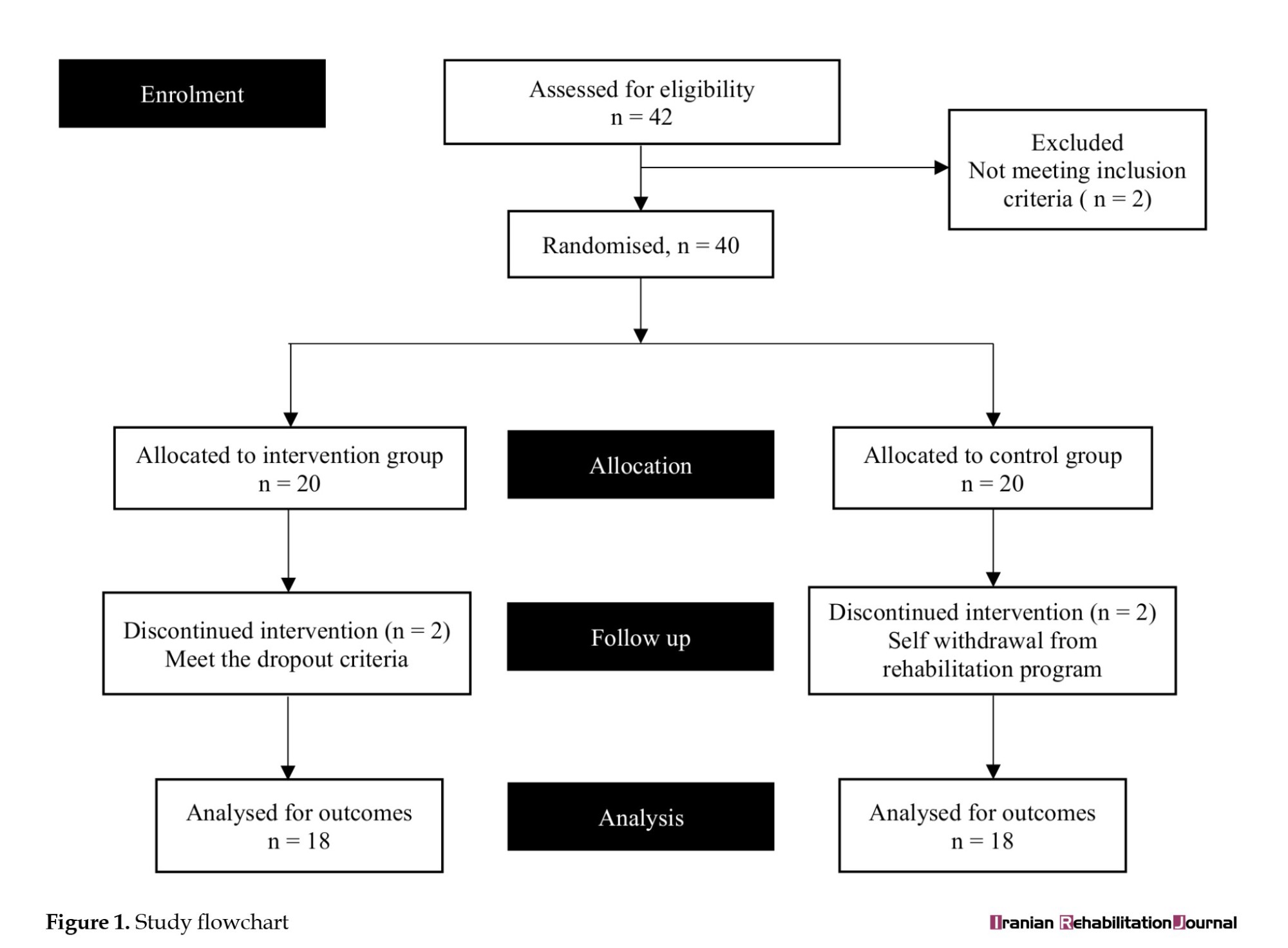
Forty-two patients fulfilled the inclusion criteria, two of whom were ineligible because they met the exclusion criteria. Forty participants were then randomized into two groups (20 in each group) (Figure 1).
Hemiplegic shoulder pain (HSP) is a significant complication in stroke survivors, known to impair functional recovery and contribute to substantial disability. Reported prevalence rates of HSP have varied widely across studies, ranging from 5% to 84%. More recent population-based research conducted in New Zealand and Sweden estimates the prevalence at approximately 22–23%, while the largest study to date, conducted in a Turkish rehabilitation center with 1,000 participants, reported a prevalence of approximately 55%. Despite its clinical importance and frequent occurrence, the multifactorial nature of HSP complicates the identification of a definitive cause, thereby hindering the development of consistently effective treatment strategies [1, 2]. Enhanced upper limb function within the initial five weeks following stroke is associated with greater utilization of the affected arm in executing functional activities [1, 3].
The Bobath approach is a rehabilitative strategy used to manage HSP. It focuses on harmonizing postural stability with selective motor control to facilitate smooth, coordinated movement patterns. With today’s advanced technology, the rehabilitation process can be carried out using smartphone-based applications, known as telerehabilitation. Home-based telerehabilitation can be described as the delivery of rehabilitation services remotely utilized electronic and communication technologies, such as mobile phones, mobile video, computers, and others [4].
Several studies have used telerehabilitation in stroke patients. Piron et al. compared the improvement of Fugl Meyer upper extremity scores between patients who received conventional therapy plus telerehabilitation and those who only received conventional therapy. After 2 months of intervention, a statistically significant difference was found between the telerehabilitation group (Mean±SD, 53.6±7.7) and the control group (49.5±4.8) [5]. Another study by Cramer et al. stated that a 6-week course of telerehabilitation in stroke patients is safe, rated favorably by patients, associated with excellent treatment adherence, and produces substantial gains in arm function with an improvement of 7.86 point Fugl-Meyer score, exceeding the 5.25 point minimal clinically important difference for Fugl-Meyer in chronic stroke. Telerehabilitation also proved to be not inferior to dose-matched interventions delivered in the clinic [6]. Szturm et al. showed improvement of the wolf motor function test in stroke patients with computer-based telerehabilitation [7].
The recovery of arm motor function in stroke patients is directly proportional to the restoration of shoulder girdle function, as dictated by the fundamental biomechanical principle of proximal stability for distal mobility. The shoulder girdle serves as the essential kinetic base of support required to facilitate controlled, functional movement of the distal upper extremity [8, 9]. A previous study on telerehabilitation had been successfully proven to have an effect on upper extremity function; in this study, researchers focused on how shoulder function recovery in HSP is one of the most prominent complications of stroke. Lack of research on the use of telerehabilitation in stroke patients who experience complications of HSP is also the reason why the researchers are interested in examining the comparison of adding app-based telerehabilitation interventions and conventional rehabilitation therapy on functional improvement of the shoulder and pain in stroke patients with HSP.
Material and Methods
Setting and study design
This study employed a randomized controlled trial to assess the effectiveness of telerehabilitation as an addition to conventional rehabilitation in individuals with HSP in stroke patients who attended rehabilitation at Wahidin Sudirohusodo Hospital and Hasanuddin University Hospital from November 2024 to July 2025.
Eligibility criteria
The inclusion criteria included patients aged 35-65 years diagnosed with stroke in the sub-acute phase (first 6 months from onset), first stroke attack, unilateral neurological deficits, full consciousness, manual muscle testing score of at least 2 for shoulder abductor and flexor at the hemiplegic shoulder, and spasticity with Modified Ashworth Scale score of <3 in the shoulder flexor, extensor, abductor, adductor, internal, and external rotator muscles.
The exclusion criteria included patients with shoulder contracture, cognitive impairment (mini-mental state examination score of <21), sensory or global aphasia, psychotic symptoms and/or severe depression, severe balance impairment (Berg balance scale score of <40), severe transfer disability (unable to change position from lying to sitting), history of coronary artery bypass graft surgery, history of active tuberculosis or severe respiratory disease, extensive hemispheric infarction in the CT scan with a volume of infarcted tissue greater than 82 cm3.
The dropout criteria were as follows: the subject did not follow the rehabilitation prescribed for 3 consecutive days during monitoring, did not perform 50% of the planned exercises recorded in the telerehabilitation application within 1 week, or death.
Group allocation and randomization
The subjects who met the inclusion criteria and did not meet the exclusion criteria were randomly assigned using sequentially numbered opaque sealed envelopes to hide their allocation. They were allocated into two groups: the intervention group and the control group. This grouping was performed using the sequence randomization technique. An independent physician created a sequential list of patient numbers from 1 to 40 in an Excel spreadsheet. Subsequently, two groups were created in the Excel sheet: the app-based telerehabilitation intervention group and the conventional rehabilitation control group. The Excel function “RAND” was then used to determine which numbers would be assigned to the app-based telerehabilitation intervention group and which would be assigned to the conventional rehabilitation control group. The minimum sample size was calculated using the paired sample size formula with effect size=8, α=0.05, power=0.84, and standard deviation=13. This calculation result 16 subjects required for each group. This study also anticipated a 10% dropout rate, resulting in a total number of participants required of 18 in each group.
Patient enrollment and baseline assessment
Patients presented at the medical rehabilitation facility with a diagnosis of stroke accompanied by HSP. The evaluator administered the informed consent in the form of an interview questionnaire and obtained approval from the relevant patients. The interview questionnaire in this study contained a list of patient identity data, current medical history, risk factors, and other comorbidities. Shoulder range of motion (ROM) was measured using a standard universal goniometer that has demonstrated excellent intra- and interrater reliability and good concurrent validity in several studies for measuring shoulder ROM [10, 11]. The functional status of the shoulder and pain level were measured using the shoulder pain and disability index (SPADI) Indonesian version, which has good construct validity, with an intraclass correlation of 0.99 and Cronbach’s α of 0.95 [12]. Patients were instructed not to inform the evaluators about their group assignments to preserve blinding.
Intervention and monitoring
Intervention Group: Patients in the intervention group were educated on the use of the smartphone application “Telerehabilitasi Hasanuddin” available in the Play Store and App Store. This application provides five videos of active assistive motoric reeducation exercises that can be performed at home using the Bobath exercise principles, including the elements of moving without effort, inhibition of flexor hypertonicity in the arm, regaining active control of the arm, elevating, and protecting the scapula. Patients performed the exercise twice a day for 30–45 minutes with the assistance of caregivers or family. In addition to telerehabilitation, these patients continued to receive conventional rehabilitation at the hospital, which included shoulder stabilizer muscle strengthening, stretching, ultrasound diathermy, and the provision of shoulder support for patients with shoulder subluxation, with a frequency of twice a week.
Control group: The control group received the same Bobath and conventional rehabilitation at the hospital twice a week for 45–60 minutes, and were taught home exercises using the Bobath method.
All study samples underwent rehabilitation from week 0 to week 12, with daily monitoring conducted via telephone and WhatsApp group. At week 12, both groups returned for a reassessment of shoulder joint functional status and pain as post-intervention data (follow-up).
Outcome
This study examined the results in two stages: Before the intervention and after a 12-week intervention.
Functional assessment was conducted by measuring the shoulder joint ROM for shoulder flexion and abduction, which was performed using a goniometer and the SPADI. Functional activity was assessed using eight questions designed to measure the level of difficulty experienced by a person in various daily activities that require the use of the upper extremity. Pain assessment also included SPADI, which consisted of five questions regarding the severity of a person’s shoulder pain while performing daily activities.
Statistical analysis
Statistical analyses were performed using SPSS software, version 25 For within-group comparisons of shoulder functional scores and pain scores before and after the intervention, the Paired t-test was used when data were normally distributed; otherwise, the Wilcoxon signed-rank test was applied. Between-group comparisons (intervention vs control) of these scores employed the independent samples t-test for normally distributed data and the Mann-Whitney U test for non-normal distributions. To evaluate the difference in improvement between groups, the Mann-Whitney U test was conducted on the change scores, calculated as post-intervention minus pre-intervention values.
Results
Participants
Forty-two patients fulfilled the inclusion criteria, two of whom were ineligible because they met the exclusion criteria. Forty participants were then randomized into two groups (20 in each group) (Figure 1).
Two subjects from each group did not continue rehabilitation; therefore, they were excluded from the dataset. Table 1 presents the patient characteristics, including age, gender, stroke type, hemiparetic side, baseline shoulder ROM, and SPADI score.
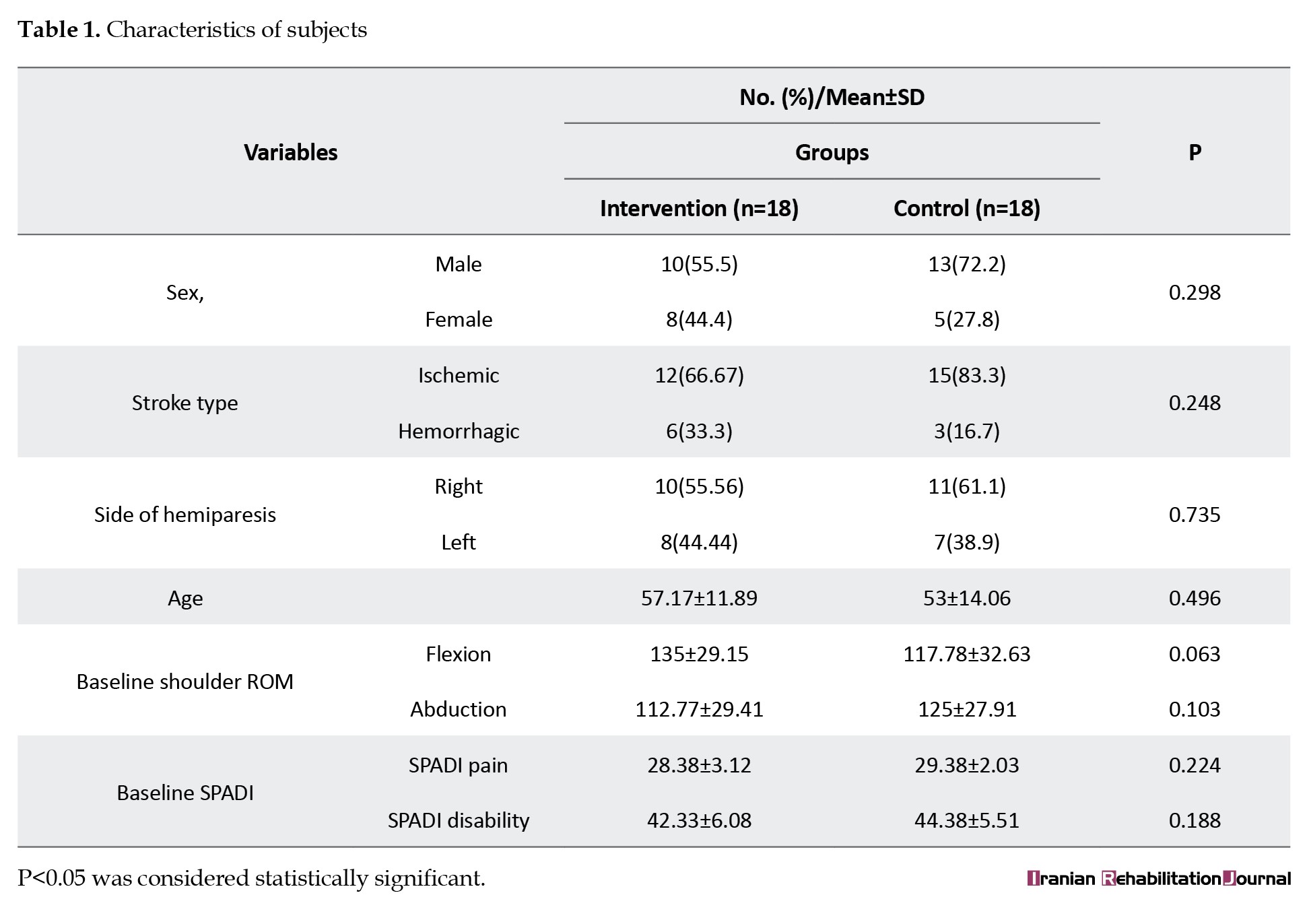
No statistically significant differences in patient characteristics were observed between the two groups (P>0.05).
Outcome measures
Shoulder ROM outcomes, as measured by goniometer, showed significant improvement in flexion and abduction shoulder ROM after 12 weeks of rehabilitation in both groups. As shown in Table 2, the intervention group showed an increase in Mean±SD for shoulder flexion ROM from 135±29.15 to 160.56±15.52 with r=0.76 and for abduction, there was also an increase from 112.77±29.41 to 132.78±25.79 with r= 0.7 and P=0.001, while in the control group, ROM flexion increased from 117.78±32.64 to 137.22±25.16 with r=0.71 and for abduction, increased from 125±27.91 to 152.78±23.21 with r=0.83 and P<0.001.
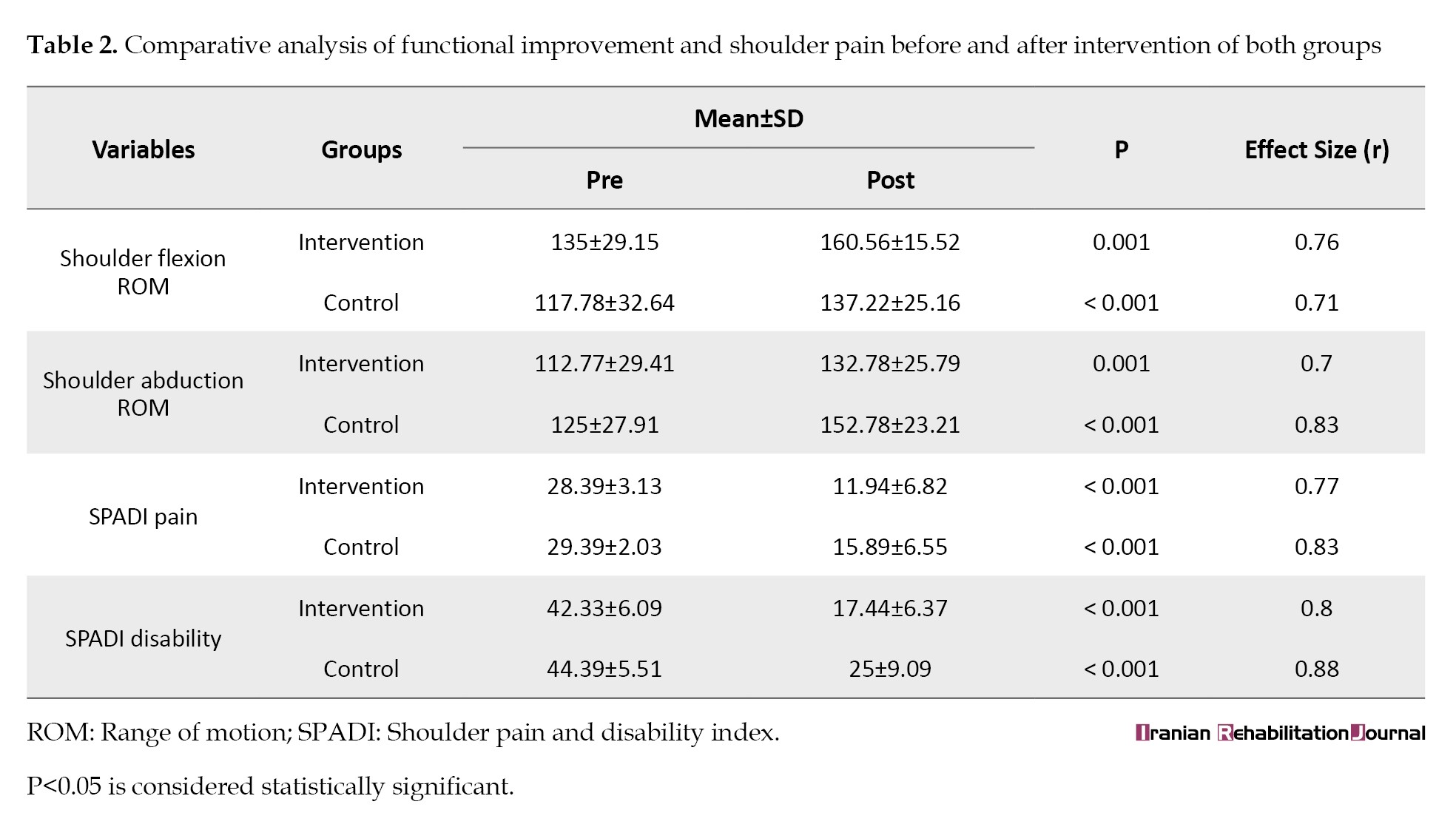
Pain outcomes as measured by the SPADI questionnaire showed a significant reduction in both groups. In the intervention group, the SPADI pain score reduced from a Mean±SD of 28.39±3.13 to 11.94±6.82 with r=0.77 and P<0.001. In the control group from 29.39±2.03 to 15.89±6.55, with r=0.83 and P<0.001.
The functional outcome of the shoulder measured by the SPADI questionnaire showed a significant reduction in disability score in both groups. In the intervention group, SPADI disability score Mean±SD reduced from 42.33±6.09 to 17.44±6.37 with r=0.8. In the control group, from 44.39±5.51 to 25±9.09, with r=0.88 and P<0.001 in both groups.
When comparing both groups, as shown in Table 3, no significant difference was observed between the two groups in the improvement of ROM with P=0.181 and 0.204 for flexion and abduction, and for pain reduction with P=0.134.
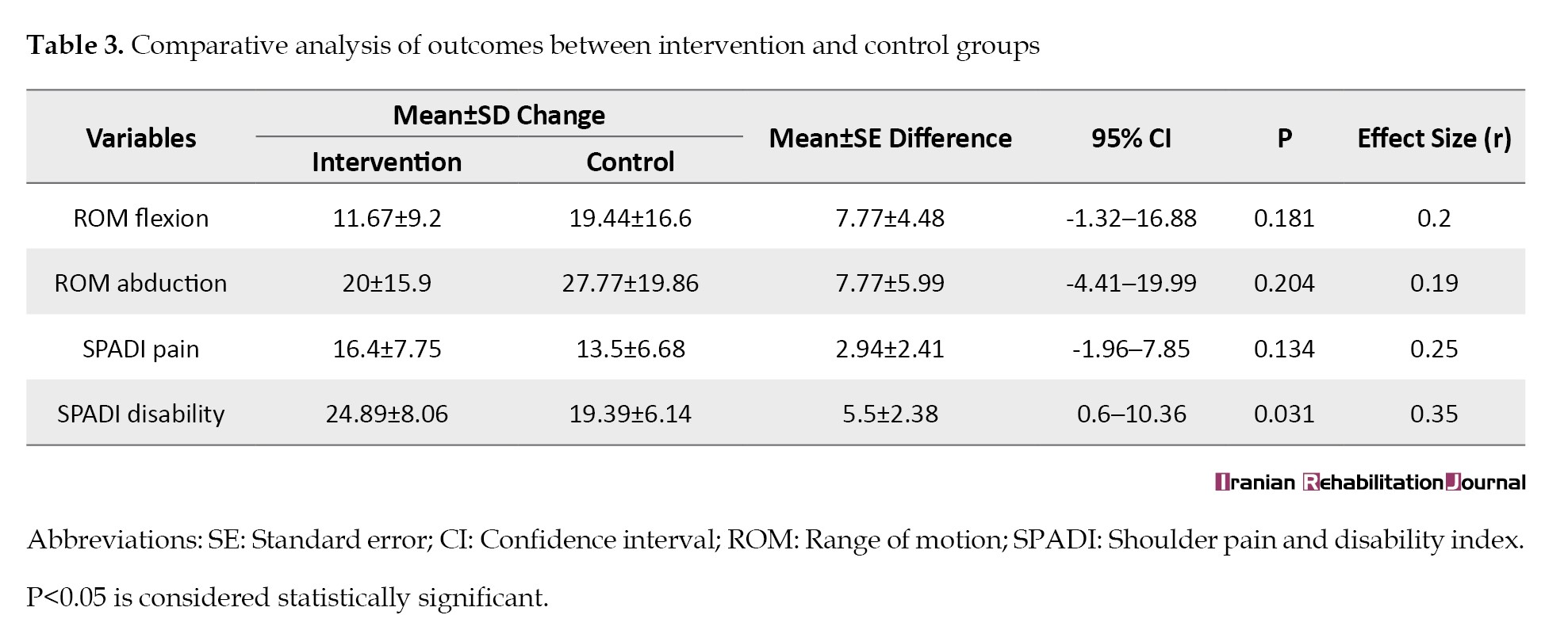
A significant difference was observed between the two groups in decreasing disability index, with the intervention group showing more decreased disability than the control group, with a Mean±SE change difference of 5.5±2.38 (95% confidence interval [CI], 0.6%, 10.36%) and r=0.35 and P=0.031.
Discussion
This study found that stroke patients with HSP who received Bobath-based telerehabilitation showed significantly reduced disability compared to those who underwent conventional rehabilitation alone. Although pain scores improved in both telerehabilitation and conventional rehabilitation groups, the difference was not significant. This suggests that pain relief may result from a multimodal approach combining strengthening, stretching, ultrasound diathermy, and shoulder support rather than Bobath therapy alone.
Previous studies, such as Partridge et al. reported better pain outcomes with Bobath compared to cryotherapy [13]. However, Hafsteinsdóttir et al. found no long-term pain reduction with Bobath alone [14]. The mechanism behind Bobath’s effect on pain remains unclear, though it may involve reflex inhibition and improved muscle tone [15].
In contrast, disability scores showed significant improvement with telerehabilitation. This supports findings by Cramer et al. [6] and Piron et al. [5] who showed that telerehabilitation can match or exceed hospital-based rehabilitation in improving motor function. Telerehabilitation also improves patient motivation and compliance. Improvement in this study relied on exercise in the telerehabilitation program, which was based on the Bobath therapy principle. Bobath therapy may enhance neuroplasticity through repetitive movement, sensory stimulation, and increased brain-derived neurotrophic factor (BDNF) levels. BDNF promotes neuroplasticity by facilitating the brain’s ability to rewire and adapt to injury, which contributes to functional recovery [16].
This concept fundamentally posits that maximizing motor learning and functional independence in stroke survivors requires an emphasis on the quality and efficiency of movement, rather than mere achievement of isolated mechanical parameters, such as passive joint ROM or isolated muscle strength [8, 9]. Which is why we found in this research better improvement in disability aspect in the telerehabilitation group, due to higher frequency of exercises that can be done at home. This finding also aligns with the concept that motor relearning therapy is better performed as frequently as possible, so that it can facilitate neuroplasticity and result in an improvement in motor function [17]. The central tenet involves the therapist utilizing specific manual guidance to normalize postural tone and facilitate active, integrated movement patterns, thereby promoting a re-organization within the central nervous system. This approach aims to provide the patient with the sensory experience of a more efficient movement, such as reaching with proper trunk control, and inhibits abnormal compensatory synergies that detract from function [8, 9, 18].
In Indonesia, the limited frequency of rehabilitation, which occurs only twice a week due to insurance policy, makes telerehabilitation especially valuable. The Telerehabilitasi Hasanuddin app helps patients follow exercises at home through reminders and video demonstrations, improving adherence compared to standard home programs.
Conclusion
This study showed that incorporating telerehabilitation into conventional rehabilitation in stroke patients with HSP for 3 months positively improved the disability of the shoulder compared to those undergoing conventional rehabilitation alone. However, pain reduction and shoulder ROM did not differ significantly between the intervention and control groups. Telerehabilitation offers a promising strategy to improve shoulder function in HSP during stroke rehabilitation.
Study limitation
This study encountered several limitations. Most notably, the sample size of 36 participants, although sufficient for preliminary analysis, may restrict the applicability of the results to a wider population. Increasing the sample size would improve statistical power and support more definitive conclusions regarding the impact of adding telerehabilitation for stroke patients with HSP. Second, this study only performed a follow-up at a single time point, specifically 12 weeks after the intervention. Future research is expected to perform follow-ups over several time periods to determine the most effective period dose of telerehabilitation therapy for stroke patients with HSP.
Ethical Considerations
Compliance with ethical guidelines
This research was approved by the Ethics Committee of Hasanuddin University, Makassar, Indonesia (Code: UH24100762) and adhered to the principles outlined in the Declaration of Helsinki.
Funding
This research did not receive any grant from funding agencies in the public, commercial, or non-profit sectors.
Authors' contributions
Study design and conceptualization: Muhammad Zuhal Darwis, Husnul Mubarak, Melda Warliani; Supervision: Husnul Mubarak, Melda Warliani, Andi Alfian Zainuddin, Yose Waluyo, Nuralam Sam; Writing: Muhammad Zuhal Darwis.
Conflict of interest
The authors declared no conflicts of interest.
Acknowledgments
The authors extend their sincere gratitude to all the individuals who participated in this study.
No statistically significant differences in patient characteristics were observed between the two groups (P>0.05).
Outcome measures
Shoulder ROM outcomes, as measured by goniometer, showed significant improvement in flexion and abduction shoulder ROM after 12 weeks of rehabilitation in both groups. As shown in Table 2, the intervention group showed an increase in Mean±SD for shoulder flexion ROM from 135±29.15 to 160.56±15.52 with r=0.76 and for abduction, there was also an increase from 112.77±29.41 to 132.78±25.79 with r= 0.7 and P=0.001, while in the control group, ROM flexion increased from 117.78±32.64 to 137.22±25.16 with r=0.71 and for abduction, increased from 125±27.91 to 152.78±23.21 with r=0.83 and P<0.001.
Pain outcomes as measured by the SPADI questionnaire showed a significant reduction in both groups. In the intervention group, the SPADI pain score reduced from a Mean±SD of 28.39±3.13 to 11.94±6.82 with r=0.77 and P<0.001. In the control group from 29.39±2.03 to 15.89±6.55, with r=0.83 and P<0.001.
The functional outcome of the shoulder measured by the SPADI questionnaire showed a significant reduction in disability score in both groups. In the intervention group, SPADI disability score Mean±SD reduced from 42.33±6.09 to 17.44±6.37 with r=0.8. In the control group, from 44.39±5.51 to 25±9.09, with r=0.88 and P<0.001 in both groups.
When comparing both groups, as shown in Table 3, no significant difference was observed between the two groups in the improvement of ROM with P=0.181 and 0.204 for flexion and abduction, and for pain reduction with P=0.134.
A significant difference was observed between the two groups in decreasing disability index, with the intervention group showing more decreased disability than the control group, with a Mean±SE change difference of 5.5±2.38 (95% confidence interval [CI], 0.6%, 10.36%) and r=0.35 and P=0.031.
Discussion
This study found that stroke patients with HSP who received Bobath-based telerehabilitation showed significantly reduced disability compared to those who underwent conventional rehabilitation alone. Although pain scores improved in both telerehabilitation and conventional rehabilitation groups, the difference was not significant. This suggests that pain relief may result from a multimodal approach combining strengthening, stretching, ultrasound diathermy, and shoulder support rather than Bobath therapy alone.
Previous studies, such as Partridge et al. reported better pain outcomes with Bobath compared to cryotherapy [13]. However, Hafsteinsdóttir et al. found no long-term pain reduction with Bobath alone [14]. The mechanism behind Bobath’s effect on pain remains unclear, though it may involve reflex inhibition and improved muscle tone [15].
In contrast, disability scores showed significant improvement with telerehabilitation. This supports findings by Cramer et al. [6] and Piron et al. [5] who showed that telerehabilitation can match or exceed hospital-based rehabilitation in improving motor function. Telerehabilitation also improves patient motivation and compliance. Improvement in this study relied on exercise in the telerehabilitation program, which was based on the Bobath therapy principle. Bobath therapy may enhance neuroplasticity through repetitive movement, sensory stimulation, and increased brain-derived neurotrophic factor (BDNF) levels. BDNF promotes neuroplasticity by facilitating the brain’s ability to rewire and adapt to injury, which contributes to functional recovery [16].
This concept fundamentally posits that maximizing motor learning and functional independence in stroke survivors requires an emphasis on the quality and efficiency of movement, rather than mere achievement of isolated mechanical parameters, such as passive joint ROM or isolated muscle strength [8, 9]. Which is why we found in this research better improvement in disability aspect in the telerehabilitation group, due to higher frequency of exercises that can be done at home. This finding also aligns with the concept that motor relearning therapy is better performed as frequently as possible, so that it can facilitate neuroplasticity and result in an improvement in motor function [17]. The central tenet involves the therapist utilizing specific manual guidance to normalize postural tone and facilitate active, integrated movement patterns, thereby promoting a re-organization within the central nervous system. This approach aims to provide the patient with the sensory experience of a more efficient movement, such as reaching with proper trunk control, and inhibits abnormal compensatory synergies that detract from function [8, 9, 18].
In Indonesia, the limited frequency of rehabilitation, which occurs only twice a week due to insurance policy, makes telerehabilitation especially valuable. The Telerehabilitasi Hasanuddin app helps patients follow exercises at home through reminders and video demonstrations, improving adherence compared to standard home programs.
Conclusion
This study showed that incorporating telerehabilitation into conventional rehabilitation in stroke patients with HSP for 3 months positively improved the disability of the shoulder compared to those undergoing conventional rehabilitation alone. However, pain reduction and shoulder ROM did not differ significantly between the intervention and control groups. Telerehabilitation offers a promising strategy to improve shoulder function in HSP during stroke rehabilitation.
Study limitation
This study encountered several limitations. Most notably, the sample size of 36 participants, although sufficient for preliminary analysis, may restrict the applicability of the results to a wider population. Increasing the sample size would improve statistical power and support more definitive conclusions regarding the impact of adding telerehabilitation for stroke patients with HSP. Second, this study only performed a follow-up at a single time point, specifically 12 weeks after the intervention. Future research is expected to perform follow-ups over several time periods to determine the most effective period dose of telerehabilitation therapy for stroke patients with HSP.
Ethical Considerations
Compliance with ethical guidelines
This research was approved by the Ethics Committee of Hasanuddin University, Makassar, Indonesia (Code: UH24100762) and adhered to the principles outlined in the Declaration of Helsinki.
Funding
This research did not receive any grant from funding agencies in the public, commercial, or non-profit sectors.
Authors' contributions
Study design and conceptualization: Muhammad Zuhal Darwis, Husnul Mubarak, Melda Warliani; Supervision: Husnul Mubarak, Melda Warliani, Andi Alfian Zainuddin, Yose Waluyo, Nuralam Sam; Writing: Muhammad Zuhal Darwis.
Conflict of interest
The authors declared no conflicts of interest.
Acknowledgments
The authors extend their sincere gratitude to all the individuals who participated in this study.
References
- Kumar P. Hemiplegic shoulder pain in people with stroke: present and the future. Pain Management. 2019; 9(2):107-10. [DOI:10.2217/pmt-2018-0075] [PMID]
- Carvalho SP, Ferro I, Pires C, Pascoal A, Lourenço A, Constantino J, et al. Stroke - shoulder pain and upper limb function. International Physical Medicine & Rehabilitation Journal. 2022; 7(1):1-4. [DOI:10.15406/ipmrj.2022.07.00293]
- Vasudevan JM, Browne BJ. Hemiplegic shoulder pain: An approach to diagnosis and management. Physical Medicine and Rehabilitation Clinics of North America. 2014; 25(2):411-37. [DOI:10.1016/j.pmr.2014.01.010] [PMID]
- Glenis G, Setiawan RC, Tambunan TF. The effectiveness of telerehabilitation for post stroke patients. Cermin Dunia Kedokteran. 2021; 48(11):329-33. [DOI:10.55175/cdk.v48i11.143]
- Piron L, Turolla A, Agostini M, Zucconi C, Cortese F, Zampolini M, et al. Exercises for paretic upper limb after stroke: A combined virtual-reality and telemedicine approach. Journal of Rehabilitation Medicine. 2009; 41(12):1016-102. [DOI:10.2340/16501977-0459] [PMID]
- Cramer SC, Dodakian L, Le V, See J, Augsburger R, McKenzie A, et al. Efficacy of Home-Based Telerehabilitation vs In-Clinic Therapy for Adults After Stroke. JAMA Neurology. 2019; 76(9):1079-87. [DOI:10.1001/jamaneurol.2019.1604] [PMID]
- Szturm T, Imran Z, Pooyania S, Kanitkar A, Mahana B. Evaluation of a Game Based Tele Rehabilitation Platform for In‐Home Therapy of Hand‐Arm Function Post Stroke: Feasibility Study. PM&R. 2021; 13(1):45-54. [DOI:10.1002/pmrj.12354] [PMID]
- Stein J, Harvey RL, Winstein CJ, Zorowitz RD, Wittenberg GF. Stroke Recovery and Rehabilitation. 2nd Ed. New York: Demos Medical Publishing; 2015. [DOI:10.1891/9781617051708]
- Gillen G. Stroke Rehabilitation : A Function-Based Approach . New York: Elsevier Inc.; 2015. [Link]
- Kiatkulanusorn S, Luangpon N, Srijunto W, Watechagit S, Pitchayadejanant K, Kuharat S, et al. Analysis of the concurrent validity and reliability of five common clinical goniometric devices. Scientific Reports. 2023; 13(1):20931. [DOI:10.1038/s41598-023-48344-6] [PMID]
- Bousquet AI, Aronsen LE, Atlas JM, Corrado BM, Pijloo H, Queiroz NA, et al. The reliability and concurrent validity of goniometric and visual estimation in participants with unilateral shoulder pain. Journal of Bodywork and Movement Therapies. 2024; 40:307-14. [DOI:10.1016/j.jbmt.2024.04.039] [PMID]
- Deviandri R, Daud A, Utami TN, Octarina P, Aminata IW, Alkaff FF. Translation, Validity, and Reliability of the Indonesian Version of the Shoulder Pain and Disability Index (SPADI). Orthopaedic Journal of Sports Medicine. 2025; 13(1):23259671241304656. [DOI:10.1177/23259671241304656] [PMID]
- Partridge C, Edwards S, Mee R, van Langenberghe H. Hemiplegic shoulder pain: A study of two methods of physiotherapy treatment. Clinical Rehabilitation. 1990; 4(1):43-9. [DOI:10.1177/026921559000400108]
- Hafsteinsdóttir T, Kappelle J, Grypdonck M, Algra A. Effects of bobath-based therapy on depression, shoulder pain and health-related quality of life in patients after stroke. Journal of Rehabilitation Medicine. 2007; 39(8):627-32. [DOI:10.2340/16501977-0097] [PMID]
- Maxwell AMW, Nguyen VQC. Management of Hemiplegic Shoulder Pain. Current Physical Medicine and Rehabilitation Reports. 2013; 1:1-8. [DOI:10.1007/s40141-012-0001-y]
- Mubarak H, Islam AA, Bintang AK, Massi MN, Putra HL, Tammasse J, et al. Correlation of Brain-Derived Neurotrophic Factor and Fugl-Meyer Score Changes after Telerehabilitation in Stroke. Journal of Modern Rehabilitation. 2025. [DOI:10.18502/jmr.v19i4.19775]
- Forman CR, Nielsen JB, Lorentzen J. Neuroplasticity at Home: Improving Home-Based Motor Learning Through Technological Solutions. A Review. Frontiers in Rehabilitation Sciences. 2021; 2:789165. [DOI:10.3389/fresc.2021.789165] [PMID]
- Pumprasart T, Pramodhyakul N, Piriyaprasarth P. The effect of the Bobath therapy programme on upper limb and hand function in chronic stroke individuals with moderate to severe deficits. International Journal of Therapy and Rehabilitation. 2019; 26(10):1-12. [DOI:10.12968/ijtr.2018.0124]
Article type: Original Research Articles |
Subject:
Physical Medicine and Rehabilitation
Received: 2025/10/29 | Accepted: 2026/02/22 | Published: 2026/04/1
Received: 2025/10/29 | Accepted: 2026/02/22 | Published: 2026/04/1
Send email to the article author

Copyright © The Author(s);
This is an open access article distributed under the terms of the Creative Commons Attribution-NonCommercial 4.0 (CC-By-NC 4.0), which permits use, distribution, and reproduction in any medium, provided the original work is properly cited and is not used for commercial purposes.
Contact Information
