
988368
Sat, Oct 31, 2026

Volume 24, Issue 3 (September 2026)
Iranian Rehabilitation Journal 2026, 24(3): 311-320 |
Back to browse issues page




Download citation:
BibTeX | RIS | EndNote | Medlars | ProCite | Reference Manager | RefWorks
Send citation to:


BibTeX | RIS | EndNote | Medlars | ProCite | Reference Manager | RefWorks
Send citation to:
Jitmal R, Vongsirinavarat M, Kunanusornchai W, Leelahavarong P, Pramuksun P. Development of Physical Therapy Home-based Rehabilitation Protocol Following Hip Fracture Surgery: A Delphi Study. Iranian Rehabilitation Journal 2026; 24 (3) :311-320
URL: http://irj.uswr.ac.ir/article-1-2710-en.html
URL: http://irj.uswr.ac.ir/article-1-2710-en.html
Rapeepat Jitmal1  , Mantana Vongsirinavarat *1 , Wanlop Kunanusornchai1 , Pattara Leelahavarong2 , Piyaporn Pramuksun3
1- Faculty of Physical Therapy, Mahidol University, Nakhon Pathom, Thailand.
2- Siriraj Health Policy Unit, Faculty of Medicine Siriraj Hospital, Mahidol University, Bangkok, Thailand.
3- Department of Physical Medicine and Rehabilitation, Bhumibol Adulyadej Hospital, Bangkok, Thailand.
2- Siriraj Health Policy Unit, Faculty of Medicine Siriraj Hospital, Mahidol University, Bangkok, Thailand.
3- Department of Physical Medicine and Rehabilitation, Bhumibol Adulyadej Hospital, Bangkok, Thailand.
Full-Text [PDF 624 kb]
(126 Downloads)
| Abstract (HTML) (1869 Views)
Statistical analysis
Descriptive statistics were used to summarize the representative results, including the characteristics of the expert panelists, using SPSS software, version 23 (Armonk, NY, USA). For the Delphi process in rounds 2 and 3, the percentage of agreement was calculated by dividing the number of experts who rated an item as “essential” by the total number of experts. Consensus was defined as a minimum agreement level of 75% among the experts [13]. To assess the stability of responses between rounds 2 and 3, the exact McNemar’s test was applied due to the small sample size of experts. A non-significant result (P>0.05) was interpreted as indicating response stability [14].
Results
Expert panelists
Table 2 presents the characteristics of eight participants in the Delphi consensus process.
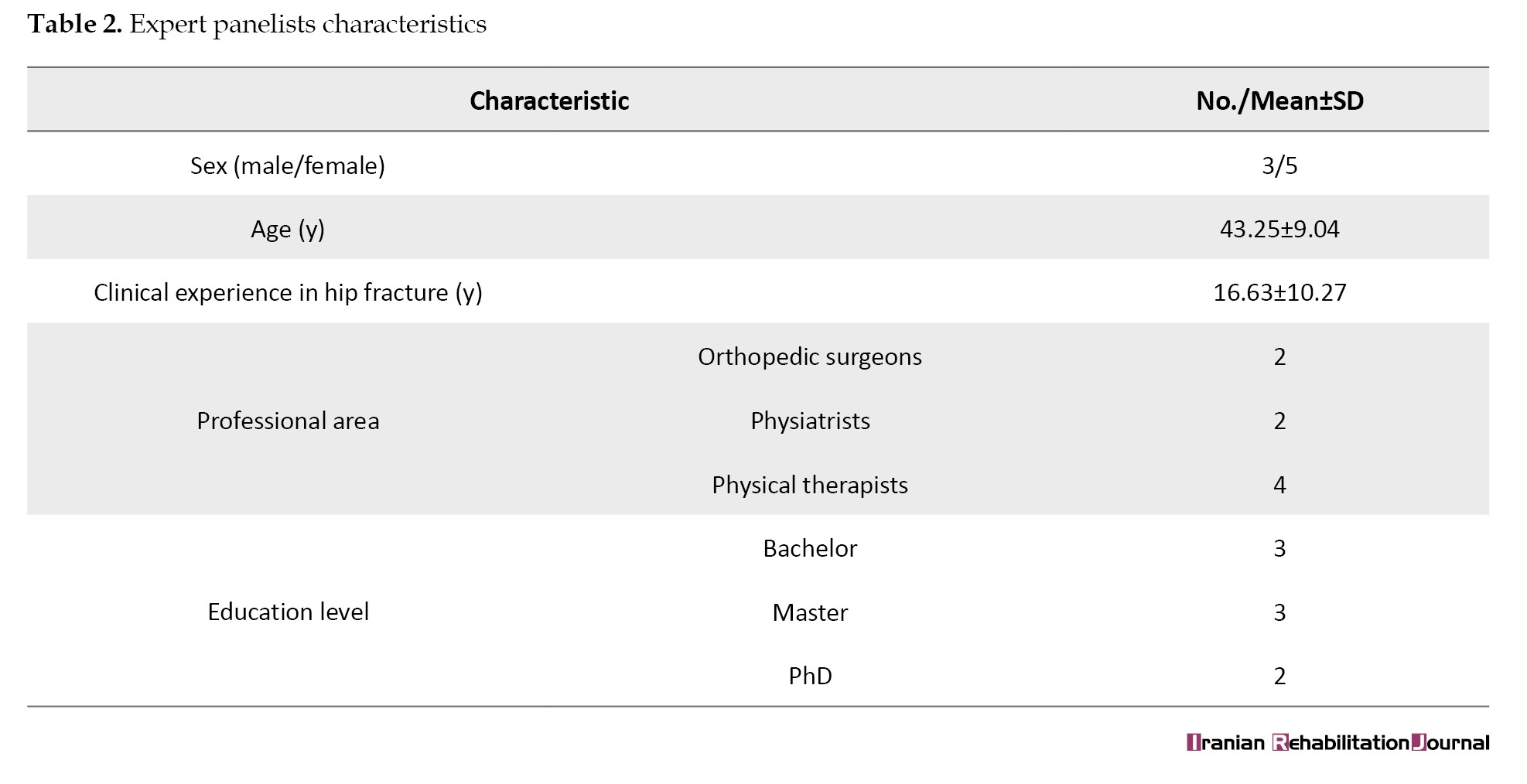
Three professional areas, including orthopedic surgeons, physiatrists, and physical therapists, were included to ensure the breadth and depth of expertise regarding hip fracture management.
Delphi results
In the first round, the expert panelists disagreed with 14 components. Additionally, they suggested components consisting of 4 items of basic knowledge, 5 items of body functions and structures evaluation, 4 items of activity limitation evaluation, 3 items of health-related quality of life assessments, 4 items of environmental assessments, 13 items of rehabilitation programs, and 3 items of educational programs. These components were included in the second round.
In the second round, the osteoporosis management component in the basic knowledge domain was eliminated since it did not reach 75% agreement. For assessment and evaluation, range of motion, muscle length, time up and go test, Barthel index, and weight-bearing status did not reach consensus. Moreover, the high-level skill training activities, including forward lunge, standing heel raise, core stabilizer muscle training, and stair climbing were also removed from the protocol.
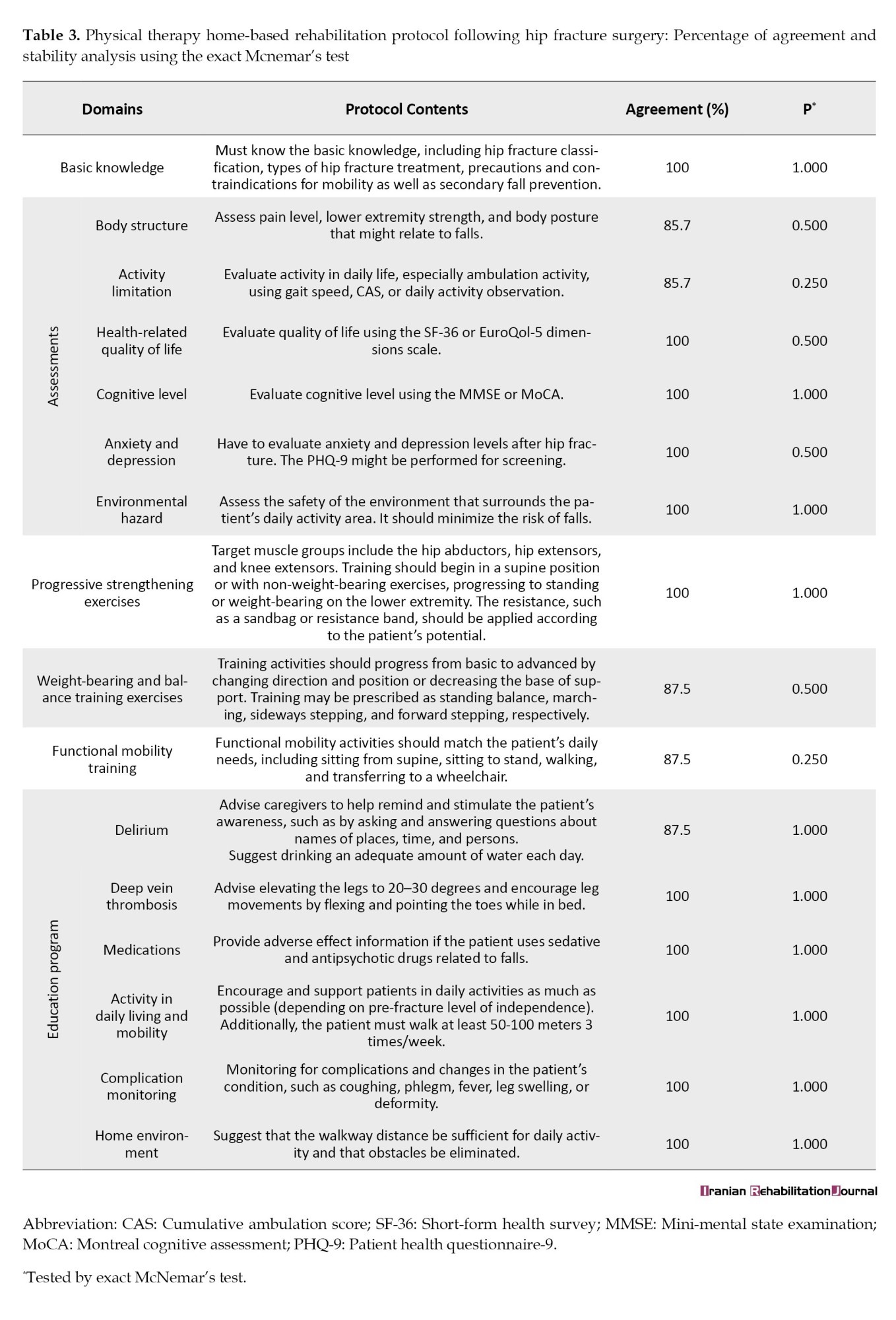
In the final round, the protocol was revised based on the results from the second round and then sent to expert panelists for final consideration. Finally, Table 3 presents the physical therapy home-based rehabilitation protocol following hip fracture surgery.
Stability and agreement
The physical therapy home-based rehabilitation protocol following hip fracture surgery achieved a consensus level greater than 75% across all retained components. The following components reached 100% agreement among the experts: basic knowledge, health-related quality of life assessment, cognitive level assessment, anxiety and depression assessment, environmental hazard evaluation, progressive strengthening exercises, deep vein thrombosis education, medication education, activities of daily living and mobility education, complication monitoring, and home environment adjustment. The remaining components—body structure and activity limitation assessment, weight-bearing and balance training exercises, functional mobility training, and delirium management—achieved 87.5% agreement.
Stability between the second and third Delphi rounds was assessed using the exact McNemar’s test. No statistically significant differences were observed between rounds for any component (P>0.05), indicating stability of expert responses.
Discussion
This study aimed to develop physical therapy practice guidelines for home-based rehabilitation following hip fracture surgery. This is the first protocol developed based on the ICF model, which includes not only assessment and evaluation but also interventions. The final guideline consists of six domains: basic knowledge, assessments, progressive strength training, weight-bearing and balance training, functional mobility training, and educational programs. This protocol could be beneficial for home-based rehabilitation prescription after hip fracture.
First, the expert panel considered basic knowledge essential for physical therapists. A previous study found that approximately 6% of patients had dislocations after hip fractures [15], which was related to an increase in mortality rate [16]. Similarly, secondary falls after hip fracture occurred in 28% of those with a hip fracture history, and 5% of them had a new hip fracture [17]. Therefore, physical therapists must know the precautions and contraindications for hip mobility by surgery types, as well as secondary fall-prevention strategies.
For the assessment, several aspects were structured based on the ICF domains. The consequences after hip fracture include mobility problems, psychological problems, and decreased quality of life [18-21]. Pain and lower-extremity strength are major issues commonly addressed in the body structure domain. However, body posture should also be highlighted in the assessment. In previous studies, awkward posture, such as a stooped position, was associated with fall incidence [22]. For the activity limitation domain, ambulation was the key problem. Gait speed was an indicator useful for predicting walking ability after hip fracture [23]. Decreased mobility can induce complications, including pneumonia, delirium, or deep vein thrombosis [24]. After hip fracture, 23% of patients had anxiety or depression, and 41.8% of patients had cognitive impairment, which were important barriers to recovery [25, 26]. More than half of patients had decreased quality of life [7]. It should be evaluated between pre- and post-rehabilitation to assess the value and success of rehabilitation. Additionally, not only personal factors or performance must be considered, but environmental factors also play a crucial role. Those who live in inappropriate home environments have a higher chance of recurrent falls [27]. This problem needs to be addressed and managed to enhance recovery [12].
This protocol included three aspects of rehabilitation training. Progressive strengthening exercises for lower extremity muscles could improve mobility, activities of daily living, balance, lower-extremity strength, and functional outcomes [28-30]. In addition, asymmetrical weight bearing is a common characteristic in patients after hip fracture surgery [31]. Therefore, exercise emphasizing weight-bearing and balance training are a strategy to solve this problem. These specific trainings after hip fracture surgery could evidently improve activities of daily living, functional tasks, as well as quality of life [30]. Functional training was also an intervention that improved recovery outcomes after hip fracture. Previous studies found that functional training, such as standing from a chair, indoor walking, or daily activities, significantly improved recovery outcomes and quality of life of these patients [33, 34].
Besides mobility or ambulation issues, several complications, such as delirium, deep vein thrombosis, pneumonia, and recurrent falls, could also occur after hip fracture. This protocol includes preventive strategies for these complications. Similarly, another study recommended including complication-prevention education in the rehabilitation program to reduce complications and improve outcomes [35].
Although holistic interventions play a crucial role in improving recovery outcomes following hip fracture, no protocol has been proposed that included all of them. This study was the first protocol to include all important domains for home-based rehabilitation following hip fracture surgery. Moreover, it was developed by a skilled multidisciplinary team. Nevertheless, our study had some limitations. First, this protocol might not be appropriate for patients with specific underlying conditions, such as dementia or Alzheimer’s disease. Second, half of the expert panelists were medical doctors, i.e., orthopedic surgeons or physiatrists, so they might not be specific in some details of the physical therapy practice. However, the criteria for expert panelist selection were based on practical context in Thailand, and all of them had extensive experience as members of the hip fracture management team. Finally, although a home-based rehabilitation protocol after hip fracture surgery has the potential to reduce indirect costs related to transportation and caregiver burden, no health economic evaluation has been conducted. In addition, this protocol has not yet been implemented in real-world clinical settings. Therefore, its feasibility and clinical effectiveness remain unestablished. Future studies incorporating health economic evaluation, feasibility assessment, and clinical effectiveness testing are warranted to further validate this protocol.
Conclusion
This study successfully developed a home-based physical therapy rehabilitation protocol following hip fracture surgery. It provides the protocol for assessment and rehabilitation based on the ICF model. However, further study should investigate the feasibility and the effectiveness of this protocol.
Ethical Considerations
Compliance with ethical guidelines
This study was approved by the Ethics Committee of Mahidol University Central Institutional Review Board, Bangkok, Thailand (Code: MU-CIRB 2025/107.0304).
Funding
This work was supported by the 60th Year Supreme Reign of His Majesty King Bhumibol Adulyadej Scholarship (Academic Year 2022), granted by the Faculty of Graduate Studies, Mahidol University.
Authors' contributions
Conceptualization, methodology, investigation, and resources: Rapeepat Jitmal and Mantana Vongsirinavarat; Formal analysis and data collection: Rapeepat Jitmal; Writing the original draft: Rapeepat Jitmal; Supervision, review, and editing: Mantana Vongsirinavarat, Wanlop Kunanusornchai, Pattara Leelahavarong, and Piyaporn Pramuksun.
Conflict of interest
The authors declared no conflict of interest.
Acknowledgments
The authors thank all health professionals who participated in the Delphi study for their valuable time, expertise, and constructive feedback. Their contributions were essential to developing the home-based physical therapy protocol.
Full-Text: (47 Views)
Introduction
The incidence of hip fracture is increasing and has become an important public health issue in an aging society worldwide [1, 2]. The predicted number of patients with hip fracture will significantly increase to 6.26 million in 2050 [2]. This increase is driven by aging, gender, and comorbidity [1]. Several complications, including delirium, urinary tract infection, pressure ulcers, and deep vein thrombosis, can occur after hip fractures [3-5]. This issue is not only an individual health problem, but also a public economic problem [6].
Although surgery is the gold standard for treating hip fracture, all patients require rehabilitation after treatment to return to function and control morbidity and mortality. During hospitalization, most patients receive postoperative rehabilitation, including early mobilization, functional training, and strength and balance exercises. However, some patients cannot reach their pre-fracture status before discharge because of the limited length of hospital stay [7]. Thus, the rehabilitation program should continue after discharge. Facility-based, community-based, and home-based rehabilitation following hip fracture surgery play a crucial role in this recovery phase. Since the major problem for hip fracture patients is dependent ambulation, home-based rehabilitation delivered to their home is recommended to improve their real-life function [6]. Previous studies have demonstrated that these patients’ function and quality of life improve after receiving home-based rehabilitation [8]. In addition, the Academy of Orthopedic Physical Therapy and the Academy of Geriatric Physical Therapy of the American Physical Therapy Association (APTA) have stated that key recommendations for hip fracture rehabilitation include progressive strengthening exercises, weight-bearing training, balance training, and functional training. Although these rehabilitation domains are established, no standardized protocols exist for post-operative rehabilitation following hip fracture surgery, particularly regarding the details of the rehabilitation prescription [7].
According to the international classification of functioning, disability and health (ICF) framework, a holistic approach to individual patients’ functional and disability status should be considered. The ICF viewpoint addresses body structure impairment, activity limitations, participation restrictions, and personal and environmental factors [9]. However, most of the hip fracture rehabilitation protocols emphasize body structure or activity limitation [10, 11]. Personal and environmental factors are often overlooked in post-operative rehabilitation interventions. In addition, a successful rehabilitation strategy should consider personal and environmental factors that influence patient recovery, including comorbidities management, medication, home environmental management, and caregiver training in the rehabilitation protocol [12].
Therefore, this study aimed to develop the physical therapy protocol based on the ICF framework for home-based rehabilitation following hip fracture surgery.
Materials and Methods
Study design
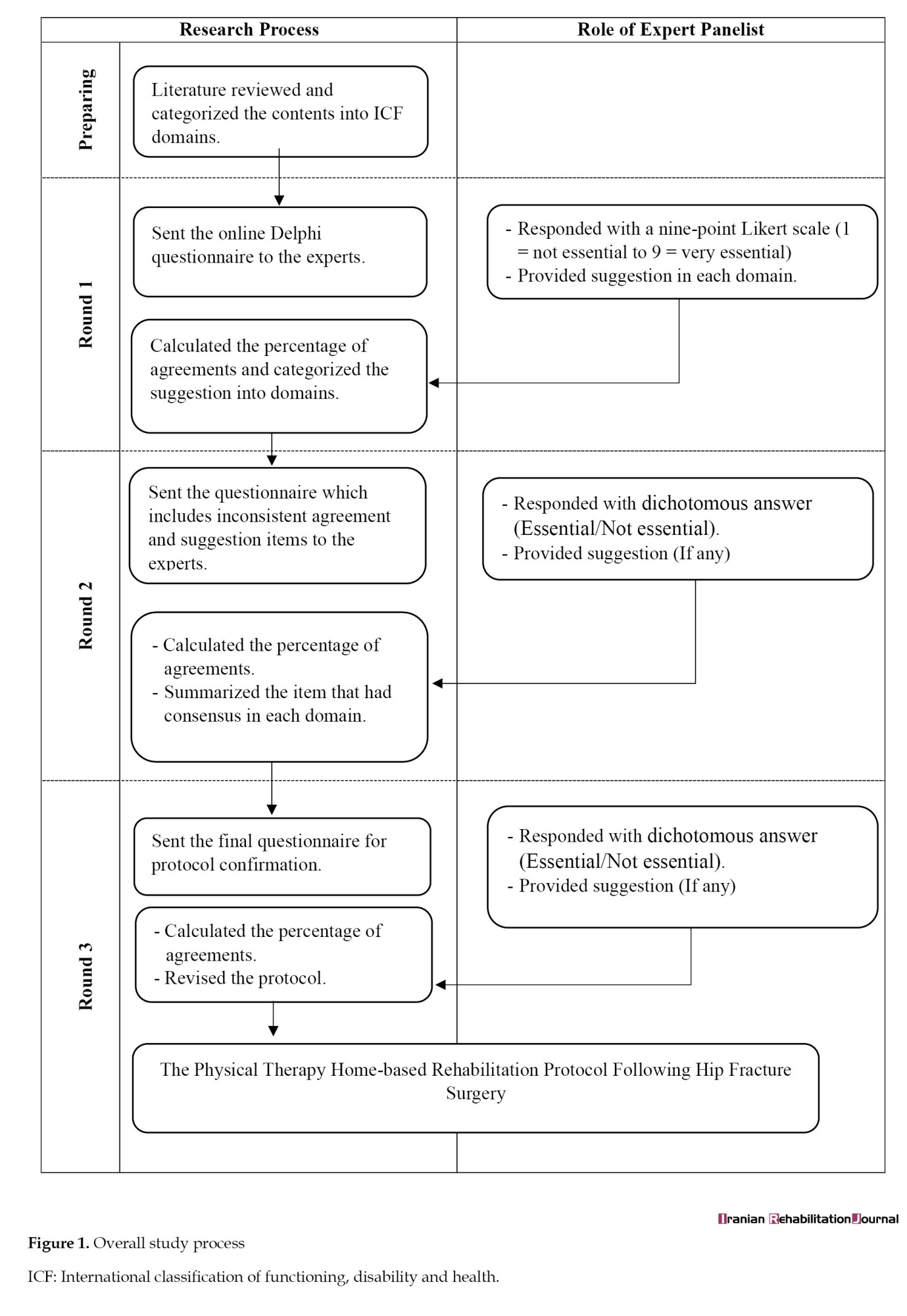
The Delphi consensus method was used to develop a physical therapy home-based rehabilitation protocol. The initial home-based rehabilitation protocol was drafted based on a literature review. The evaluation and interventions were then categorized into ICF domains. Eventually, three rounds of consensus on the physical therapy home-based rehabilitation protocol following hip fracture surgery were performed by the expert panels.
Expert panelists
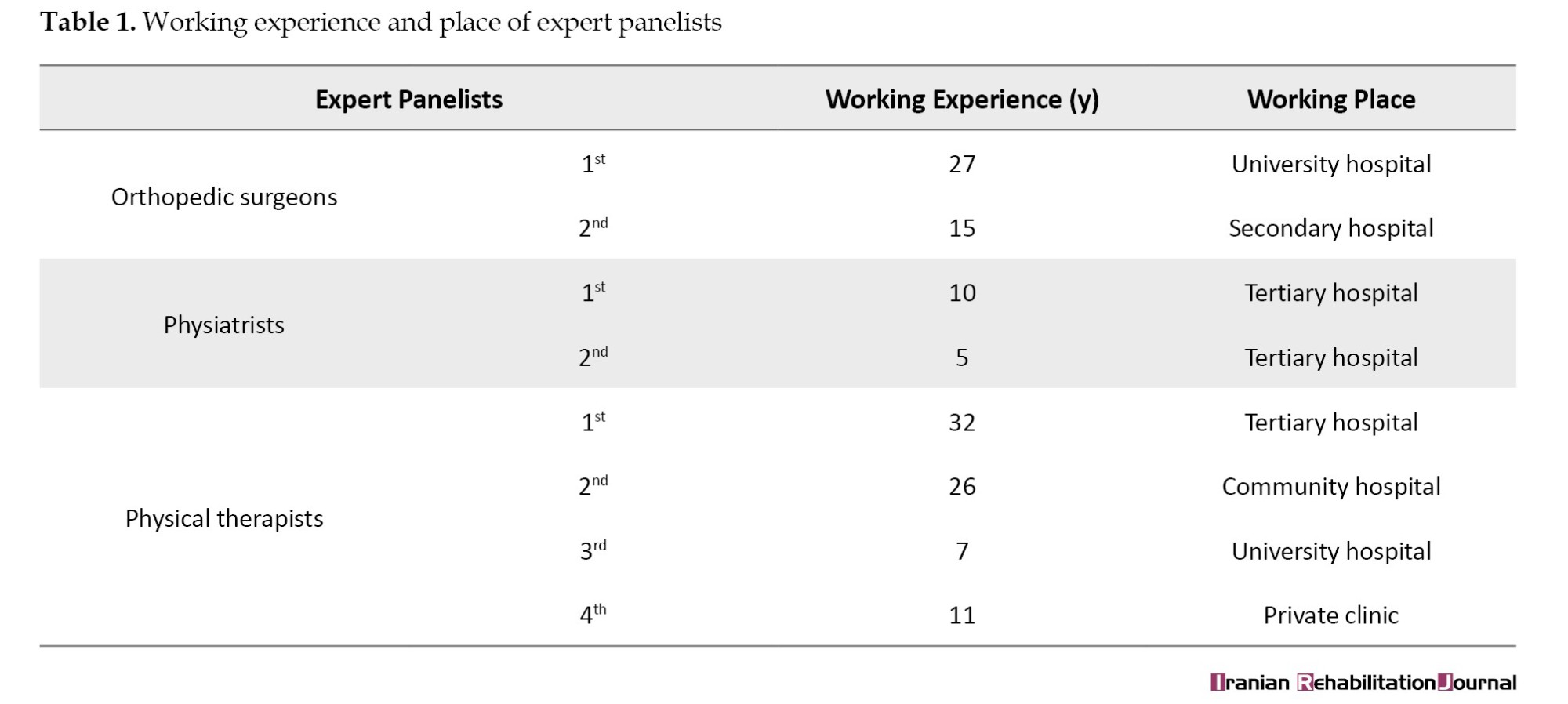
The inclusion criteria for expert panelists required at least five years of health professional experience in managing and caring for patients with hip fractures. The panel consists of eight healthcare professionals, including two orthopedic surgeons, two physiatrists, and four physical therapists. These experts had more than five years of clinical experience in hip fracture management (Table 1).
They received the study details and provided informed consent before participating.
The first Delphi round
Two physical therapists developed the initial draft of the home-based physical therapy rehabilitation protocol based on a comprehensive literature review. The review involved a systematic search using the following keywords: “hip fractures,” “rehabilitation,” “home-based rehabilitation,” “multidisciplinary,” and “home environment adjustment.” All relevant articles were critically appraised and used to inform protocol development. The protocol comprises fundamental knowledge, assessment of body functions and structures, evaluation of activity limitations, assessment of health-related quality of life, environmental assessment, and rehabilitation and educational components. Finally, the completed draft protocol was sent to an expert panel for review. The experts were asked to read the full protocol and rate each component using an online questionnaire that included all protocol topics. Each item was scored on a nine-point Likert scale (1=not essential, 9=very essential), and additional comments for each section and for the overall protocol were encouraged.
The second Delphi round
In the second round, the percentages of agreement from the first round were presented. Elements that experts agreed on inconsistently were finalized using a dichotomous answer (essential/not essential). Additionally, the protocol summarized comments and suggestions from the first round by domain. The experts were then asked to confirm whether the suggestions were appropriate for inclusion in the protocol. In this round, elements and suggestions with more than 75% agreement were included in the protocol [13].
The third Delphi round
In the final round, the protocol was revised based on feedback from the second round. Then, the experts were asked to re-evaluate the appropriateness of the elements in the protocol. Items that reached consensus (at least 75% agreement) were kept in the protocol [13]. Finally, the physical therapy home-based rehabilitation protocol following hip fracture surgery was completed in this round. Figure 1 shows the overall Delphi process.
The incidence of hip fracture is increasing and has become an important public health issue in an aging society worldwide [1, 2]. The predicted number of patients with hip fracture will significantly increase to 6.26 million in 2050 [2]. This increase is driven by aging, gender, and comorbidity [1]. Several complications, including delirium, urinary tract infection, pressure ulcers, and deep vein thrombosis, can occur after hip fractures [3-5]. This issue is not only an individual health problem, but also a public economic problem [6].
Although surgery is the gold standard for treating hip fracture, all patients require rehabilitation after treatment to return to function and control morbidity and mortality. During hospitalization, most patients receive postoperative rehabilitation, including early mobilization, functional training, and strength and balance exercises. However, some patients cannot reach their pre-fracture status before discharge because of the limited length of hospital stay [7]. Thus, the rehabilitation program should continue after discharge. Facility-based, community-based, and home-based rehabilitation following hip fracture surgery play a crucial role in this recovery phase. Since the major problem for hip fracture patients is dependent ambulation, home-based rehabilitation delivered to their home is recommended to improve their real-life function [6]. Previous studies have demonstrated that these patients’ function and quality of life improve after receiving home-based rehabilitation [8]. In addition, the Academy of Orthopedic Physical Therapy and the Academy of Geriatric Physical Therapy of the American Physical Therapy Association (APTA) have stated that key recommendations for hip fracture rehabilitation include progressive strengthening exercises, weight-bearing training, balance training, and functional training. Although these rehabilitation domains are established, no standardized protocols exist for post-operative rehabilitation following hip fracture surgery, particularly regarding the details of the rehabilitation prescription [7].
According to the international classification of functioning, disability and health (ICF) framework, a holistic approach to individual patients’ functional and disability status should be considered. The ICF viewpoint addresses body structure impairment, activity limitations, participation restrictions, and personal and environmental factors [9]. However, most of the hip fracture rehabilitation protocols emphasize body structure or activity limitation [10, 11]. Personal and environmental factors are often overlooked in post-operative rehabilitation interventions. In addition, a successful rehabilitation strategy should consider personal and environmental factors that influence patient recovery, including comorbidities management, medication, home environmental management, and caregiver training in the rehabilitation protocol [12].
Therefore, this study aimed to develop the physical therapy protocol based on the ICF framework for home-based rehabilitation following hip fracture surgery.
Materials and Methods
Study design
The Delphi consensus method was used to develop a physical therapy home-based rehabilitation protocol. The initial home-based rehabilitation protocol was drafted based on a literature review. The evaluation and interventions were then categorized into ICF domains. Eventually, three rounds of consensus on the physical therapy home-based rehabilitation protocol following hip fracture surgery were performed by the expert panels.
Expert panelists
The inclusion criteria for expert panelists required at least five years of health professional experience in managing and caring for patients with hip fractures. The panel consists of eight healthcare professionals, including two orthopedic surgeons, two physiatrists, and four physical therapists. These experts had more than five years of clinical experience in hip fracture management (Table 1).
They received the study details and provided informed consent before participating.
The first Delphi round
Two physical therapists developed the initial draft of the home-based physical therapy rehabilitation protocol based on a comprehensive literature review. The review involved a systematic search using the following keywords: “hip fractures,” “rehabilitation,” “home-based rehabilitation,” “multidisciplinary,” and “home environment adjustment.” All relevant articles were critically appraised and used to inform protocol development. The protocol comprises fundamental knowledge, assessment of body functions and structures, evaluation of activity limitations, assessment of health-related quality of life, environmental assessment, and rehabilitation and educational components. Finally, the completed draft protocol was sent to an expert panel for review. The experts were asked to read the full protocol and rate each component using an online questionnaire that included all protocol topics. Each item was scored on a nine-point Likert scale (1=not essential, 9=very essential), and additional comments for each section and for the overall protocol were encouraged.
The second Delphi round
In the second round, the percentages of agreement from the first round were presented. Elements that experts agreed on inconsistently were finalized using a dichotomous answer (essential/not essential). Additionally, the protocol summarized comments and suggestions from the first round by domain. The experts were then asked to confirm whether the suggestions were appropriate for inclusion in the protocol. In this round, elements and suggestions with more than 75% agreement were included in the protocol [13].
The third Delphi round
In the final round, the protocol was revised based on feedback from the second round. Then, the experts were asked to re-evaluate the appropriateness of the elements in the protocol. Items that reached consensus (at least 75% agreement) were kept in the protocol [13]. Finally, the physical therapy home-based rehabilitation protocol following hip fracture surgery was completed in this round. Figure 1 shows the overall Delphi process.
Statistical analysis
Descriptive statistics were used to summarize the representative results, including the characteristics of the expert panelists, using SPSS software, version 23 (Armonk, NY, USA). For the Delphi process in rounds 2 and 3, the percentage of agreement was calculated by dividing the number of experts who rated an item as “essential” by the total number of experts. Consensus was defined as a minimum agreement level of 75% among the experts [13]. To assess the stability of responses between rounds 2 and 3, the exact McNemar’s test was applied due to the small sample size of experts. A non-significant result (P>0.05) was interpreted as indicating response stability [14].
Results
Expert panelists
Table 2 presents the characteristics of eight participants in the Delphi consensus process.
Three professional areas, including orthopedic surgeons, physiatrists, and physical therapists, were included to ensure the breadth and depth of expertise regarding hip fracture management.
Delphi results
In the first round, the expert panelists disagreed with 14 components. Additionally, they suggested components consisting of 4 items of basic knowledge, 5 items of body functions and structures evaluation, 4 items of activity limitation evaluation, 3 items of health-related quality of life assessments, 4 items of environmental assessments, 13 items of rehabilitation programs, and 3 items of educational programs. These components were included in the second round.
In the second round, the osteoporosis management component in the basic knowledge domain was eliminated since it did not reach 75% agreement. For assessment and evaluation, range of motion, muscle length, time up and go test, Barthel index, and weight-bearing status did not reach consensus. Moreover, the high-level skill training activities, including forward lunge, standing heel raise, core stabilizer muscle training, and stair climbing were also removed from the protocol.
In the final round, the protocol was revised based on the results from the second round and then sent to expert panelists for final consideration. Finally, Table 3 presents the physical therapy home-based rehabilitation protocol following hip fracture surgery.
Stability and agreement
The physical therapy home-based rehabilitation protocol following hip fracture surgery achieved a consensus level greater than 75% across all retained components. The following components reached 100% agreement among the experts: basic knowledge, health-related quality of life assessment, cognitive level assessment, anxiety and depression assessment, environmental hazard evaluation, progressive strengthening exercises, deep vein thrombosis education, medication education, activities of daily living and mobility education, complication monitoring, and home environment adjustment. The remaining components—body structure and activity limitation assessment, weight-bearing and balance training exercises, functional mobility training, and delirium management—achieved 87.5% agreement.
Stability between the second and third Delphi rounds was assessed using the exact McNemar’s test. No statistically significant differences were observed between rounds for any component (P>0.05), indicating stability of expert responses.
Discussion
This study aimed to develop physical therapy practice guidelines for home-based rehabilitation following hip fracture surgery. This is the first protocol developed based on the ICF model, which includes not only assessment and evaluation but also interventions. The final guideline consists of six domains: basic knowledge, assessments, progressive strength training, weight-bearing and balance training, functional mobility training, and educational programs. This protocol could be beneficial for home-based rehabilitation prescription after hip fracture.
First, the expert panel considered basic knowledge essential for physical therapists. A previous study found that approximately 6% of patients had dislocations after hip fractures [15], which was related to an increase in mortality rate [16]. Similarly, secondary falls after hip fracture occurred in 28% of those with a hip fracture history, and 5% of them had a new hip fracture [17]. Therefore, physical therapists must know the precautions and contraindications for hip mobility by surgery types, as well as secondary fall-prevention strategies.
For the assessment, several aspects were structured based on the ICF domains. The consequences after hip fracture include mobility problems, psychological problems, and decreased quality of life [18-21]. Pain and lower-extremity strength are major issues commonly addressed in the body structure domain. However, body posture should also be highlighted in the assessment. In previous studies, awkward posture, such as a stooped position, was associated with fall incidence [22]. For the activity limitation domain, ambulation was the key problem. Gait speed was an indicator useful for predicting walking ability after hip fracture [23]. Decreased mobility can induce complications, including pneumonia, delirium, or deep vein thrombosis [24]. After hip fracture, 23% of patients had anxiety or depression, and 41.8% of patients had cognitive impairment, which were important barriers to recovery [25, 26]. More than half of patients had decreased quality of life [7]. It should be evaluated between pre- and post-rehabilitation to assess the value and success of rehabilitation. Additionally, not only personal factors or performance must be considered, but environmental factors also play a crucial role. Those who live in inappropriate home environments have a higher chance of recurrent falls [27]. This problem needs to be addressed and managed to enhance recovery [12].
This protocol included three aspects of rehabilitation training. Progressive strengthening exercises for lower extremity muscles could improve mobility, activities of daily living, balance, lower-extremity strength, and functional outcomes [28-30]. In addition, asymmetrical weight bearing is a common characteristic in patients after hip fracture surgery [31]. Therefore, exercise emphasizing weight-bearing and balance training are a strategy to solve this problem. These specific trainings after hip fracture surgery could evidently improve activities of daily living, functional tasks, as well as quality of life [30]. Functional training was also an intervention that improved recovery outcomes after hip fracture. Previous studies found that functional training, such as standing from a chair, indoor walking, or daily activities, significantly improved recovery outcomes and quality of life of these patients [33, 34].
Besides mobility or ambulation issues, several complications, such as delirium, deep vein thrombosis, pneumonia, and recurrent falls, could also occur after hip fracture. This protocol includes preventive strategies for these complications. Similarly, another study recommended including complication-prevention education in the rehabilitation program to reduce complications and improve outcomes [35].
Although holistic interventions play a crucial role in improving recovery outcomes following hip fracture, no protocol has been proposed that included all of them. This study was the first protocol to include all important domains for home-based rehabilitation following hip fracture surgery. Moreover, it was developed by a skilled multidisciplinary team. Nevertheless, our study had some limitations. First, this protocol might not be appropriate for patients with specific underlying conditions, such as dementia or Alzheimer’s disease. Second, half of the expert panelists were medical doctors, i.e., orthopedic surgeons or physiatrists, so they might not be specific in some details of the physical therapy practice. However, the criteria for expert panelist selection were based on practical context in Thailand, and all of them had extensive experience as members of the hip fracture management team. Finally, although a home-based rehabilitation protocol after hip fracture surgery has the potential to reduce indirect costs related to transportation and caregiver burden, no health economic evaluation has been conducted. In addition, this protocol has not yet been implemented in real-world clinical settings. Therefore, its feasibility and clinical effectiveness remain unestablished. Future studies incorporating health economic evaluation, feasibility assessment, and clinical effectiveness testing are warranted to further validate this protocol.
Conclusion
This study successfully developed a home-based physical therapy rehabilitation protocol following hip fracture surgery. It provides the protocol for assessment and rehabilitation based on the ICF model. However, further study should investigate the feasibility and the effectiveness of this protocol.
Ethical Considerations
Compliance with ethical guidelines
This study was approved by the Ethics Committee of Mahidol University Central Institutional Review Board, Bangkok, Thailand (Code: MU-CIRB 2025/107.0304).
Funding
This work was supported by the 60th Year Supreme Reign of His Majesty King Bhumibol Adulyadej Scholarship (Academic Year 2022), granted by the Faculty of Graduate Studies, Mahidol University.
Authors' contributions
Conceptualization, methodology, investigation, and resources: Rapeepat Jitmal and Mantana Vongsirinavarat; Formal analysis and data collection: Rapeepat Jitmal; Writing the original draft: Rapeepat Jitmal; Supervision, review, and editing: Mantana Vongsirinavarat, Wanlop Kunanusornchai, Pattara Leelahavarong, and Piyaporn Pramuksun.
Conflict of interest
The authors declared no conflict of interest.
Acknowledgments
The authors thank all health professionals who participated in the Delphi study for their valuable time, expertise, and constructive feedback. Their contributions were essential to developing the home-based physical therapy protocol.
References
- Dong Y, Zhang Y, Song K, Kang H, Ye D, Li F. What was the epidemiology and global burden of disease of hip fractures from 1990 to 2019? Results from and additional analysis of the global burden of disease study 2019. Clinical Orthopaedics and Related Research. 2022; 481(6):1209. [DOI:10.1097/CORR.0000000000002465] [PMID]
- Cooper C, Campion G, Melton III L. Hip fractures in the elderly: A world-wide projection. Osteoporosis International. 1992; 2(6):285-9. [DOI:10.1007/BF01623184] [PMID]
- Dyer SM, Crotty M, Fairhall N, Magaziner J, Beaupre LA, Cameron ID, et al. A critical review of the long-term disability outcomes following hip fracture. BMC Geriatrics. 2016; 16(1):158. [DOI:10.1186/s12877-016-0332-0] [PMID] [PMCID]
- Kim SJ, Park HS, Lee DW. Outcome of nonoperative treatment for hip fractures in elderly patients: A systematic review of recent literature. Journal of Orthopaedic Surgery. 2020; 28(2):2309499020936848. [DOI:10.1177/2309499020936848] [PMID] [PMCID]
- Carpintero P, Caeiro JR, Carpintero R, Morales A, Silva S, Mesa M. Complications of hip fractures: A review. World Journal of Orthopedics. 2014; 5(4):402-11. [DOI:10.5312/wjo.v5.i4.402] [PMID] [PMCID]
- Falaschi P, Marsh D. Orthogeriatrics: The management of older patients with fragility fractures. New York: Springer; 2021. [Link]
- McDonough CM, Harris-Hayes M, Kristensen MT, Overgaard JA, Herring TB, Kenny AM, et al. Physical therapy management of older adults with hip fracture: Clinical practice guidelines linked to the international classification of functioning, disability and health from the academy of orthopaedic physical therapy and the academy of geriatric physical therapy of the American physical therapy association. Journal of Orthopaedic & Sports Physical Therapy. 2021; 51(2):CPG1-81. [DOI:10.2519/jospt.2021.0301] [PMID]
- Tsauo JY, Leu WS, Chen YT, Yang RS. Effects on function and quality of life of postoperative home-based physical therapy for patients with hip fracture. Archives of Physical Medicine and Rehabilitation. 2005; 86(10):1953-7. [DOI:10.1016/j.apmr.2005.04.020] [PMID]
- Rauch A, Cieza A, Stucki G. How to apply the International Classification of Functioning, Disability and Health (ICF) for rehabilitation management in clinical practice. European Journal of Physical and Rehabilitation Medicine. 2008; 44(3):329-42. [PMID]
- Lee H, Lee SH. Effectiveness of multicomponent home-based rehabilitation in older patients after hip fracture surgery: A systematic review and meta-analysis. Journal of Clinical Nursing. 2023; 32(1-2):31-48. [DOI:10.1111/jocn.16256] [PMID]
- Fairhall NJ, Dyer SM, Mak JC, Diong J, Kwok WS, Sherrington C. Interventions for improving mobility after hip fracture surgery in adults. Cochrane Library: Cochrane Reviews. 2022; 9(9):CD001704. [DOI:10.1002/14651858.CD001704.pub5] [PMID] [PMCID]
- Smith TO, Jepson P, Beswick A, Sands G, Drummond A, Davis ET, et al. Assistive devices, hip precautions, environmental modifications and training to prevent dislocation and improve function after hip arthroplasty. Cochrane Library: Cochrane Reviews. 2016; 7(7):CD010815. [DOI:10.1002/14651858.CD010815.pub2]
- Bowker R, Lakhanpaul M, Atkinson M, Armon K, MacFaul R, Stephenson T. How to write a guideline from start to finish: A handbook for healthcare professionals. Amsterdam: Elsevier Health Sciences; 2008. [Link]
- Von Der Gracht HA. Consensus measurement in Delphi studies: Review and implications for future quality assurance. Technological Forecasting and Social Change. 2012; 79(8):1525-36. [DOI:10.1016/j.techfore.2012.04.013] [PMCID]
- Pangaud C, Pioger C, Pauly V, Orleans V, Boyer L, Argenson JN, et al. Total hip arthroplasty reduces the risk of dislocation after femoral neck fracture. Orthopaedics & Traumatology: Surgery & Research. 2023; 109(4):103575. [DOI:10.1016/j.otsr.2023.103575] [PMID]
- Blanco JF, Da Casa C, Fidalgo H, García-Iglesias MA, González-Garcia L, Burón-Alvarez I, et al. Effect of hip hemiarthroplasty dislocation on mortality after hip fracture surgery. Revista Espanola de Cirugia Ortopedica Y Traumatologia. 2023; 67(1):3-11. [DOI:10.1016/j.recot.2022.08.006] [PMID]
- Lloyd BD, Williamson DA, Singh NA, Hansen RD, Diamond TH, Finnegan TP, et al. Recurrent and injurious falls in the year following hip fracture: A prospective study of incidence and risk factors from the sarcopenia and hip fracture study. Journals of Gerontology Series A. 2009; 64(5):599-609. [DOI:10.1093/gerona/glp003] [PMID]
- Miller RR, Eastlack M, Hicks GE, Alley DE, Shardell MD, Orwig DL, et al. Asymmetry in CT scan measures of thigh muscle 2 months after hip fracture: The Baltimore hip studies. Journals of Gerontology Series A. 2015; 70(10):1276-80. [DOI:10.1093/gerona/glr188] [PMID]
- Takahiro F, Shigeharu T. Skeletal muscle tissue composition ratio in patients with hip fracture: Comparison of fractured side and non-fractured side. Journal of Back and Musculoskeletal Rehabilitation. 2023; 36(3):669-76. [DOI:10.3233/BMR-220083] [PMID]
- Morrison SR, Magaziner J, McLaughlin MA, Orosz G, Silberzweig SB, Koval KJ, et al. The impact of post-operative pain on outcomes following hip fracture. Pain. 2003; 103(3):303-11. [DOI:10.1016/S0304-3959(02)00458-X] [PMID]
- Pipatyaokul R. Outcome After Hip fracture in elderly patients. Medical Journal of Sisaket Surin Buriram Hospitals. 2018; 32(1):21-32. [Link]
- Ishikawa Y, Miyakoshi N, Hongo M, Kasukawa Y, Kudo D, Shimada Y. Relationships among spinal mobility and sagittal alignment of spine and lower extremity to quality of life and risk of falls. Gait & Posture. 2017; 53:98-103. [DOI:10.1016/j.gaitpost.2017.01.011] [PMID]
- Bajracharya R, Guralnik JM, Shardell MD, Hochberg MC, Orwig DL, Magaziner JS. Predictors of mobility status one year post hip fracture among community-dwelling older adults prior to fracture: A prospective cohort study. Journal of the American Geriatrics Society. 2023; 71(8):2441-50. [DOI:10.1111/jgs.18327] [PMID] [PMCID]
- Kenyon-Smith T, Nguyen E, Oberai T, Jarsma R. Early mobilization post–hip fracture surgery. Geriatric Orthopaedic Surgery & Rehabilitation. 2019; 10:2151459319826431.[DOI:10.1177/2151459319826431] [PMID] [PMCID]
- Heidari ME, Irvani SS, Dalvand P, Khadem M, Eskandari F, Torabi F, et al. Prevalence of depression in older people with hip fracture: A systematic review and meta-analysis. International Journal of Orthopaedic and Trauma Nursing. 2021; 40:100813. [DOI:10.1016/j.ijotn.2020.100813] [PMID]
- Seitz MD, Adunuri BN, Gill MS, Rochon MP. Prevalence of dementia and cognitive impairment among older adults with hip fractures. Journal of the American Medical Directors Association. 2011; 12(8):556-64. [DOI:10.1016/j.jamda.2010.12.001] [PMID]
- Xu BY, Yan S, Low LL, Vasanwala FF, Low SG. Predictors of poor functional outcomes and mortality in patients with hip fracture: A systematic review. BMC Musculoskeletal Disorders. 2019; 20(1):568. [DOI:10.1186/s12891-019-2950-0] [PMID] [PMCID]
- Radinovic KS, Markovic-Denic L, Dubljanin-Raspopovic E, Marinkovic J, Jovanovic LB, Bumbasirevic V. Effect of the overlap syndrome of depressive symptoms and delirium on outcomes in elderly adults with hip fracture: A prospective cohort study. Journal of the American Geriatrics Society. 2014; 62(9):1640-8. [DOI:10.1111/jgs.12992] [PMID]
- Lektip C, Chaovalit S, Wattanapisit A, Lapmanee S, Nawarat J, Yaemrattanakul W. Home hazard modification programs for reducing falls in older adults: A systematic review and meta-analysis. PeerJ. 2023; 11:e15699. [DOI:10.7717/peerj.15699] [PMID] [PMCID]
- Lee SY, Yoon BH, Beom J, Ha YC, Lim JY. Effect of lower-limb progressive resistance exercise after hip fracture surgery: A systematic review and meta-analysis of randomized controlled studies. Journal of the American Medical Directors Association. 2017; 18(12):1096-e19. [DOI:10.1016/j.jamda.2017.08.021] [PMID]
- Kneiss JA, Hilton TN, Tome J, Houck JR. Weight-bearing asymmetry in individuals post-hip fracture during the sit to stand task. Clinical Biomechanics. 2015; 30(1):14-21.[DOI:10.1016/j.clinbiomech.2014.11.012] [PMID]
- Lee SY, Jung SH, Lee SU, Ha YC, Lim JY. Effect of balance training after hip fracture surgery: A systematic review and meta-analysis of randomized controlled studies. The Journals of Gerontology: Series A. 2019; 74(10):1679-85.[DOI:10.1093/gerona/gly271] [PMID]
- Magaziner J, Mangione KK, Orwig D, Baumgarten M, Magder L, Terrin M, et al. Effect of a multicomponent home-based physical therapy intervention on ambulation after hip fracture in older adults: The CAP randomized clinical trial. JAMA. 2019; 322(10):946-56. [DOI:10.1001/jama.2019.12964] [PMID] [PMCID]
- Latham NK, Harris BA, Bean JF, Heeren T, Goodyear C, Zawacki S, et al. Effect of a home-based exercise program on functional recovery following rehabilitation after hip fracture: A randomized clinical trial. JAMA. 2014; 311(7):700-8. [DOI:10.1001/jama.2014.469] [PMID] [PMCID]
- Freitas MM, Antunes S, Ascenso D, Silveira A. Outpatient and home-based treatment: Effective settings for hip fracture rehabilitation in elderly patients. Geriatrics. 2021; 6(3):83.[DOI:10.3390/geriatrics6030083] [PMID] [PMCID]
Article type: Original Research Articles |
Subject:
Physiotherapy
Received: 2026/01/8 | Accepted: 2026/06/8 | Published: 2026/09/26
Received: 2026/01/8 | Accepted: 2026/06/8 | Published: 2026/09/26
Send email to the article author

Copyright © The Author(s);
This is an open access article distributed under the terms of the Creative Commons Attribution-NonCommercial 4.0 (CC-By-NC 4.0), which permits use, distribution, and reproduction in any medium, provided the original work is properly cited and is not used for commercial purposes.
Contact Information
