
988368
Fri, Oct 30, 2026

Volume 24, Issue 3 (September 2026)
Iranian Rehabilitation Journal 2026, 24(3): 283-296 |
Back to browse issues page



Ethics code: IR.USWR.REC.1402. 253


Download citation:
BibTeX | RIS | EndNote | Medlars | ProCite | Reference Manager | RefWorks
Send citation to:


BibTeX | RIS | EndNote | Medlars | ProCite | Reference Manager | RefWorks
Send citation to:
Barati Z, Kharazi Baheri P, Zarifian T, Ashtari A, Vahedi M. The Role of Text Genre in Reading Fluency Components and Comprehension in Persian-speaking Students. Iranian Rehabilitation Journal 2026; 24 (3) :283-296
URL: http://irj.uswr.ac.ir/article-1-2743-en.html
URL: http://irj.uswr.ac.ir/article-1-2743-en.html

1- Department of Speech Therapy, Faculty of Rehabilitation Sciences, University of Social Welfare and Rehabilitation Sciences, Tehran, Iran. & Pediatric Neurorehabilitation Research Center, University of Social Welfare and Rehabilitation Sciences, Tehran, Iran.
2- Pediatric Neurorehabilitation Research Center, University of Social Welfare and Rehabilitation Sciences, Tehran, Iran.
3- Department of Biostatistics and Epidemiology, Substance Abuse and Dependence Research Center, Faculty of Social Health, University of Social Welfare and Rehabilitation Sciences, Tehran, Iran.
Full-Text [PDF 676 kb]
(148 Downloads)
| Abstract (HTML) (1468 Views)
References
Full-Text: (41 Views)
Introduction
Reading plays a fundamental role in learning, everyday life, and participation in society [1, 2]. In school settings, much of students’ learning depends on their ability to read fluently and understand complex texts, and beyond the classroom, strong reading skills are closely linked to academic and future career success [3-5]. Beyond its educational importance, reading fluency and comprehension are also core components of clinical and neuropsychological assessments. These skills reflect underlying cognitive–linguistic processes, including phonological processing, attention, working memory, and executive functioning [6-9], that are frequently evaluated in the diagnosis of learning disorder, language disorders, and other neurodevelopmental conditions [10, 11]. Therefore, variations in reading performance can provide clinically relevant information about children’s cognitive profiles.
Among the various factors influencing reading performance, text genre plays a critical role. Educational texts are typically categorized into two major genres: Narrative and expository genres [12]. Narrative texts describe experiences and events related to characters, usually follow a relatively chronological sequence and predictable plot, and incorporate general vocabulary [12-15]. In contrast, explanatory texts are designed to convey knowledge and provide information associated with a particular topic [12, 13, 15, 16], use more complex, specialized vocabulary and academic terms [15, 17], do not necessarily follow a coherent temporal structure, and rely on more complex logical relationships to convey meaning [18]. These differences in the structure, content, and purpose of each genre can substantially influence how readers process the text and construct meaning [15].
Because narrative and expository texts differ in cognitive load, inferencing demands, and linguistic complexity, genre effects can reveal subtle patterns of cognitive–linguistic vulnerability. Children with attentional difficulties, weak working memory, or decoding inefficiency often show disproportionate challenges when processing expository texts. Therefore, examining performance across different text genres provides valuable information not only for educational instruction but also for reading assessment, early identification of difficulties, and the design of targeted rehabilitation interventions aimed at improving reading fluency and comprehension.
Because students are constantly exposed to both narrative and expository texts throughout formal education, proficiency in both genres is essential for effective learning and deeper comprehension [3, 19-21]. A large part of academic success and even future professional success relies on processing and comprehending expository texts [3, 22, 23]. Expository texts make up a substantial amount of the content of literature, science, social studies, and other educational subjects in the higher grades.
As students progress through school, they are increasingly exposed to expository texts [24, 25]. Beyond the classroom, expository texts also dominate adult daily life and professional settings, including digital content such as websites [26, 27]. Therefore, it is essential to assess and foster the ability to read and comprehend expository texts from the early years of elementary school to develop proficient reading skills. This pattern aligns with reading development stages. In the initial years of schooling, reading instruction tends to emphasize foundational skills, including decoding and oral reading fluency [28]. However, beginning around fourth grade, students typically shift from “learning to read” to “reading to learn” [29]. This transitional stage, often described as the “fourth-grade slump”, is marked by a decline in reading performance for many students [2, 28, 30–32]. This stage is accompanied by increasing text complexity and greater exposure to expository materials [29]. In sum, these findings underscore the importance of considering text genre in developing reading skills. Evaluating differences in students’ performance in reading narrative and expository texts provides valuable insight into reading development throughout the elementary school years. In addition, it can provide valuable evidence for improving reading instruction methods and designing curricula and intervention and rehabilitation plans appropriate to the cognitive and linguistic characteristics of each grade. Therefore, research on the role of text genre in reading performance is essential for understanding developmental patterns of reading, improving the quality of reading instruction, and guiding the development of appropriate assessment tools and intervention methods within the educational system, ensuring that these tools and methods can accurately address students’ needs and enhance rehabilitative outcomes.
Several studies have compared students’ reading performance across narrative and expository genres. Although findings have not been entirely consistent, many studies have shown that expository texts tend to be more difficult to read and comprehend than narrative texts [2, 12, 28, 31, 33]. For example, Cain et al. (2025) report that elementary school students generally perform better on narrative than expository texts, showing higher comprehension, accuracy, and relatively faster processing for narrative passages [34]. In contrast, expository texts impose greater cognitive and linguistic demands and are associated with reduced inferential processing. Barth et al. (2014) found that the narrativity in a text was positively associated with both reading rate and accuracy, accounting for 34% of the variance in oral reading fluency [35]. However, not all studies have reported consistent finding. In a study by Cervetti et al. (2009) involving third- and fourth-grade students, no significant differences were found in reading accuracy and rate between the two genres, although correct comprehension responses and recall of key concepts were higher in expository texts [36].
Despite the importance of considering text genre in curriculum design and clinical goals, patterns of variation in reading skills across different text genres have not been clearly documented in Persian. Most of the available evidence comes from studies involving adult populations or second-language learners, rather than elementary school students [37, 38]. The limitation of research in this field has led to educational decisions, such as determining the appropriate balance of genres in textbooks, teaching genre-specific reading strategies, and developing assessment tools tailored to each genre, being made without a solid empirical foundation in the Persian-language context. This is particularly important in clinical contexts where reading performance is used to inform diagnostic evaluations and intervention planning. Therefore, examining the effect of text genre on reading components among Persian-speaking elementary school students seems essential.
On this basis, the present study aimed to address the following research questions: Does text genre influence the components of reading fluency (rate and accuracy) and comprehension in elementary school students?
If text genre affects reading performance, what are the extent and pattern of its impact on each of the three components?
Does the effect of text genre on reading performance vary across different grade levels?
Materials and Methods
Participants
This study employed a cross-sectional, descriptive–analytical design. The sample consisted of 260 Persian-speaking students (124 girls and 136 boys) without identified reading disorders from second to sixth grades, selected using a multistage cluster random sampling method from public elementary schools in Tehran. The distribution of participants across the five grade levels was as follows: 50 students in grade two, 52 in grade three, 51 in grade four, 52 in grade five, and 55 in grade six.
The inclusion criteria were being a native Persian speaker, enrollment in the second to sixth grades of elementary school, a nonverbal IQ score above 85, and the absence of any speech, hearing, or visual impairments, psychiatric conditions, or history of neurological disorders. Information related to the inclusion criteria was collected through a combination of sources, including students’ health records, a parent-completed demographic questionnaire, teacher interviews, and informal assessments conducted by a speech-language pathologist.
The parent-completed demographic questionnaire included items regarding developmental milestones, speech and language development, family history of speech, language, reading, or writing difficulties, previous speech-language therapy services, hearing and visual impairments, neurological and neurodevelopmental conditions, medication use, and educational history. Teacher interviews focused on students’ academic performance and any suspected reading difficulties. The speech-language pathologist conducted an informal assessment that included brief conversational interaction, observation of speech-language abilities, monitoring of oral reading performance, and qualitative analysis of reading error patterns. These sources were reviewed collectively to identify students with typical reading development and to exclude those suspected of reading disorders.
Although some Persian reading assessments have been developed and normed, no standardized instrument with established diagnostic criteria and clear interpretation guidelines for identifying reading disorders was available that aligned with the purposes of the present study.
The data used in this study were derived from a larger research project focused on reading assessment among Persian-speaking students in grades two to six in Tehran. For the present study, data obtained from the implementation of the KHANA-2 test were analyzed to examine the effects of text genre and grade level on reading rate, accuracy, and comprehension components.
Instruments
Demographic information questionnaire
A researcher-developed questionnaire (Appendix 1) was used to gather demographic data and to assess eligibility based on the study’s inclusion criteria.
Appendix 1. Demographic information questionnaire
Full Name: .....Gender:..........
Date of Birth:. Grade:
Age of School Entry: ........
Dominant Language Spoken at Home: .......
1. Did your child achieve early developmental motor milestones such as head control, sitting, and walking on time during the first 0–2 years of life?
2. Did your child achieve speech and language developmental milestones such as first words and sentence formation on time?
3. Is there any history in your family or your spouse’s family of speech, reading, or writing difficulties?
4. Have you ever visited a speech-language pathologist due to your child’s speech and language problems (e.g., articulation or sentence formation difficulties)?
5. Does your child have any hearing problems? If yes, does the child use a hearing aid?
6. Does your child have a history of recurrent ear infections? (If yes, please specify)
7. Does your child have any significant visual problems? If yes, does the child wear glasses?
8. Has your child ever experienced any of the following conditions?
Epilepsy □ Seizures □ Fainting □Severe head injury □Autism □Attention Deficit Hyperactivity Disorder (ADHD) □
(If yes, is the child currently taking any medication? Please specify)
9. Does your child have a history of taking any medication or is currently taking any medication?
10. Which of the following applies to your child? (You may check more than one option)
Is easily distracted □
Frequently requests repetition of speech □
Has difficulty hearing and understanding speech in noisy environments (e.g. bus, gym, classroom) □
11. Has your child ever had prolonged absence from school? (If yes, for what reason?)
This questionnaire included questions on personal and family information, medical history, developmental milestones (including motor, speech, and language development), and educational background. To ensure accuracy and verify participant eligibility, additional data were obtained through interviews with teachers and parents, as well as by reviewing students’ health records.
KHANA-2 test
KHANA-2 is a reliable and valid tool designed to assess three core components of reading in elementary school students: reading rate, accuracy, and comprehension [39]. The test consists of two parallel Booklets, A and B, each containing 12 passages that gradually increase in length and complexity. These passages represent both narrative and expository genres. To clarify the description of the materials used in the analyses, Table 1 summarizes the structural features of the KHANA-2 test passages employed in the present research.
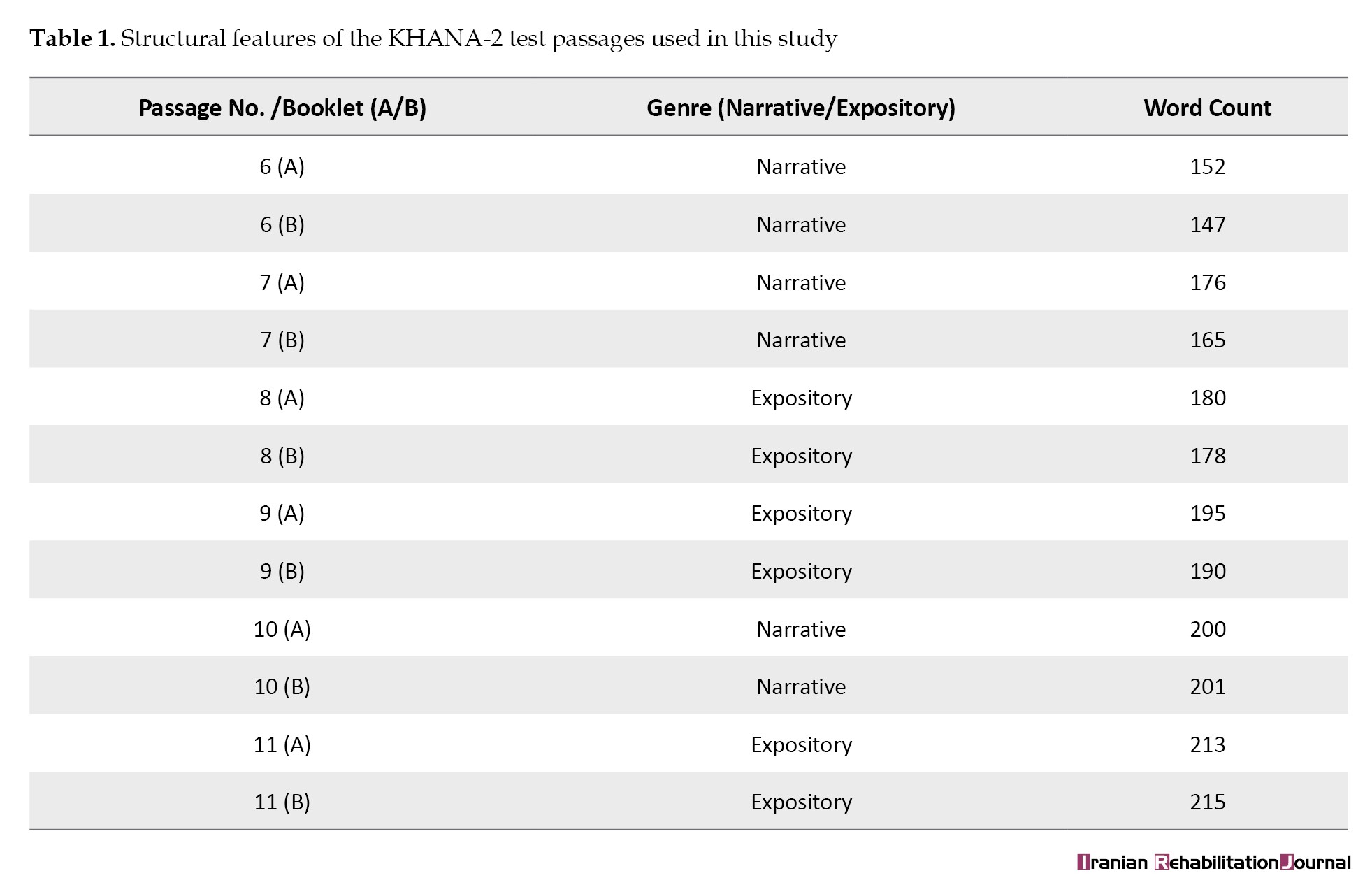
The narrative and expository passages differ in genre but are broadly comparable in length, and their difficulty increases across passage numbers in accordance with the KHANA-2 design. The test was administered individually, following instructions and continued until the participant reached the ceiling score. In this study, passages from the KHANA-2 test were used as the criterion for measuring reading rate, accuracy, and comprehension. KHANA-2 is a revised version of the KHANA test [40].
Procedure
The KHANA-2 test was individually administered in a quiet school setting. Students read each passage aloud and then answered five comprehension questions. In this study, reading rate was calculated as the number of words read per minute, accuracy as the percentage of words read correctly, and comprehension as the percentage of correct answers to the comprehension questions. For analysis, three narrative and three expository passages were chosen from each booklet. The passages were selected with adjacent sequence numbers to maintain the highest possible equivalence in difficulty level.
Data analysis
To examine the effects of text genre and grade level on reading performance, linear mixed models (LMM) were employed. This method was selected due to the repeated-measures structure of the data (each participant reading multiple passages) and the dataset’s unbalanced nature. The LMM allows for the simultaneous consideration of fixed effects (grade level and text genre) and random effects (participant ID). Compared to traditional methods, such as analysis of variance, this method provides greater flexibility to handle within-subject correlations, unbalanced designs, and missing data. Furthermore, LMMs allow for the inclusion of covariates, such as text length, which enhances the precision and interpretability of the estimated main effects [41, 42].
In these analyses, three dependent variables were considered: Reading rate, accuracy, and comprehension. Each outcome Y_ij (student i, passage j) was modeled using the Equation 1:
1. Yij=β0+β1 Gradei+β2 Bookletj+β3 Genrej+β4 (Gradei×Genrej)+β5(Bookletj×Genrej)+β6 WordCountj+β7 PassageNumberj+u0i+εij
Fixed effects included grade (five levels), genre (narrative vs expository), Booklet (two parallel passage forms), the interactions Grade×Genre and Booklet×Genre, and two covariates: WordCount (number of words in the passage) and PassageNumber (the sequential identifier of each passage). A random intercept was specified for each student to account for between-student variability and the repeated-measures structure of the data. Random effects were estimated using a variance-components covariance structure, meaning that only the variance of the random intercept was estimated, without random slopes.
o model within-student correlations among passages, Passage number was also specified as a repeated factor, and the residuals were modeled using a first-order autoregressive (1) covariance structure. All models were estimated using restricted maximum likelihood (REML) with Satterthwaite’s approximation for denominator degrees of freedom. For each fixed effect, we report Type III F-tests, P, and partial eta squared (η²p) as an effect size index. Model fit indices (–2 log likelihood, AIC, BIC) are provided for all models. Pairwise comparisons were adjusted using Sidak correction. Normality assumptions were conducted using Q–Q plots, detrended Q–Q plots, residual-versus-fitted plots, and histograms of standardized residuals. Missing data were accommodated by REML estimation, which uses all available observations under the missing-at-random assumption; no imputation was required.
The analysis tested the main effects of text genre and grade level, as well as their interaction, on the three dependent variables. All statistical analyses were performed using SPSS software, version 27, with the significance level set at 0.05.
Results
Model fit indices
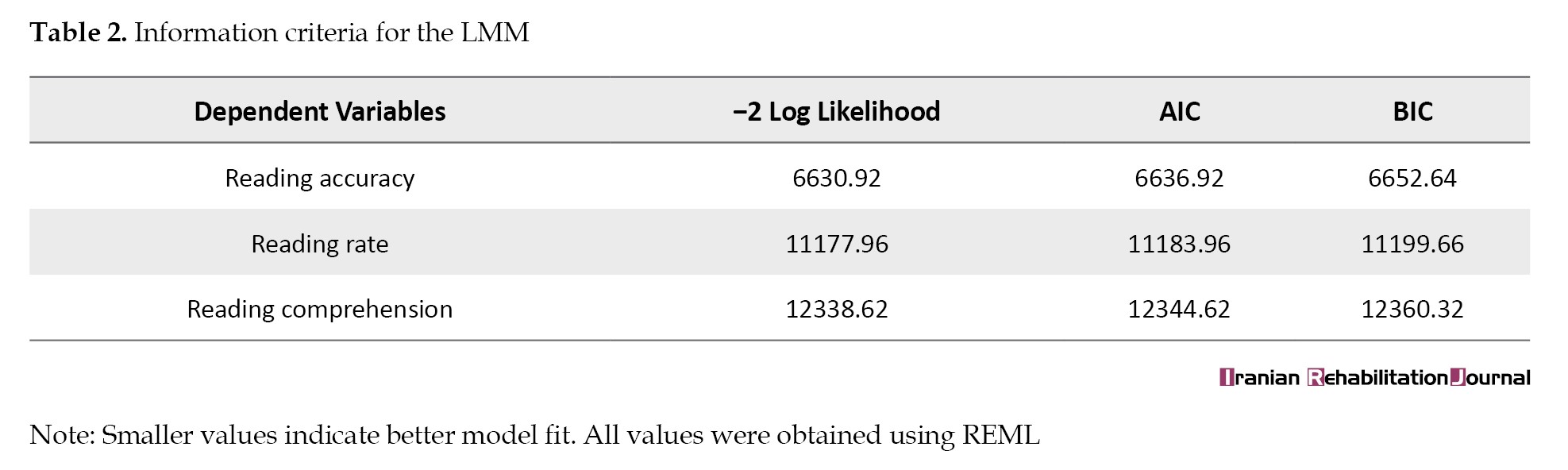
LMMs were used to examine the effects of grade and text genre on reading accuracy, comprehension, and rate. The information criteria (−2LL, AIC, BIC) indicated stable and adequate model estimation across all three outcomes. Because no alternative model specifications were compared, these indices are reported descriptively rather than used for model selection (Table 2).
Diagnostic plots (Q–Q plots, detrended Q–Q plots, histogram of residuals, and residual-versus-fitted plots) indicated no major violations of model assumptions. Accuracy and rate models demonstrated approximately normal residual distributions with homogeneous variance. The comprehension model showed mild deviations from normality in the tails, which are expected for bounded percentage scores and are not considered problematic for linear mixed-effects modeling. No influential outliers were detected.
Descriptive statistics
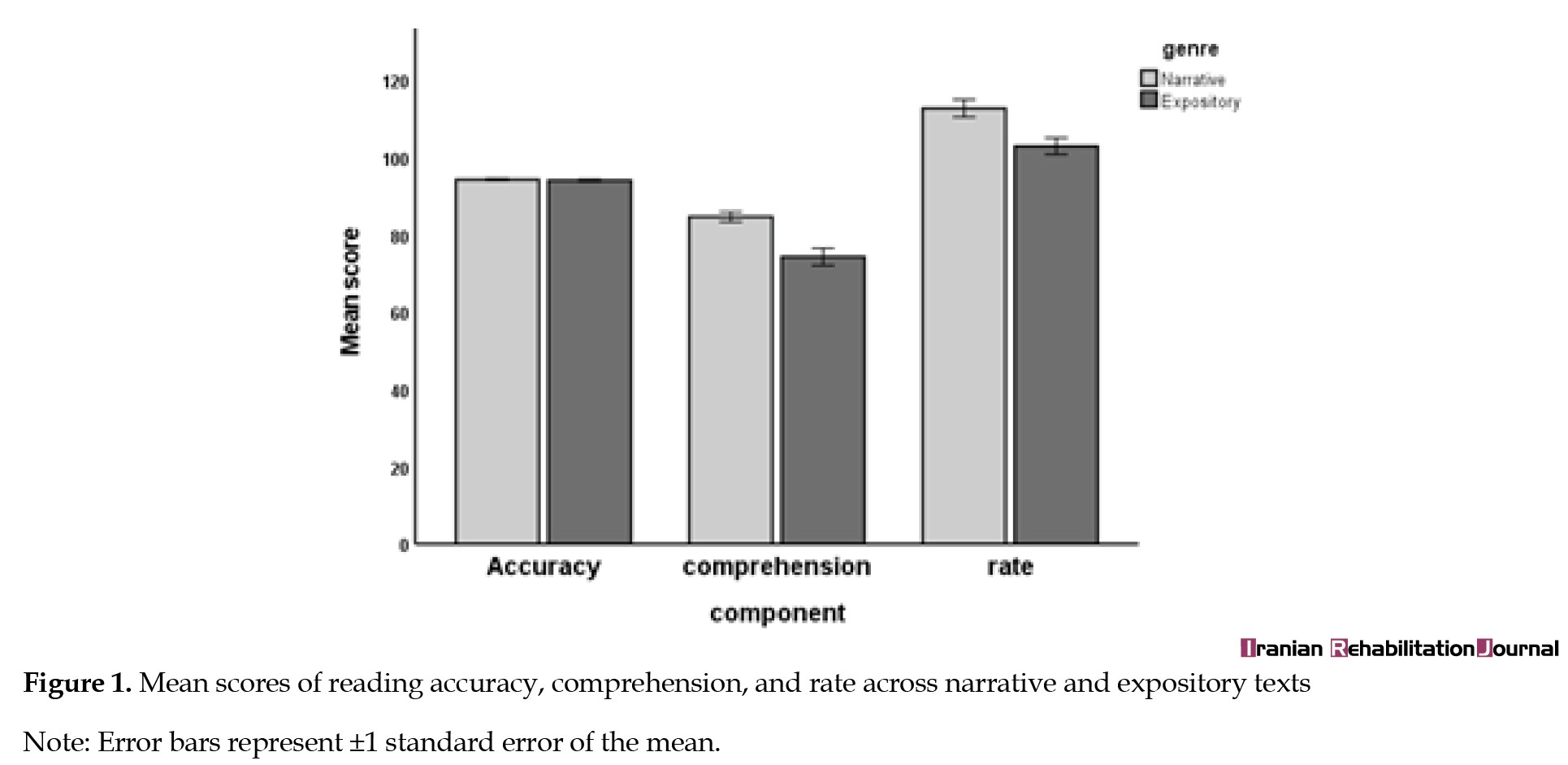
Figure 1 shows descriptive statistics for students’ reading performance across narrative and expository texts.
Reading plays a fundamental role in learning, everyday life, and participation in society [1, 2]. In school settings, much of students’ learning depends on their ability to read fluently and understand complex texts, and beyond the classroom, strong reading skills are closely linked to academic and future career success [3-5]. Beyond its educational importance, reading fluency and comprehension are also core components of clinical and neuropsychological assessments. These skills reflect underlying cognitive–linguistic processes, including phonological processing, attention, working memory, and executive functioning [6-9], that are frequently evaluated in the diagnosis of learning disorder, language disorders, and other neurodevelopmental conditions [10, 11]. Therefore, variations in reading performance can provide clinically relevant information about children’s cognitive profiles.
Among the various factors influencing reading performance, text genre plays a critical role. Educational texts are typically categorized into two major genres: Narrative and expository genres [12]. Narrative texts describe experiences and events related to characters, usually follow a relatively chronological sequence and predictable plot, and incorporate general vocabulary [12-15]. In contrast, explanatory texts are designed to convey knowledge and provide information associated with a particular topic [12, 13, 15, 16], use more complex, specialized vocabulary and academic terms [15, 17], do not necessarily follow a coherent temporal structure, and rely on more complex logical relationships to convey meaning [18]. These differences in the structure, content, and purpose of each genre can substantially influence how readers process the text and construct meaning [15].
Because narrative and expository texts differ in cognitive load, inferencing demands, and linguistic complexity, genre effects can reveal subtle patterns of cognitive–linguistic vulnerability. Children with attentional difficulties, weak working memory, or decoding inefficiency often show disproportionate challenges when processing expository texts. Therefore, examining performance across different text genres provides valuable information not only for educational instruction but also for reading assessment, early identification of difficulties, and the design of targeted rehabilitation interventions aimed at improving reading fluency and comprehension.
Because students are constantly exposed to both narrative and expository texts throughout formal education, proficiency in both genres is essential for effective learning and deeper comprehension [3, 19-21]. A large part of academic success and even future professional success relies on processing and comprehending expository texts [3, 22, 23]. Expository texts make up a substantial amount of the content of literature, science, social studies, and other educational subjects in the higher grades.
As students progress through school, they are increasingly exposed to expository texts [24, 25]. Beyond the classroom, expository texts also dominate adult daily life and professional settings, including digital content such as websites [26, 27]. Therefore, it is essential to assess and foster the ability to read and comprehend expository texts from the early years of elementary school to develop proficient reading skills. This pattern aligns with reading development stages. In the initial years of schooling, reading instruction tends to emphasize foundational skills, including decoding and oral reading fluency [28]. However, beginning around fourth grade, students typically shift from “learning to read” to “reading to learn” [29]. This transitional stage, often described as the “fourth-grade slump”, is marked by a decline in reading performance for many students [2, 28, 30–32]. This stage is accompanied by increasing text complexity and greater exposure to expository materials [29]. In sum, these findings underscore the importance of considering text genre in developing reading skills. Evaluating differences in students’ performance in reading narrative and expository texts provides valuable insight into reading development throughout the elementary school years. In addition, it can provide valuable evidence for improving reading instruction methods and designing curricula and intervention and rehabilitation plans appropriate to the cognitive and linguistic characteristics of each grade. Therefore, research on the role of text genre in reading performance is essential for understanding developmental patterns of reading, improving the quality of reading instruction, and guiding the development of appropriate assessment tools and intervention methods within the educational system, ensuring that these tools and methods can accurately address students’ needs and enhance rehabilitative outcomes.
Several studies have compared students’ reading performance across narrative and expository genres. Although findings have not been entirely consistent, many studies have shown that expository texts tend to be more difficult to read and comprehend than narrative texts [2, 12, 28, 31, 33]. For example, Cain et al. (2025) report that elementary school students generally perform better on narrative than expository texts, showing higher comprehension, accuracy, and relatively faster processing for narrative passages [34]. In contrast, expository texts impose greater cognitive and linguistic demands and are associated with reduced inferential processing. Barth et al. (2014) found that the narrativity in a text was positively associated with both reading rate and accuracy, accounting for 34% of the variance in oral reading fluency [35]. However, not all studies have reported consistent finding. In a study by Cervetti et al. (2009) involving third- and fourth-grade students, no significant differences were found in reading accuracy and rate between the two genres, although correct comprehension responses and recall of key concepts were higher in expository texts [36].
Despite the importance of considering text genre in curriculum design and clinical goals, patterns of variation in reading skills across different text genres have not been clearly documented in Persian. Most of the available evidence comes from studies involving adult populations or second-language learners, rather than elementary school students [37, 38]. The limitation of research in this field has led to educational decisions, such as determining the appropriate balance of genres in textbooks, teaching genre-specific reading strategies, and developing assessment tools tailored to each genre, being made without a solid empirical foundation in the Persian-language context. This is particularly important in clinical contexts where reading performance is used to inform diagnostic evaluations and intervention planning. Therefore, examining the effect of text genre on reading components among Persian-speaking elementary school students seems essential.
On this basis, the present study aimed to address the following research questions: Does text genre influence the components of reading fluency (rate and accuracy) and comprehension in elementary school students?
If text genre affects reading performance, what are the extent and pattern of its impact on each of the three components?
Does the effect of text genre on reading performance vary across different grade levels?
Materials and Methods
Participants
This study employed a cross-sectional, descriptive–analytical design. The sample consisted of 260 Persian-speaking students (124 girls and 136 boys) without identified reading disorders from second to sixth grades, selected using a multistage cluster random sampling method from public elementary schools in Tehran. The distribution of participants across the five grade levels was as follows: 50 students in grade two, 52 in grade three, 51 in grade four, 52 in grade five, and 55 in grade six.
The inclusion criteria were being a native Persian speaker, enrollment in the second to sixth grades of elementary school, a nonverbal IQ score above 85, and the absence of any speech, hearing, or visual impairments, psychiatric conditions, or history of neurological disorders. Information related to the inclusion criteria was collected through a combination of sources, including students’ health records, a parent-completed demographic questionnaire, teacher interviews, and informal assessments conducted by a speech-language pathologist.
The parent-completed demographic questionnaire included items regarding developmental milestones, speech and language development, family history of speech, language, reading, or writing difficulties, previous speech-language therapy services, hearing and visual impairments, neurological and neurodevelopmental conditions, medication use, and educational history. Teacher interviews focused on students’ academic performance and any suspected reading difficulties. The speech-language pathologist conducted an informal assessment that included brief conversational interaction, observation of speech-language abilities, monitoring of oral reading performance, and qualitative analysis of reading error patterns. These sources were reviewed collectively to identify students with typical reading development and to exclude those suspected of reading disorders.
Although some Persian reading assessments have been developed and normed, no standardized instrument with established diagnostic criteria and clear interpretation guidelines for identifying reading disorders was available that aligned with the purposes of the present study.
The data used in this study were derived from a larger research project focused on reading assessment among Persian-speaking students in grades two to six in Tehran. For the present study, data obtained from the implementation of the KHANA-2 test were analyzed to examine the effects of text genre and grade level on reading rate, accuracy, and comprehension components.
Instruments
Demographic information questionnaire
A researcher-developed questionnaire (Appendix 1) was used to gather demographic data and to assess eligibility based on the study’s inclusion criteria.
Appendix 1. Demographic information questionnaire
Full Name: .....Gender:..........
Date of Birth:. Grade:
Age of School Entry: ........
Dominant Language Spoken at Home: .......
1. Did your child achieve early developmental motor milestones such as head control, sitting, and walking on time during the first 0–2 years of life?
2. Did your child achieve speech and language developmental milestones such as first words and sentence formation on time?
3. Is there any history in your family or your spouse’s family of speech, reading, or writing difficulties?
4. Have you ever visited a speech-language pathologist due to your child’s speech and language problems (e.g., articulation or sentence formation difficulties)?
5. Does your child have any hearing problems? If yes, does the child use a hearing aid?
6. Does your child have a history of recurrent ear infections? (If yes, please specify)
7. Does your child have any significant visual problems? If yes, does the child wear glasses?
8. Has your child ever experienced any of the following conditions?
Epilepsy □ Seizures □ Fainting □Severe head injury □Autism □Attention Deficit Hyperactivity Disorder (ADHD) □
(If yes, is the child currently taking any medication? Please specify)
9. Does your child have a history of taking any medication or is currently taking any medication?
10. Which of the following applies to your child? (You may check more than one option)
Is easily distracted □
Frequently requests repetition of speech □
Has difficulty hearing and understanding speech in noisy environments (e.g. bus, gym, classroom) □
11. Has your child ever had prolonged absence from school? (If yes, for what reason?)
This questionnaire included questions on personal and family information, medical history, developmental milestones (including motor, speech, and language development), and educational background. To ensure accuracy and verify participant eligibility, additional data were obtained through interviews with teachers and parents, as well as by reviewing students’ health records.
KHANA-2 test
KHANA-2 is a reliable and valid tool designed to assess three core components of reading in elementary school students: reading rate, accuracy, and comprehension [39]. The test consists of two parallel Booklets, A and B, each containing 12 passages that gradually increase in length and complexity. These passages represent both narrative and expository genres. To clarify the description of the materials used in the analyses, Table 1 summarizes the structural features of the KHANA-2 test passages employed in the present research.
The narrative and expository passages differ in genre but are broadly comparable in length, and their difficulty increases across passage numbers in accordance with the KHANA-2 design. The test was administered individually, following instructions and continued until the participant reached the ceiling score. In this study, passages from the KHANA-2 test were used as the criterion for measuring reading rate, accuracy, and comprehension. KHANA-2 is a revised version of the KHANA test [40].
Procedure
The KHANA-2 test was individually administered in a quiet school setting. Students read each passage aloud and then answered five comprehension questions. In this study, reading rate was calculated as the number of words read per minute, accuracy as the percentage of words read correctly, and comprehension as the percentage of correct answers to the comprehension questions. For analysis, three narrative and three expository passages were chosen from each booklet. The passages were selected with adjacent sequence numbers to maintain the highest possible equivalence in difficulty level.
Data analysis
To examine the effects of text genre and grade level on reading performance, linear mixed models (LMM) were employed. This method was selected due to the repeated-measures structure of the data (each participant reading multiple passages) and the dataset’s unbalanced nature. The LMM allows for the simultaneous consideration of fixed effects (grade level and text genre) and random effects (participant ID). Compared to traditional methods, such as analysis of variance, this method provides greater flexibility to handle within-subject correlations, unbalanced designs, and missing data. Furthermore, LMMs allow for the inclusion of covariates, such as text length, which enhances the precision and interpretability of the estimated main effects [41, 42].
In these analyses, three dependent variables were considered: Reading rate, accuracy, and comprehension. Each outcome Y_ij (student i, passage j) was modeled using the Equation 1:
1. Yij=β0+β1 Gradei+β2 Bookletj+β3 Genrej+β4 (Gradei×Genrej)+β5(Bookletj×Genrej)+β6 WordCountj+β7 PassageNumberj+u0i+εij
Fixed effects included grade (five levels), genre (narrative vs expository), Booklet (two parallel passage forms), the interactions Grade×Genre and Booklet×Genre, and two covariates: WordCount (number of words in the passage) and PassageNumber (the sequential identifier of each passage). A random intercept was specified for each student to account for between-student variability and the repeated-measures structure of the data. Random effects were estimated using a variance-components covariance structure, meaning that only the variance of the random intercept was estimated, without random slopes.
o model within-student correlations among passages, Passage number was also specified as a repeated factor, and the residuals were modeled using a first-order autoregressive (1) covariance structure. All models were estimated using restricted maximum likelihood (REML) with Satterthwaite’s approximation for denominator degrees of freedom. For each fixed effect, we report Type III F-tests, P, and partial eta squared (η²p) as an effect size index. Model fit indices (–2 log likelihood, AIC, BIC) are provided for all models. Pairwise comparisons were adjusted using Sidak correction. Normality assumptions were conducted using Q–Q plots, detrended Q–Q plots, residual-versus-fitted plots, and histograms of standardized residuals. Missing data were accommodated by REML estimation, which uses all available observations under the missing-at-random assumption; no imputation was required.
The analysis tested the main effects of text genre and grade level, as well as their interaction, on the three dependent variables. All statistical analyses were performed using SPSS software, version 27, with the significance level set at 0.05.
Results
Model fit indices
LMMs were used to examine the effects of grade and text genre on reading accuracy, comprehension, and rate. The information criteria (−2LL, AIC, BIC) indicated stable and adequate model estimation across all three outcomes. Because no alternative model specifications were compared, these indices are reported descriptively rather than used for model selection (Table 2).
Diagnostic plots (Q–Q plots, detrended Q–Q plots, histogram of residuals, and residual-versus-fitted plots) indicated no major violations of model assumptions. Accuracy and rate models demonstrated approximately normal residual distributions with homogeneous variance. The comprehension model showed mild deviations from normality in the tails, which are expected for bounded percentage scores and are not considered problematic for linear mixed-effects modeling. No influential outliers were detected.
Descriptive statistics
Figure 1 shows descriptive statistics for students’ reading performance across narrative and expository texts.
Descriptive statistics were calculated from the raw observed data prior to model estimation. The mean reading rate for narrative texts was 111.34±36.61 words per minute, while for expository texts it was 103.3±24.72 words per minute. The mean percentage of reading accuracy in narrative texts was 95.29±4.21 %, and in expository texts it was 94.13±3.19 %. Also, the mean percentage of reading comprehension for narrative texts was 85.96±18.05 %, whereas for expository it texts was 74.56±25.74 %.
Fixed effects tests
LMMs showed significant main effects of grade and genre on reading accuracy, comprehension, and rate (Tables 3, 4 and 5).
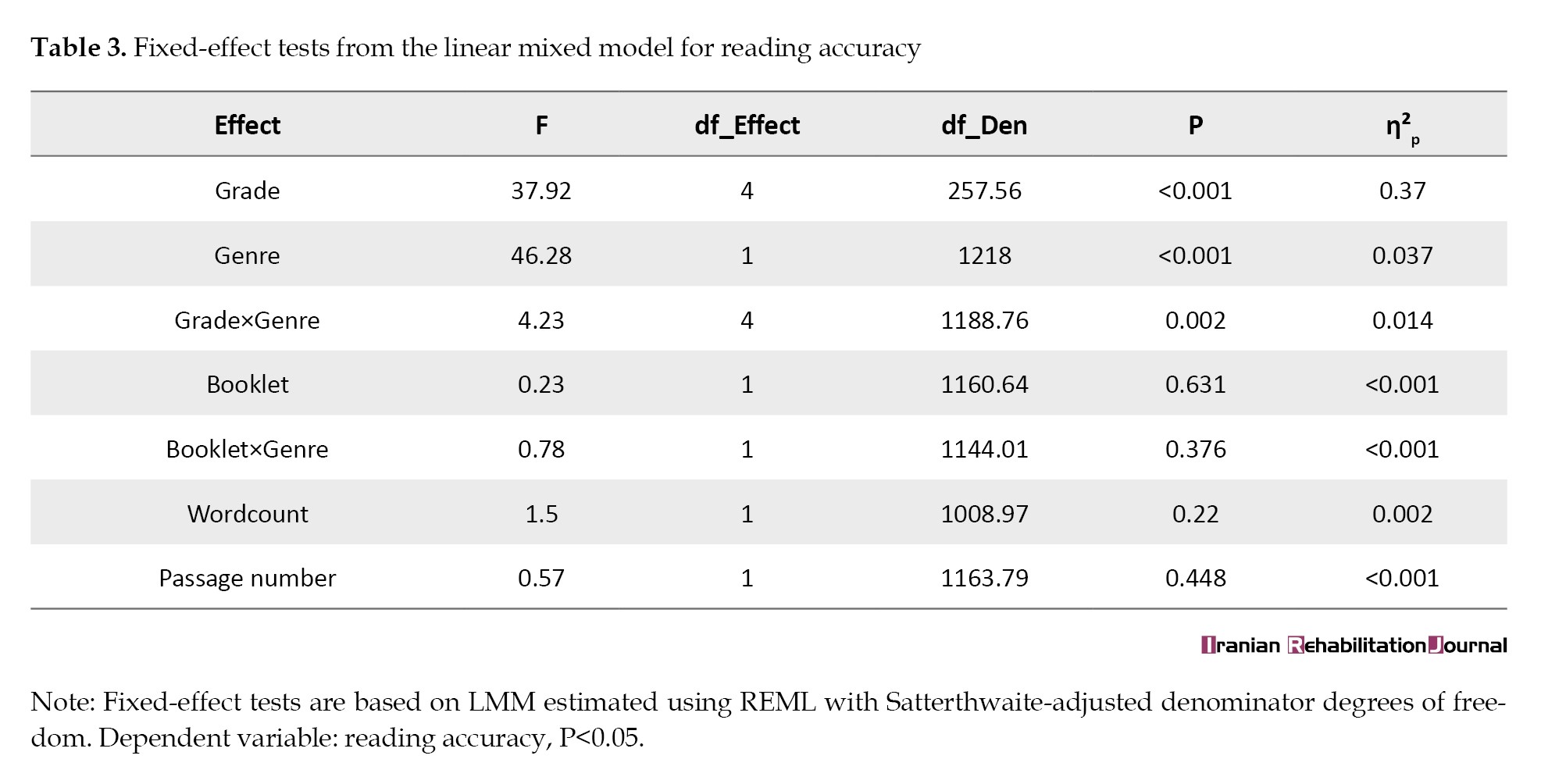
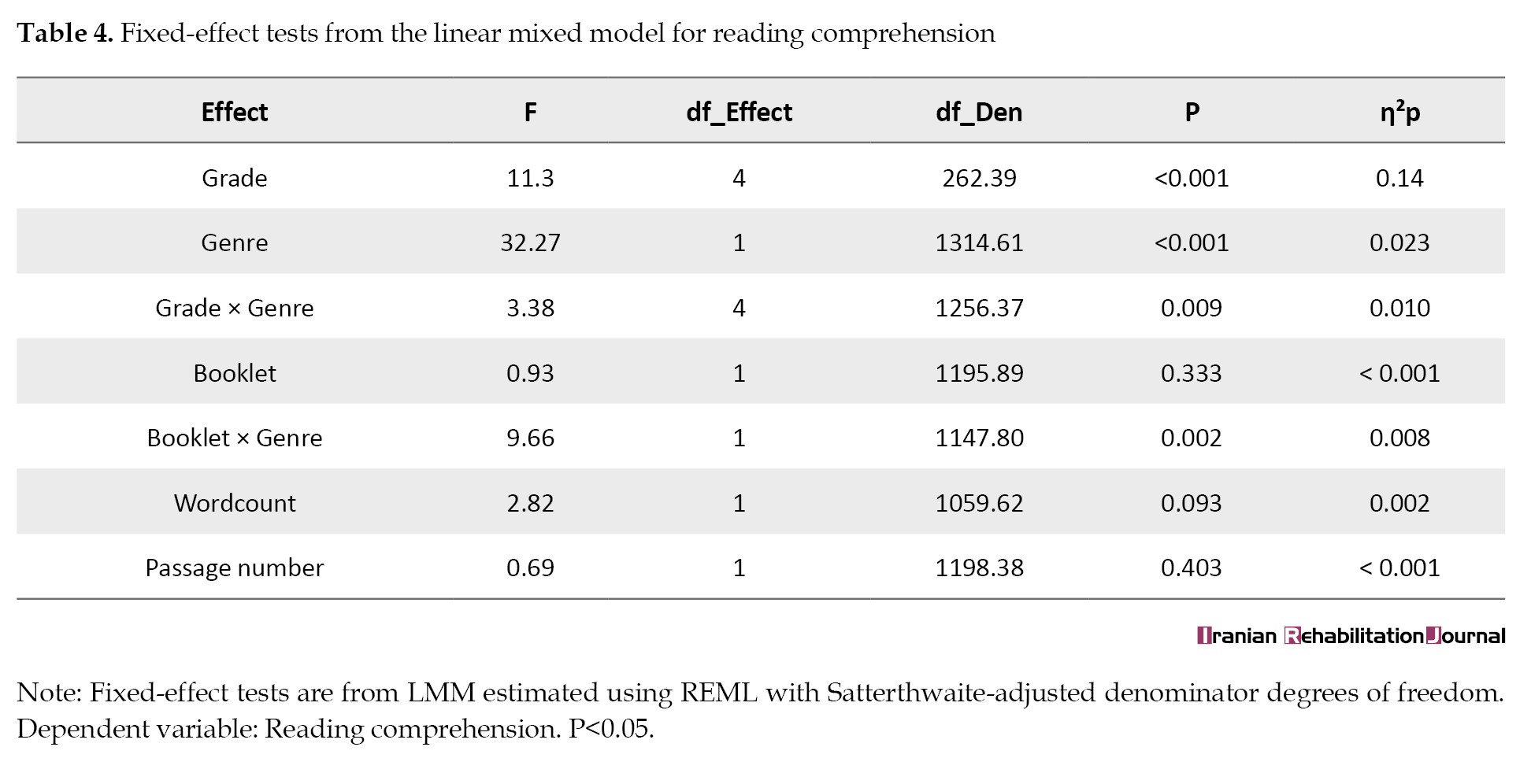
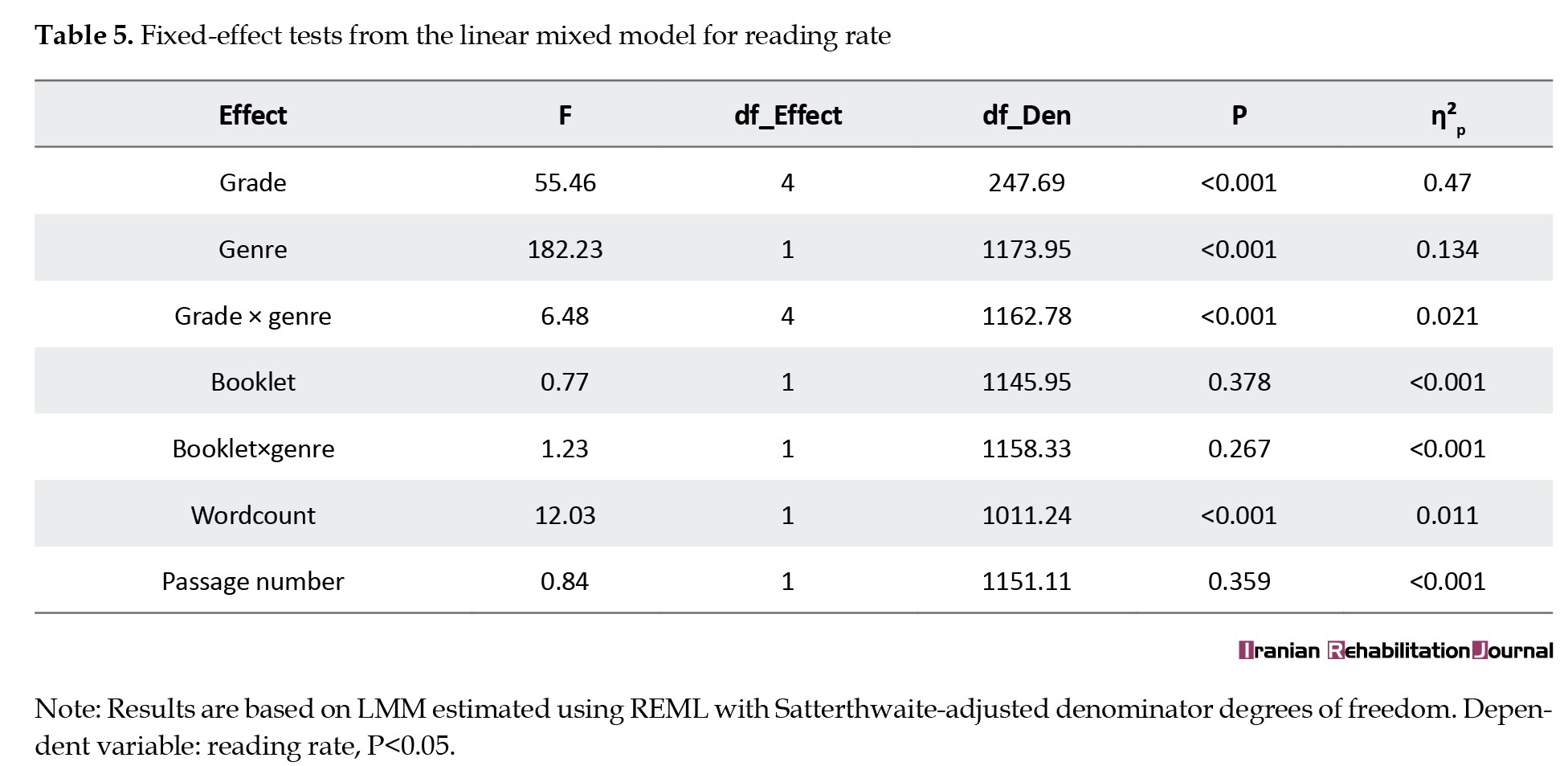
The Grade×Genre interaction was also significant across all three outcomes. In contrast, Booklet, Booklet×Genre, Wordcount, and PassageNumber did not show significant effects in most models. Tables 3, 4 and 5 presents full F-statistics, degrees of freedom, P, and partial eta-squared estimates for all fixed effects.
Partial eta squared (η²p) was computed from the F statistic using the standard formula (Equation 2):
2. η²ₚ=(F×df_effect)/(F×df_effect+df_den)
as recommended when sums of squares are not available in mixed models [43].
Main effects of genre and grade on reading performance (estimated marginal means)
LMMs indicated a significant main effect of text genre on all three reading measures: rate, accuracy, and comprehension. Students scored significantly higher on narrative texts than on expository texts (Table 6).
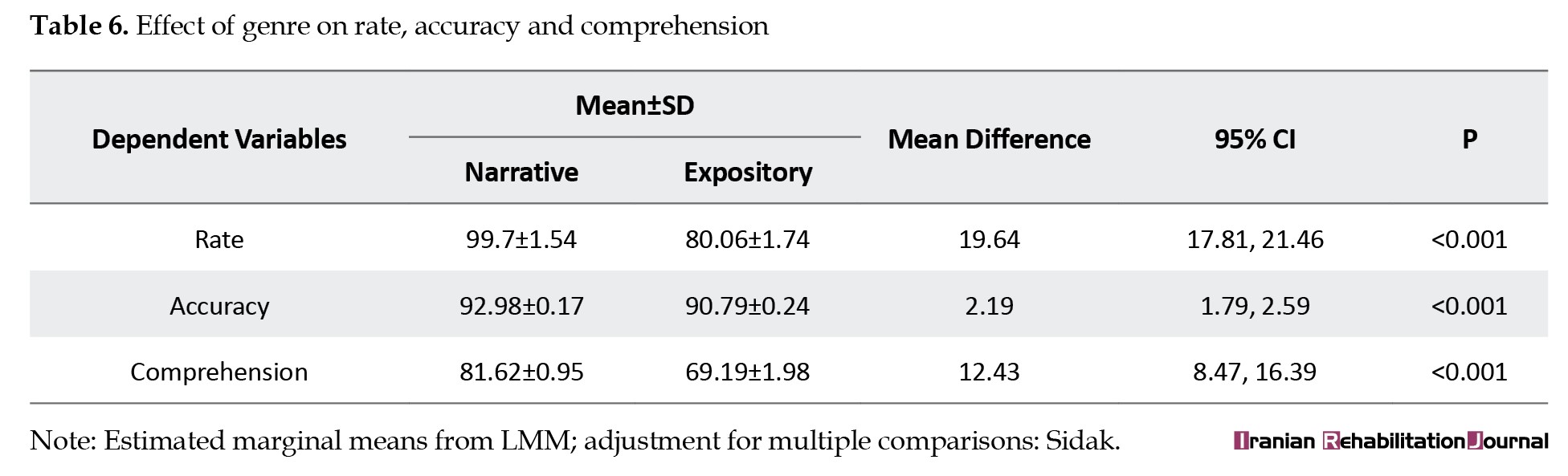
The results also showed that grade level had a significant main effect for all three components (P<0.001), indicating improved reading performance with increasing grade level.
Interaction of genre and grade level: Estimated marginal means for reading performance
In addition, the interaction between genre and grade level was significant across all components (P<0.001). Pairwise comparisons showed that at all grade levels, students performed significantly better on narrative texts than on expository texts (Table 7).
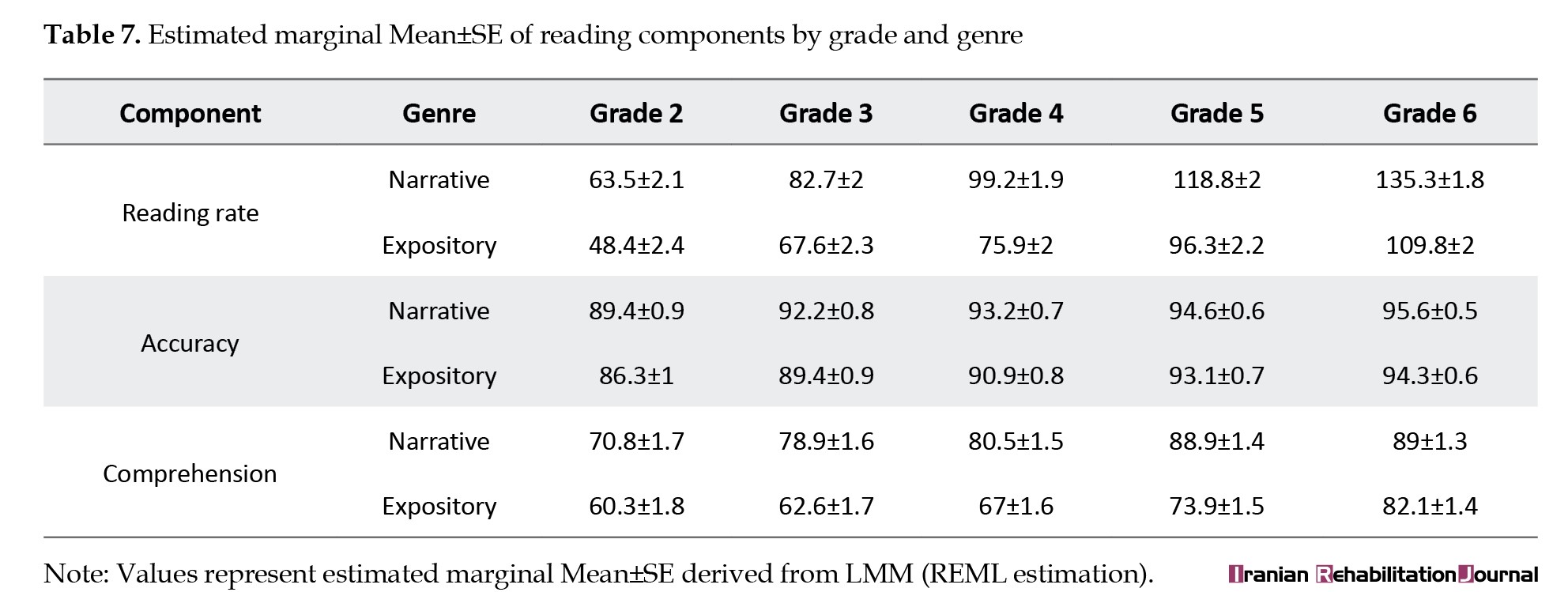
Both genre and grade effects were significant across all components (P<0.05). Narrative texts yielded higher means than expository texts at all grade levels, with overall improvement in both genres.
Discussion
This study investigated the impact of text genre on reading rate, accuracy, and comprehension in Persian-speaking elementary school students in Tehran, and further examined the interaction between genre and grade level. The findings revealed a significant main effect of text genre on all three components of reading performance. Students read narrative texts faster, with fewer mistakes, and with higher comprehension compared to expository texts. This pattern was consistent across all grade levels. Although overall reading skills improved from second to sixth grade, significant differences between narrative and expository texts persisted at every grade level. These findings align with previous research indicating that expository texts are more difficult than narrative texts [12, 28, 31, 33, 35]. In the present study, this increased difficulty was most clearly reflected in reading rate, whereas effects on accuracy and comprehension were relatively small.
Students’ better reading performance on narrative texts, compared to expository texts, can be explained by structural and content differences between these two genres. Narrative texts tend to employ more general vocabulary [15], convey familiar and everyday concepts [17], and follow a clear and predictable sequence of events [44]. These features contribute to a distinct cognitive processing pathway [2, 12, 14, 28], that facilitates better performance on these texts.
In contrast, expository texts contain less frequent, more specialized, and abstract vocabulary [18, 39], and convey a higher density of information and more complex concepts [45]. Moreover, they often incorporate a variety of text structures, such as cause–effect, problem–solution, compare–contrast, sequence, and description [46, 47]. Processing these structures requires greater integration of information, higher inferential demands, and more intensive meaning construction, particularly when readers have limited prior knowledge of the content, all of which contribute to the increased difficulty associated with expository texts [2, 12, 48]. From a cognitive perspective, these features increase working memory and processing load during reading, which can negatively affect fluency and comprehension efficiency.
Overall, these systematic differences in linguistic, structural, and cognitive processing demands between narrative and expository texts provide a coherent and theoretically grounded explanation for the observed differences in students’ reading performance across genres. Therefore, the genre effects observed in the present study are likely driven, at least in part, by differences in discourse complexity and associated cognitive processing demands rather than genre classification alone.
An interesting finding of the present study was that genre effects followed different developmental patterns across reading components. While the performance gap between narrative and expository texts increased for reading rate across grade levels, genre-related differences in reading accuracy decreased, and the comprehension gap was smaller in grade 6 than in the lower grades. These findings suggest that genre’s influence on reading performance may change as different reading skills develop.
One possible explanation for the reduced genre gap in reading accuracy is that students become increasingly familiar with the vocabulary, linguistic features, and organizational structures of expository texts as they progress through elementary school. Greater exposure to informational materials in academic settings may particularly benefit performance on expository texts, which initially pose greater challenges than narrative texts. As a result, accuracy in expository reading may improve faster than accuracy in narrative reading, leading to a gradual reduction in genre-related differences across grade levels.
A different mechanism may explain the developmental pattern observed for reading comprehension. Best et al. (2008) reported that comprehension of narrative texts was primarily associated with decoding skills, whereas readers’ prior knowledge more strongly influenced comprehension of expository texts [28]. According to the Construction–Integration model of reading comprehension [49, 50], successful comprehension requires readers to integrate information from the text with their existing knowledge to construct a coherent situation model. This process may be particularly important for expository texts, which often introduce unfamiliar concepts and require readers to connect new information with previously acquired knowledge. Best et al. (2008) further argued that most children possess well-developed schemas for the characters, events, and settings commonly found in narrative texts, whereas comprehension of expository texts relies more heavily on topic-specific knowledge [28]. Therefore, increased exposure to informational materials throughout elementary school may gradually expand students’ background knowledge and improve their ability to comprehend expository texts, contributing to the smaller genre-related gap in comprehension observed in grade 6.
At the same time, expository texts continue to impose greater processing demands than narrative texts. Previous studies have shown that expository texts typically contain denser information, more abstract concepts, more specialized vocabulary, and more complex organizational structures [17, 38, 45]. These characteristics require readers to engage in deeper analysis, integrate information across multiple propositions, and generate inferences to maintain textual coherence [51, 52].
This interpretation is consistent with Barth et al. (2014), who reported that older and more skilled readers showed greater modulation of reading rate when reading texts that were more expository, less cohesive, and more difficult [35]. Previous research has suggested that successful comprehension of expository texts requires greater engagement of higher-level cognitive processes, including planning, problem solving, organization, and integrating textual information with prior knowledge [53]. Importantly, slower reading rates in such contexts do not necessarily reflect comprehension difficulties; rather, they may indicate more strategic and effortful processing aimed at maintaining coherence and constructing a meaningful mental representation of the text. Therefore, the widening genre gap in reading rate observed in the present study may not indicate a lack of improvement in expository reading. Rather, it suggests that although reading rate improved across both genres, the greater linguistic and cognitive demands of expository texts limited the magnitude of improvement relative to narrative texts, resulting in a progressively larger gap across grade levels.
The findings suggest that the typical progression of reading development alone is insufficient to compensate for the performance gap between narrative and expository texts. This disparity remains evident through the sixth grade, indicating that students continue to face challenges when engaging with expository materials. This result aligns with evidence related to the “fourth-grade slump”, which highlights a decline in reading performance as curricular materials increasingly shift toward expository texts in upper elementary grades [2, 28, 30, 31, 33]. These findings suggest potential implications for educational and rehabilitative approaches that go beyond general reading skill development. Specifically, successful engagement with expository texts requires integrating prior knowledge and applying genre-specific reading strategies to support comprehension and learning.
From an academic and rehabilitative perspective, the findings of this study highlight the importance of increasing student’s exposure to expository texts from the early grades as a means of early intervention. Direct instruction in text reading strategies, such as identifying cause-and-effect or comparative relationships, can help improve students’ reading performance [54, 55]. Moreover, targeted instruction of difficult vocabulary prior to reading can reduce cognitive load and support more effective comprehension [55, 56]. In addition to these instructional strategies, selecting expository texts that align with students’ personal interests can enhance their motivation to read expository texts, which is a critical factor in sustained engagement with rehabilitative programs [55].
From a practical perspective, the findings of this study may guide textbook authors to include a balanced mix of narrative and expository texts in instructional materials to better prepare students for diverse academic and professional demands. Additionally, increased awareness of genre differences can help teachers and speech-language pathologists design more precise reading exercises and rehabilitative assessment tools tailored to address specific challenges with expository texts.
Limitation
This study has several limitations. Although the texts used in this research were approximately equivalent in overall difficulty level and were controlled for word count, other linguistic features, such as lexical difficulty, syntactic complexity, and content characteristics, were not fully matched across narrative and expository passages. This mismatch is inherent to the KHANA-2 test, in which passages are intentionally designed to vary in difficulty across passage numbers and grade levels rather than to be linguistically parallel across genres. To address this, passage-level characteristics (e.g. word count and passage number) were included in the mixed models. Passage Number did not emerge as a significant predictor in any analysis, indicating that differences in built-in passage difficulty did not systematically influence the observed genre effects. Therefore, although the texts were not matched on all linguistic dimensions, this variability is unlikely to have biased the study’s main findings. In addition, contextual factors such as socioeconomic status (SES) were not independently assessed. Although SES was not directly measured, the within-student comparison (Genre) and the inclusion of random intercepts in the mixed models reduce the likelihood that unmeasured SES differences biased the results. Sampling from five districts of Tehran also ensured natural variability in student background.
Finally, the research sample was limited to Persian-speaking students from public schools in Tehran; therefore, these findings should be interpreted in the context of the study sample, which consisted of Persian-speaking students from public schools in Tehran, and the generalization of the findings to other linguistic, cultural, or educational contexts should be done with caution. Although text genre showed a statistically significant effect on all reading components, the magnitude of this effect varied across outcomes. Specifically, the effect was more substantial for reading rate, whereas it was small for reading accuracy and comprehension. This suggests that genre influences reading performance in a consistent but limited manner for accuracy and comprehension, and should not be interpreted as a major determinant of individual differences in these components.
Implications for future research
Future research should examine whether genre-related differences in reading performance vary across regions, school systems, and socioeconomic contexts. In addition, studies that employ linguistically matched narrative and expository passages, or that incorporate detailed linguistic analyses of passage features, would help clarify the extent to which specific text characteristics contribute to genre effects.
Conclusion
This study demonstrated that text genre significantly influences reading performance in Persian-speaking elementary school students. Across grades two to six, students consistently performed better on narrative texts than on expository texts in terms of reading rate, accuracy, and comprehension, and these differences remained evident across all grade levels.
The findings highlight the challenges posed by expository texts and suggest that, without targeted educational interventions focused on rehabilitation, the performance gap between genres is likely to persist throughout the elementary years. These results underscore the need for curriculum design and therapeutic programs that prioritize explicit instruction in text-reading strategies, vocabulary development, and consistent exposure to expository texts. Such efforts are essential to adequately prepare students for the increased demands of academic reading in upper grades and beyond, serving as a foundation for reading rehabilitation.
Overall, these findings emphasize the importance of considering text genre in both reading instruction and assessment and highlight the need for providing students with systematic exposure to expository texts and explicit instruction in genre-specific reading strategies.
Ethical Considerations
Compliance with ethical guidelines
This study was approved by the Ethics Committee of University of Social Welfare and Rehabilitation Sciences, Tehran, Iran (Code: IR.USWR.REC.1402.253). The data collection procedure was accomplished in accordance with the guidelines of the Declaration of Helsinki for the protection of human research subjects. Written informed consent was obtained from parents of all participants.
Funding
This research did not receive any grant from funding agencies in the public, commercial, or non-profit sectors.
Authors' contributions
Methodology and formal analysis: Zeinab Barati, Pegah Kharazi Baheri, and Mohsen Vahedi; Investigation and data collection: Zeinab Barati and Pegah Kharazi Baheri; Writing the original draft: Zeinab Barati, Pegah Kharazi Baheri, Atieh Ashtari, and Talieh Zarifian; Review and editing: Atieh Ashtari and Talieh Zarifian; Visualization: Zeinab Barati and Pegah Kharazi Baheri; Supervision and project administration: Atieh Ashtari and Talieh Zarifian; Conceptualization and final approval: All authors.
Conflict of interest
The authors declared no conflict of interest.
Acknowledgments
The authors sincerely appreciate the cooperation of the Tehran Department of Education, as well as the participation of the students, families, and teachers who made this study possible.
Fixed effects tests
LMMs showed significant main effects of grade and genre on reading accuracy, comprehension, and rate (Tables 3, 4 and 5).
The Grade×Genre interaction was also significant across all three outcomes. In contrast, Booklet, Booklet×Genre, Wordcount, and PassageNumber did not show significant effects in most models. Tables 3, 4 and 5 presents full F-statistics, degrees of freedom, P, and partial eta-squared estimates for all fixed effects.
Partial eta squared (η²p) was computed from the F statistic using the standard formula (Equation 2):
2. η²ₚ=(F×df_effect)/(F×df_effect+df_den)
as recommended when sums of squares are not available in mixed models [43].
Main effects of genre and grade on reading performance (estimated marginal means)
LMMs indicated a significant main effect of text genre on all three reading measures: rate, accuracy, and comprehension. Students scored significantly higher on narrative texts than on expository texts (Table 6).
The results also showed that grade level had a significant main effect for all three components (P<0.001), indicating improved reading performance with increasing grade level.
Interaction of genre and grade level: Estimated marginal means for reading performance
In addition, the interaction between genre and grade level was significant across all components (P<0.001). Pairwise comparisons showed that at all grade levels, students performed significantly better on narrative texts than on expository texts (Table 7).
Both genre and grade effects were significant across all components (P<0.05). Narrative texts yielded higher means than expository texts at all grade levels, with overall improvement in both genres.
Discussion
This study investigated the impact of text genre on reading rate, accuracy, and comprehension in Persian-speaking elementary school students in Tehran, and further examined the interaction between genre and grade level. The findings revealed a significant main effect of text genre on all three components of reading performance. Students read narrative texts faster, with fewer mistakes, and with higher comprehension compared to expository texts. This pattern was consistent across all grade levels. Although overall reading skills improved from second to sixth grade, significant differences between narrative and expository texts persisted at every grade level. These findings align with previous research indicating that expository texts are more difficult than narrative texts [12, 28, 31, 33, 35]. In the present study, this increased difficulty was most clearly reflected in reading rate, whereas effects on accuracy and comprehension were relatively small.
Students’ better reading performance on narrative texts, compared to expository texts, can be explained by structural and content differences between these two genres. Narrative texts tend to employ more general vocabulary [15], convey familiar and everyday concepts [17], and follow a clear and predictable sequence of events [44]. These features contribute to a distinct cognitive processing pathway [2, 12, 14, 28], that facilitates better performance on these texts.
In contrast, expository texts contain less frequent, more specialized, and abstract vocabulary [18, 39], and convey a higher density of information and more complex concepts [45]. Moreover, they often incorporate a variety of text structures, such as cause–effect, problem–solution, compare–contrast, sequence, and description [46, 47]. Processing these structures requires greater integration of information, higher inferential demands, and more intensive meaning construction, particularly when readers have limited prior knowledge of the content, all of which contribute to the increased difficulty associated with expository texts [2, 12, 48]. From a cognitive perspective, these features increase working memory and processing load during reading, which can negatively affect fluency and comprehension efficiency.
Overall, these systematic differences in linguistic, structural, and cognitive processing demands between narrative and expository texts provide a coherent and theoretically grounded explanation for the observed differences in students’ reading performance across genres. Therefore, the genre effects observed in the present study are likely driven, at least in part, by differences in discourse complexity and associated cognitive processing demands rather than genre classification alone.
An interesting finding of the present study was that genre effects followed different developmental patterns across reading components. While the performance gap between narrative and expository texts increased for reading rate across grade levels, genre-related differences in reading accuracy decreased, and the comprehension gap was smaller in grade 6 than in the lower grades. These findings suggest that genre’s influence on reading performance may change as different reading skills develop.
One possible explanation for the reduced genre gap in reading accuracy is that students become increasingly familiar with the vocabulary, linguistic features, and organizational structures of expository texts as they progress through elementary school. Greater exposure to informational materials in academic settings may particularly benefit performance on expository texts, which initially pose greater challenges than narrative texts. As a result, accuracy in expository reading may improve faster than accuracy in narrative reading, leading to a gradual reduction in genre-related differences across grade levels.
A different mechanism may explain the developmental pattern observed for reading comprehension. Best et al. (2008) reported that comprehension of narrative texts was primarily associated with decoding skills, whereas readers’ prior knowledge more strongly influenced comprehension of expository texts [28]. According to the Construction–Integration model of reading comprehension [49, 50], successful comprehension requires readers to integrate information from the text with their existing knowledge to construct a coherent situation model. This process may be particularly important for expository texts, which often introduce unfamiliar concepts and require readers to connect new information with previously acquired knowledge. Best et al. (2008) further argued that most children possess well-developed schemas for the characters, events, and settings commonly found in narrative texts, whereas comprehension of expository texts relies more heavily on topic-specific knowledge [28]. Therefore, increased exposure to informational materials throughout elementary school may gradually expand students’ background knowledge and improve their ability to comprehend expository texts, contributing to the smaller genre-related gap in comprehension observed in grade 6.
At the same time, expository texts continue to impose greater processing demands than narrative texts. Previous studies have shown that expository texts typically contain denser information, more abstract concepts, more specialized vocabulary, and more complex organizational structures [17, 38, 45]. These characteristics require readers to engage in deeper analysis, integrate information across multiple propositions, and generate inferences to maintain textual coherence [51, 52].
This interpretation is consistent with Barth et al. (2014), who reported that older and more skilled readers showed greater modulation of reading rate when reading texts that were more expository, less cohesive, and more difficult [35]. Previous research has suggested that successful comprehension of expository texts requires greater engagement of higher-level cognitive processes, including planning, problem solving, organization, and integrating textual information with prior knowledge [53]. Importantly, slower reading rates in such contexts do not necessarily reflect comprehension difficulties; rather, they may indicate more strategic and effortful processing aimed at maintaining coherence and constructing a meaningful mental representation of the text. Therefore, the widening genre gap in reading rate observed in the present study may not indicate a lack of improvement in expository reading. Rather, it suggests that although reading rate improved across both genres, the greater linguistic and cognitive demands of expository texts limited the magnitude of improvement relative to narrative texts, resulting in a progressively larger gap across grade levels.
The findings suggest that the typical progression of reading development alone is insufficient to compensate for the performance gap between narrative and expository texts. This disparity remains evident through the sixth grade, indicating that students continue to face challenges when engaging with expository materials. This result aligns with evidence related to the “fourth-grade slump”, which highlights a decline in reading performance as curricular materials increasingly shift toward expository texts in upper elementary grades [2, 28, 30, 31, 33]. These findings suggest potential implications for educational and rehabilitative approaches that go beyond general reading skill development. Specifically, successful engagement with expository texts requires integrating prior knowledge and applying genre-specific reading strategies to support comprehension and learning.
From an academic and rehabilitative perspective, the findings of this study highlight the importance of increasing student’s exposure to expository texts from the early grades as a means of early intervention. Direct instruction in text reading strategies, such as identifying cause-and-effect or comparative relationships, can help improve students’ reading performance [54, 55]. Moreover, targeted instruction of difficult vocabulary prior to reading can reduce cognitive load and support more effective comprehension [55, 56]. In addition to these instructional strategies, selecting expository texts that align with students’ personal interests can enhance their motivation to read expository texts, which is a critical factor in sustained engagement with rehabilitative programs [55].
From a practical perspective, the findings of this study may guide textbook authors to include a balanced mix of narrative and expository texts in instructional materials to better prepare students for diverse academic and professional demands. Additionally, increased awareness of genre differences can help teachers and speech-language pathologists design more precise reading exercises and rehabilitative assessment tools tailored to address specific challenges with expository texts.
Limitation
This study has several limitations. Although the texts used in this research were approximately equivalent in overall difficulty level and were controlled for word count, other linguistic features, such as lexical difficulty, syntactic complexity, and content characteristics, were not fully matched across narrative and expository passages. This mismatch is inherent to the KHANA-2 test, in which passages are intentionally designed to vary in difficulty across passage numbers and grade levels rather than to be linguistically parallel across genres. To address this, passage-level characteristics (e.g. word count and passage number) were included in the mixed models. Passage Number did not emerge as a significant predictor in any analysis, indicating that differences in built-in passage difficulty did not systematically influence the observed genre effects. Therefore, although the texts were not matched on all linguistic dimensions, this variability is unlikely to have biased the study’s main findings. In addition, contextual factors such as socioeconomic status (SES) were not independently assessed. Although SES was not directly measured, the within-student comparison (Genre) and the inclusion of random intercepts in the mixed models reduce the likelihood that unmeasured SES differences biased the results. Sampling from five districts of Tehran also ensured natural variability in student background.
Finally, the research sample was limited to Persian-speaking students from public schools in Tehran; therefore, these findings should be interpreted in the context of the study sample, which consisted of Persian-speaking students from public schools in Tehran, and the generalization of the findings to other linguistic, cultural, or educational contexts should be done with caution. Although text genre showed a statistically significant effect on all reading components, the magnitude of this effect varied across outcomes. Specifically, the effect was more substantial for reading rate, whereas it was small for reading accuracy and comprehension. This suggests that genre influences reading performance in a consistent but limited manner for accuracy and comprehension, and should not be interpreted as a major determinant of individual differences in these components.
Implications for future research
Future research should examine whether genre-related differences in reading performance vary across regions, school systems, and socioeconomic contexts. In addition, studies that employ linguistically matched narrative and expository passages, or that incorporate detailed linguistic analyses of passage features, would help clarify the extent to which specific text characteristics contribute to genre effects.
Conclusion
This study demonstrated that text genre significantly influences reading performance in Persian-speaking elementary school students. Across grades two to six, students consistently performed better on narrative texts than on expository texts in terms of reading rate, accuracy, and comprehension, and these differences remained evident across all grade levels.
The findings highlight the challenges posed by expository texts and suggest that, without targeted educational interventions focused on rehabilitation, the performance gap between genres is likely to persist throughout the elementary years. These results underscore the need for curriculum design and therapeutic programs that prioritize explicit instruction in text-reading strategies, vocabulary development, and consistent exposure to expository texts. Such efforts are essential to adequately prepare students for the increased demands of academic reading in upper grades and beyond, serving as a foundation for reading rehabilitation.
Overall, these findings emphasize the importance of considering text genre in both reading instruction and assessment and highlight the need for providing students with systematic exposure to expository texts and explicit instruction in genre-specific reading strategies.
Ethical Considerations
Compliance with ethical guidelines
This study was approved by the Ethics Committee of University of Social Welfare and Rehabilitation Sciences, Tehran, Iran (Code: IR.USWR.REC.1402.253). The data collection procedure was accomplished in accordance with the guidelines of the Declaration of Helsinki for the protection of human research subjects. Written informed consent was obtained from parents of all participants.
Funding
This research did not receive any grant from funding agencies in the public, commercial, or non-profit sectors.
Authors' contributions
Methodology and formal analysis: Zeinab Barati, Pegah Kharazi Baheri, and Mohsen Vahedi; Investigation and data collection: Zeinab Barati and Pegah Kharazi Baheri; Writing the original draft: Zeinab Barati, Pegah Kharazi Baheri, Atieh Ashtari, and Talieh Zarifian; Review and editing: Atieh Ashtari and Talieh Zarifian; Visualization: Zeinab Barati and Pegah Kharazi Baheri; Supervision and project administration: Atieh Ashtari and Talieh Zarifian; Conceptualization and final approval: All authors.
Conflict of interest
The authors declared no conflict of interest.
Acknowledgments
The authors sincerely appreciate the cooperation of the Tehran Department of Education, as well as the participation of the students, families, and teachers who made this study possible.
References
- Colenbrander D, Ricketts J, Breadmore HL. Early identification of dyslexia: Understanding the issues. Language, Speech, and Hearing Services in Schools. 2018; 49(4):817-28. [DOI:10.1044/2018_LSHSS-DYSLC-18-0007] [PMID]
- Kraal A, Koornneef AW, Saab N, van den Broek PW. Processing of expository and narrative texts by low- and high-comprehending children. Reading and Writing. 2018; 31(9):2017-40. [DOI:10.1007/s11145-017-9789-2] [PMID] [PMCID]
- Paige D, Theresa ML, Timothy R, Willam R. Fluency differences by text genre in proficient and struggling secondary students. Advances in Literary Study. 2015; 3(4):102-17. [DOI:10.4236/als.2015.34016]
- Slavin RE, Lake C, Chambers B, Cheung A, Davis S. Effective reading programs for the elementary grades: A best-evidence synthesis. Review of Educational Research. 2009; 79(4):1391-466. [DOI:10.3102/0034654309341374]
- Mihret G, Joshi J. The relationship between students’ reading skill and academic achievement: A comprehensive investigation. International Journal of Research Publication and Reviews. 2025; 6(2):2171-81. [DOI:10.55248/gengpi.6.0225.0913]
- Ghelani K, Sidhu R, Jain U, Tannock R. Reading comprehension and reading related abilities in adolescents with reading disabilities and attention-deficit/hyperactivity disorder. Dyslexia. 2004; 10(4):364-84. [DOI:10.1002/dys.285] [PMID]
- Cutting LE, Scarborough HS. Prediction of reading comprehension: Relative contributions of word recognition, language proficiency, and other cognitive skills can depend on how comprehension is measured. Scientific Studies of Reading. 2006; 10(3):277-99. [DOI:10.1207/s1532799xssr1003_5]
- Just MA, Carpenter PA. A capacity theory of comprehension: Individual differences in working memory. Psychological Review. 1992; 99(1):122. [DOI:10.1037/0033-295X.99.1.122] [PMID]
- Bauer JR, Booth AE. Exploring potential cognitive foundations of scientific literacy in preschoolers: Causal reasoning and executive function. Early Childhood Research Quarterly. 2019; 46:275-84. [DOI:10.1016/j.ecresq.2018.09.007]
- Semrud-Clikeman M, Fiorello CA, Hale JB. School neuropsychology: A practitioner's handbook. New York: Guilford Publications; 2025. [Link]
- Pennington BF. Diagnosing learning disorders: A neuropsychological framework. New York: Guilford Press; 2008. [Link]
- Mar RA, Li J, Nguyen AT, Ta CP. Memory and comprehension of narrative versus expository texts: A meta-analysis. Psychonomic Bulletin & Review. 2021; 28(3):732-49. [DOI:10.3758/s13423-020-01853-1] [PMID] [PMCID]
- Schumm, JS. Reading assessment and instruction for all learners. New York: Guilford Press; 2006. [Link]
- Berman RA, Nir-Sagiv B. Comparing narrative and expository text construction across adolescence: A developmental paradox. Discourse Processes. 2007; 43(2):79-120. [DOI:10.1080/01638530709336894]
- Nguyen TQ. Impact of processing various textual genres on the incidental acquisition and retention of L2 vocabulary. English Teaching. 2023; 78(2):139-64. [DOI:10.15858/engtea.78.2.202306.139]
- Weaver III CA, Kintsch W. Expository text. In: Barr R, Kamil ML, Mosenthal PB, Pearson PD, editors. Handbook of reading research. Mahwah: Lawrence Erlbaum Associates; 1991. [Link]
- Gardner D. Vocabulary input through extensive reading: A comparison of words found in children's narrative and expository reading materials. Applied Linguistics. 2004; 25(1):1-37. [DOI:10.1093/applin/25.1.1]
- Graesser AC, Goodman SM. Implicit knowledge, question answering, and the representation of expository text. InUnderstanding expository text. Oxfordshire: Routledge; 1985. [DOI:10.4324/9781315099958-5]
- Makhoul B, Copti-Mshael T. Reading comprehension as a function of text genre and presentation environment: Comprehension of narrative and informational texts in a computer-assisted environment vs. print. Psychology. 2015; 6(8):1001-12. [DOI:10.4236/psych.2015.68097]
- Calimutan GI, Barcelona KE. Media literacy, student reading engagement, and text genre exposure: Determinants of evaluative reading comprehension among grade 9 students. International Journal of Sustainability and Advanced Integrated Research. 2026; 2(2):553-66. [DOI:10.65339/ijsair.V2.I2.222]
- Andreani S, Muniroh S, Suharyadi S, Astuti UP, Yulizar Y. The contribution of genre awareness and reading habits towards students' reading comprehension. Indonesian Journal of Applied Linguistics. 2021; 11(2):463-76. [DOI:10.17509/ijal.v11i2.35260]
- de Lourdes Ojeda-Criollo GG, Cardoza-Sernaqué LS, Jiménez-Jáuregui YJ, García-Farías VA, Lachira-Prieto LI, García-Ventura CC, et al. The comprehension of expository texts in students: A systematic review study between 2017-2022. International Journal. 2023; 10(4):412-22. [DOI:10.15379/ijmst.v10i4.2057]
- Tibken C, Richter T, Wannagat W, Schmiedeler S, von der Linden N, Schneider W. Measuring comprehension monitoring with the inconsistency task in adolescents: Stability, associations with reading comprehension skills, and differences between grade levels. Discourse Processes. 2022; 59(5-6):439-61. [DOI:10.1080/0163853X.2022.2073736]
- Schutz D. The common core state standards for English language arts & literacy in history/social studies, science, and technical subjects: An analysis and an alternative. Social Studies, Science, and Technical Subjects: An analysis and an alternative. SSRN Electronic Journal. 2011; 1-9. [DOI:10.2139/ssrn.1965026]
- Moss B. Fabulous, fascinating fact books: Using informational trade books as models for kids’ writing can yield rich results. Instructor. 2004; 113(8):28-29, 65.
- Venezky RL. The origins of the present-day chasm between adult literacy needs and school literacy instruction. Scientific Studies of Reading. 2000; 4(1):19-39. [DOI:10.1207/S1532799XSSR0401_3]
- Kamil ML, Lane DM. Researching the relationship between technology and literacy: An agenda for the 21st century. In: Reinking D, McKenna MC, Labbo LD, Kieffer RD, editors. Handbook of literacy and technology: transformations in a post-typographic world. Abingdon: Routledge; 1998. [Link]
- Best R, Ozuru Y, Floyd R, McNamara D. Children's text comprehension: Effects of genre, knowledge and text cohesion. In: SA Barab, KE Hay, DT Hickey, editors. The International conference of the learning sciences. Bloomington: International Society of the Learning Sciences; 2006. [Link]
- Chall JS, Jacobs VA, Baldwin LE. The reading crisis: Why poor children fall behind. Harvard: Harvard University Press; 1990. [DOI:10.4159/9780674029354]
- Sweet AP, Snow CE, editors. Rethinking reading comprehension. New York: Guilford Press; 2003. [Link]
- Best RM, Floyd RG, McNamara DS. Differential competencies contributing to children's comprehension of narrative and expository texts. Reading psychology. 2008; 29(2):137-64. [DOI:10.1080/02702710801963951]
- Meichenbaum D, Biemiller A. Nurturing independent learners: Helping students take charge of their learning. Cambridge: Brookline Books; 1998. [Link]
- Wu Y, Barquero LA, Pickren SE, Barber AT, Cutting LE. The relationship between cognitive skills and reading comprehension of narrative and expository texts: A longitudinal study from grade 1 to grade 4. Learning and Individual Differences. 2020; 80:101848. [DOI:10.1016/j.lindif.2020.101848] [PMID] [PMCID]
- Cain K, Currie NK, Francey G, Davies R, Gray S, Bridges MS, et al. The influence of reader and text characteristics on sixth graders' inference making. Journal of Research in Reading. 2025; 48(1):24-45. [DOI:10.1111/1467-9817.12474] [PMID] [PMCID]
- Barth AE, Tolar TD, Fletcher JM, Francis D. The effects of student and text characteristics on the oral reading fluency of middle-grade students. Journal of Educational Psychology. 2014; 106(1):162-80. [DOI:10.1037/a0033826] [PMID] [PMCID]
- Cervetti GN, Bravo MA, Hiebert EH, Pearson PD, Jaynes CA. Text genre and science content: Ease of reading, comprehension, and reader preference. Reading Psychology. 2009; 30(6):487-511. [DOI:10.1080/02702710902733550]
- Behzadi A, Azimi Amoli F. The relationship between two different text types and reading comprehension strategy use of advanced EFL learners. European Online Journal of Natural and Social Sciences. 2013; 2(2s):130. [Link]
- Saadatnia M, Ketabi S, Tavakoli M. Levels of reading comprehension across text types: A comparison of literal and inferential comprehension of expository and narrative texts in Iranian EFL learners. Journal of Psycholinguistic Research. 2017; 46(5):1087-99. [DOI:10.1007/s10936-017-9481-3] [PMID]
- Kharazi-Baheri P, Barati Z, Zarifian T, Ashtari A, Vahedi M. KHANA-2: A valid and reliable tool for assessing oral reading skills in Persian-speaking elementary students. Applied Neuropsychology. Child. 2026; 1-11. [DOI:10.1080/21622965.2026.2676805] [PMID]
- Zarifian T, Ashtari A, Nilipour R, Nematzadeh S, Bayat N. Developing the KHANA test to evaluate reading skills in Persian-speaking students: A preliminary study. Iranian Rehabilitation Journal. 2023; 21(4):639-54. [DOI:10.32598/irj.21.4.1605.2]
- Willett JB, Singer JD. Applied longitudinal data analysis: Modeling change and event occurrence. New York: Oxford University Press; 2003. [DOI:10.1093/acprof:oso/9780195152968.001.0001]
- Shek DT, Ma CM. Longitudinal data analyses using linear mixed models in SPSS: Concepts, procedures and illustrations. The Scientific World Journal. 2011; 11(1):42-76. [DOI:10.1100/tsw.2011.2]
- Field A. Discovering statistics using IBM SPSS statistics. Los Angeles: Sage Publications; 2024. [Link]
- Tun PA. Age differences in processing expository and narrative text. Journal of Gerontology. 1989; 44(1):P9-15. [DOI:10.1093/geronj/44.1.P9] [PMID]
- Coté N, Goldman SR, Saul EU. Students making sense of informational text: Relations between processing and representation. Discourse Processes. 1998; 25(1):1-53. [DOI:10.1080/01638539809545019]
- Meyer BJ, Poon LW. Effects of structure strategy training and signaling on recall of text. Journal of Educational Psychology. 2001; 93(1):141. [DOI:10.1037/0022-0663.93.1.141]
- Williams JP, Nubla-Kung AM, Pollini S, Stafford KB, Garcia A, Snyder AE. Teaching cause—effect text structure through social studies content to at-risk second graders. Journal of Learning Disabilities. 2007; 40(2):111-20. [DOI:10.1177/00222194070400020201] [PMID]
- Johns, Ann M. Genre in the classroom: Multiple perspectives. Oxfordshire: Routledge; 2001. [DOI:10.4324/9781410604262]
- McNamaraKintsch W. The role of knowledge in discourse comprehension: A construction-integration model. Psychological Review. 1988; 95(2):163-82. [DOI:10.1037/0033-295X.95.2.163] [PMID]
- Kintsch W. Comprehension: A paradigm for cognition. Cambridge: Cambridge University Press; 1998. [Link]
- McNamara DS, Ozuru Y, Best R, O’Reilly T. The 4-pronged comprehension strategy framework. In: McNamara DS, editor. Reading comprehension strategies: Theories, interventions, and technologies. New York: Lawrence Erlbaum Associates; 2007. [Link]
- van den Broek P. Using texts in science education: Cognitive processes and knowledge representation. Science. 2010; 328(5977):453-6. [DOI:10.1126/science.1182594] [PMID]
- Eason SH, Goldberg LF, Young KM, Geist MC, Cutting LE. Reader-text interactions: How differential text and question types influence cognitive skills needed for reading comprehension. Journal of Educational Psychology. 2012; 104(3):515-28. [DOI:10.1037/a0027182] [PMID] [PMCID]
- Botsas G. Differences in strategy use in the reading comprehension of narrative and science texts among students with and without learning disabilities. Learning Disabilities. 2017; 15(1):139-62. [Link]
- Cruz Neri N, Bernholt S, Härtig H, Schmitz A, Retelsdorf J. Cognitive and motivational characteristics as predictors of students’ expository versus narrative text comprehension: European Journal of Psychology of Education. 2024; 39(2):885-905. [DOI:10.1007/s10212-023-00717-1]
- Pellicer-Sánchez A, Conklin K, Vilkaitė-Lozdienė L. The effect of pre-reading instruction on vocabulary learning: An investigation of L1 and L2 readers’ eye movements. Language Learning. 2021; 71(1):162-203. [DOI:10.1111/lang.12430]
Article type: Original Research Articles |
Subject:
Speech therapy
Received: 2026/04/1 | Accepted: 2026/06/28 | Published: 2026/09/26
Received: 2026/04/1 | Accepted: 2026/06/28 | Published: 2026/09/26
Send email to the article author

Copyright © The Author(s);
This is an open access article distributed under the terms of the Creative Commons Attribution-NonCommercial 4.0 (CC-By-NC 4.0), which permits use, distribution, and reproduction in any medium, provided the original work is properly cited and is not used for commercial purposes.
Contact Information
