
988368
Sat, Nov 7, 2026

Volume 24, Issue 3 (September 2026)
Iranian Rehabilitation Journal 2026, 24(3): 273-282 |
Back to browse issues page




Download citation:
BibTeX | RIS | EndNote | Medlars | ProCite | Reference Manager | RefWorks
Send citation to:


BibTeX | RIS | EndNote | Medlars | ProCite | Reference Manager | RefWorks
Send citation to:
Massah O, Rafiey H, Radfar S R, Farhoudian A. Factor Structure of the Persian Version of the Leeds Dependence Questionnaire: An Exploratory Factor Analysis. Iranian Rehabilitation Journal 2026; 24 (3) :273-282
URL: http://irj.uswr.ac.ir/article-1-2782-en.html
URL: http://irj.uswr.ac.ir/article-1-2782-en.html

1- Substance Abuse and Dependence Research Center, Social Health Research Institute, University of Social Welfare and Rehabilitation Sciences, Tehran, Iran.
2- Social Welfare Management Research Center, Social Health Research Institute, University of Social Welfare and Rehabilitation Sciences, Tehran, Iran.
3- Department of Neuroscience and Addiction, School of Advanced Technologies in Medicine (SATiM), Tehran University of Medical Sciences, Tehran, Iran.
4- Department of Psychiatry, School of Medicine, Tehran University of Medical Sciences, Tehran, Iran.
2- Social Welfare Management Research Center, Social Health Research Institute, University of Social Welfare and Rehabilitation Sciences, Tehran, Iran.
3- Department of Neuroscience and Addiction, School of Advanced Technologies in Medicine (SATiM), Tehran University of Medical Sciences, Tehran, Iran.
4- Department of Psychiatry, School of Medicine, Tehran University of Medical Sciences, Tehran, Iran.
Keywords: Leeds dependence questionnaire (LDQ), Substance use disorder, Dependence severity, Factor analysis, Psychometrics, Validation study, Iran
Full-Text [PDF 575 kb]
(144 Downloads)
| Abstract (HTML) (1394 Views)
Full-Text: (108 Views)
Introduction
Evaluating the severity of substance dependence is a central task in addiction rehabilitation and research. Rather than a binary determination of substance use, the intensity of dependence informs treatment design, prognosis, and the need for monitoring and rehabilitation planning [1]. In routine clinical settings, lengthy interviews are not always feasible, making brief patient-reported measures especially valuable. For instance, while the addiction severity index (ASI) provides a comprehensive multidimensional profile, its reliance on semi-structured clinical interviews limits feasibility in fast-paced or resource-limited settings [2]. Consequently, brief instruments that can capture the core features of dependence with acceptable psychometric precision have become increasingly important.
To address this gap, Raistrick et al. developed the Leeds dependence questionnaire (LDQ), a 10-item self-report instrument originally designed to evaluate alcohol and opiate dependence within treatment monitoring frameworks [3]. The LDQ focuses on psychological dependence rather than solely physiological withdrawal, and its items reflect key dependence phenomena such as preoccupation with use, salience, compulsion, planning around use, maximization of effect, narrowing of repertoire, and difficulty coping without the substance. Thus, the LDQ captures a common dependence syndrome intended to be applicable across psychoactive substances [3, 4].
Initial psychometric evaluations showed strong content, concurrent, and discriminant validity, together with robust internal consistency [3]. Subsequent work with a large sample of clinic attenders reinforced these findings and suggested that the LDQ primarily measures a single dependence construct rather than multiple independent dimensions [5]. This positioned the LDQ as a brief global measure of dependence severity rather than an instrument tied to a particular substance class or treatment context. A short unidimensional scale has clear practical value for screening, baseline assessment, treatment planning, and longitudinal outcome monitoring [3].
The LDQ has been examined in several additional populations. Ford reported that the instrument was useful among detained psychiatric inpatients, supporting its applicability beyond specialist addiction clinics [6]. Lennings evaluated the LDQ in adolescent and young adult contexts, suggesting broader clinical utility [7]. Kelly et al. later validated the instrument in a young adult clinical sample and found satisfactory measurement properties [8]. Together, these studies indicate that the LDQ is not restricted to one subgroup of substance users but has acceptable cross-sample robustness.
More recent psychometric studies have deepened understanding of the scale’s structure. Galecki et al. applied item response theory, Mokken analysis, and differential item functioning procedures to a large clinical sample and found that the LDQ functions largely as a unidimensional measure of psychological dependence, although some items contribute less information than others and item 7 showed substance-related differential functioning [9]. Similarly, Fairhurst et al. examined the relationship between the LDQ, psychological distress, and social satisfaction in a specialist addiction-service sample and found that LDQ items loaded strongly on a common factor, supporting the interpretation of dependence as a specific psychological construct closely linked to broader distress but still clinically meaningful in its own right [10]. Taken together, these findings suggest that the LDQ has a stable core structure, while certain item-level characteristics may vary across samples and settings.
For Persian-speaking populations, such evidence is especially important because translation alone does not guarantee cross-cultural equivalence. A Persian version of the LDQ was previously translated, back-translated, and evaluated in an Iranian sample of individuals with substance dependence [11]. This study reported acceptable criterion-related validity with the substance dependence severity scale (SDSS), acceptable construct validity with the general health questionnaire, strong internal consistency, and excellent test–retest reliability [11]. These findings established that the Persian LDQ is a reliable and valid measure. However, factorial validity was not independently examined, leaving open the question of whether the translated instrument reproduces the latent structure observed in English-language samples.
This gap matters conceptually and practically. If the Persian LDQ retains the same latent structure as the original scale, it would support the cross-cultural stability of psychological dependence as a construct and justify use of the total score as a summary index of severity. If the structure differs, one or more items may behave differently in the Iranian context and require revision or cautious interpretation. Because the LDQ is used in clinical and research settings to assess dependence severity, explicit examination of its factorial structure in Persian is necessary.
Accordingly, the present study aimed to investigate the factor structure of the Persian version of the LDQ in an Iranian clinical sample of individuals with substance use disorders. By examining the latent organization of the items, this study extends the psychometric evidence base for the Persian LDQ. It evaluates whether it reproduces the essentially unidimensional structure reported in the original instrument and subsequent international studies [3, 5, 9, 10].
Materials and Methods
Study design and participants
This study was a secondary analysis of the dataset used in the initial validation study of the Persian LDQ. This study was a sub-study of a validation research [11]. The sample consisted of 170 treatment-seeking individuals with substance use disorders who completed all 10 items on the questionnaire. Participants were recruited from addiction treatment services in Tehran City, Iran. Most participants were polysubstance users; however, opioids were the primary substance of use for the majority of the sample, followed by methamphetamine. Questionnaires with missing LDQ responses were excluded from the factor analysis.
Instrument
The LDQ is a 10-item self-report instrument designed to assess the severity of psychological dependence on psychoactive substances [3]. Each item is scored on a 4-point Likert scale from 0 to 3, yielding a total score ranging from 0 to 30, with higher scores indicating greater dependence severity. The scale was originally developed to capture core dependence features applicable across substances [3, 5]. In the previous validation study of the Persian LDQ, the instrument showed acceptable criterion-related and construct validity coefficients of 0.773 and 0.780, respectively. Its internal consistency was good (Cronbach’s α=0.809), and test–retest reliability over a two-week interval was excellent, with ICC values of 0.957 for single measures and 0.978 for average measures [11].
Statistical analysis
Descriptive statistics were calculated for each item, including Mean±SD. The correlation matrix was examined for factorability using the Kaiser–Meyer–Olkin (KMO) measure and Bartlett’s test of sphericity. Anti-image correlations and item-level measures of sampling adequacy were also inspected.
Exploratory factor analysis was conducted using IBM SPSS software, version 26. The suitability of the data for factor analysis was examined using the KMO measure of sampling adequacy (MSA) and Bartlett’s test of sphericity. Factor extraction was performed using principal axis factoring. The number of factors to retain was determined using multiple criteria, including eigenvalues greater than 1, visual inspection of the scree plot, theoretical interpretability, and parallel analysis [12].
Parallel analysis was performed in SPSS using O’Connor’s SPSS syntax to determine the number of components and factors by parallel analysis. The procedure generated 1,000 random datasets with the same number of observations and variables as the original dataset. The observed eigenvalues from the empirical data were compared with the 95th percentile of eigenvalues obtained from the randomly generated datasets. Factors were retained only when the observed eigenvalue exceeded the corresponding random eigenvalue. This approach reduced the risk of over-extracting factors based solely on Kaiser’s eigenvalue-greater-than-one criterion or subjective interpretation of the scree plot [13].
Results
Descriptive statistics
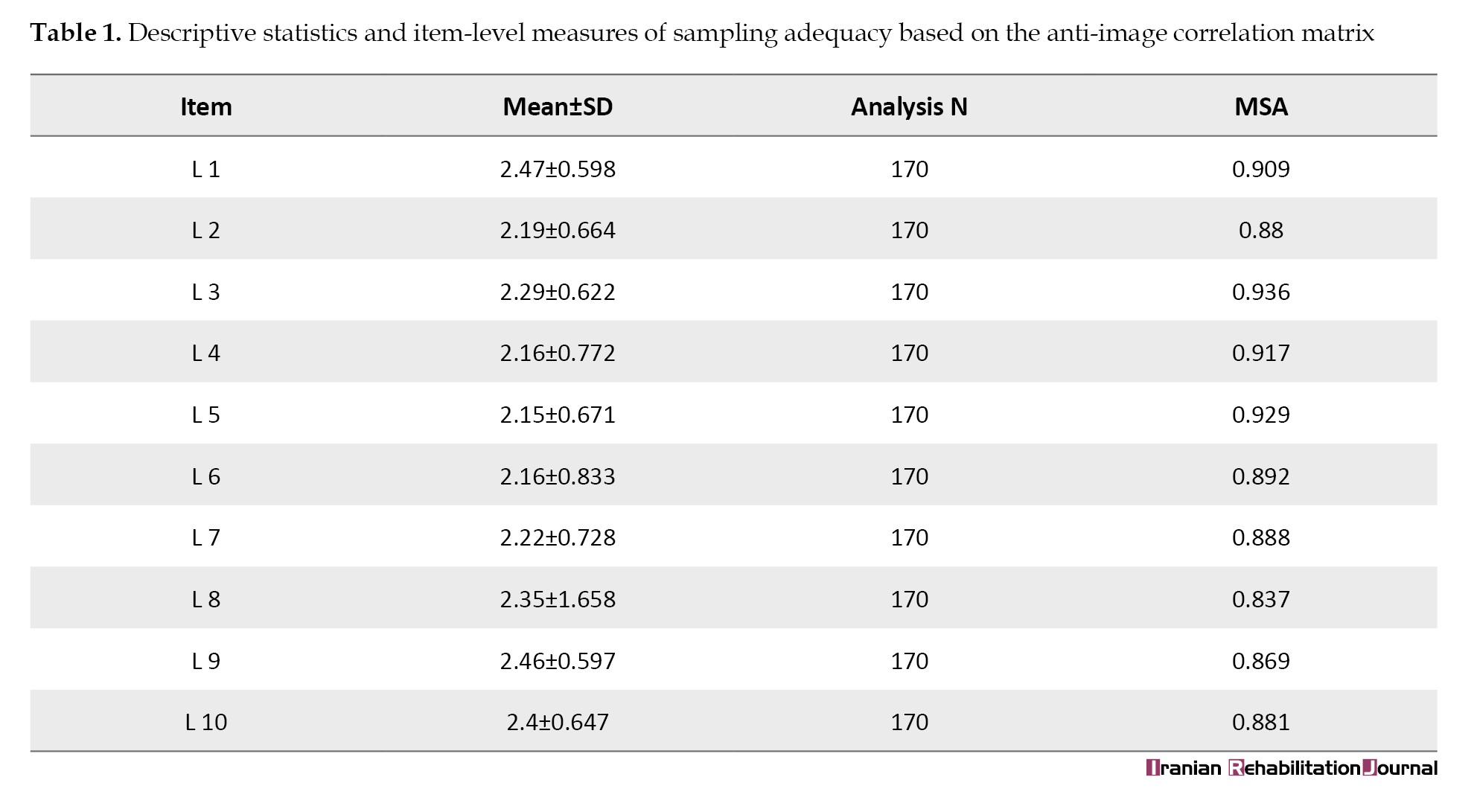
The mean item scores ranged from 2.15 to 2.47, indicating generally moderate to high dependence-related endorsement across the sample. Item 1 had the highest mean score, whereas item 5 had the lowest mean score. Item 8 showed the largest standard deviation, suggesting greater response dispersion than the other items (Table 1).
Factorability of the data
The inter-item correlation matrix indicated positive associations among all LDQ items, with most correlations falling in the small-to-moderate range. The determinant of the correlation matrix (0.025) indicated no evidence of severe multicollinearity. Item 8 showed comparatively weaker correlations with the other items, which was consistent with its lower communality and more distinctive loading pattern in the exploratory factor analysis.
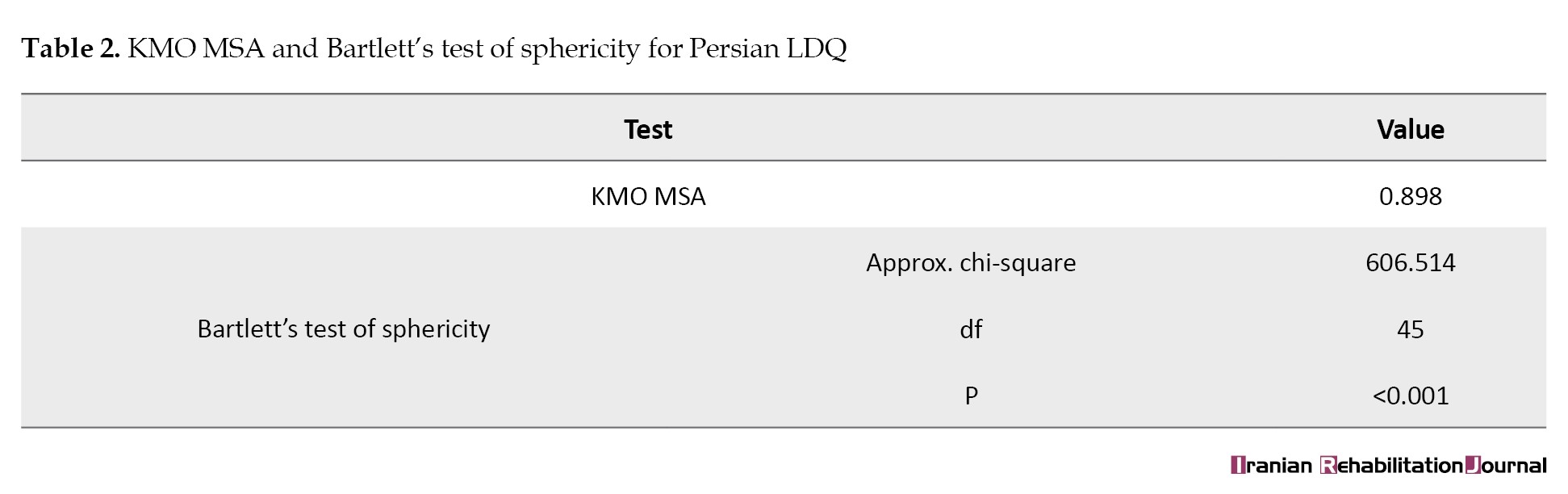
The data were suitable for factor analysis. The KMO value was 0.898, indicating excellent sampling adequacy. Bartlett’s test of sphericity was significant (χ²=606.514, df=45, P<0.001), demonstrating that the correlation matrix contained sufficient shared variance for factor extraction. All item-level measures of sampling adequacy were above the commonly accepted threshold (Table 2).
Sampling adequacy
The sample size was considered adequate for the exploratory factor analysis because the LDQ contains only 10 items and the final sample included 170 participants, corresponding to a participant-to-item ratio of 17:1. This exceeded commonly recommended minimum ratios of 5–10 participants per item for exploratory factor analysis. The diagonal values of the anti-image correlation matrix, representing item-level measures of sampling adequacy, ranged from 0.837 to 0.936. All items exceeded the recommended minimum threshold, supporting their inclusion in the exploratory factor analysis. Although item 8 showed weaker inter-item correlations and a lower communality than the other items, its individual MSA remained acceptable (MSA=0.837), and therefore it was retained in the analysis (Table 1).
Communalities
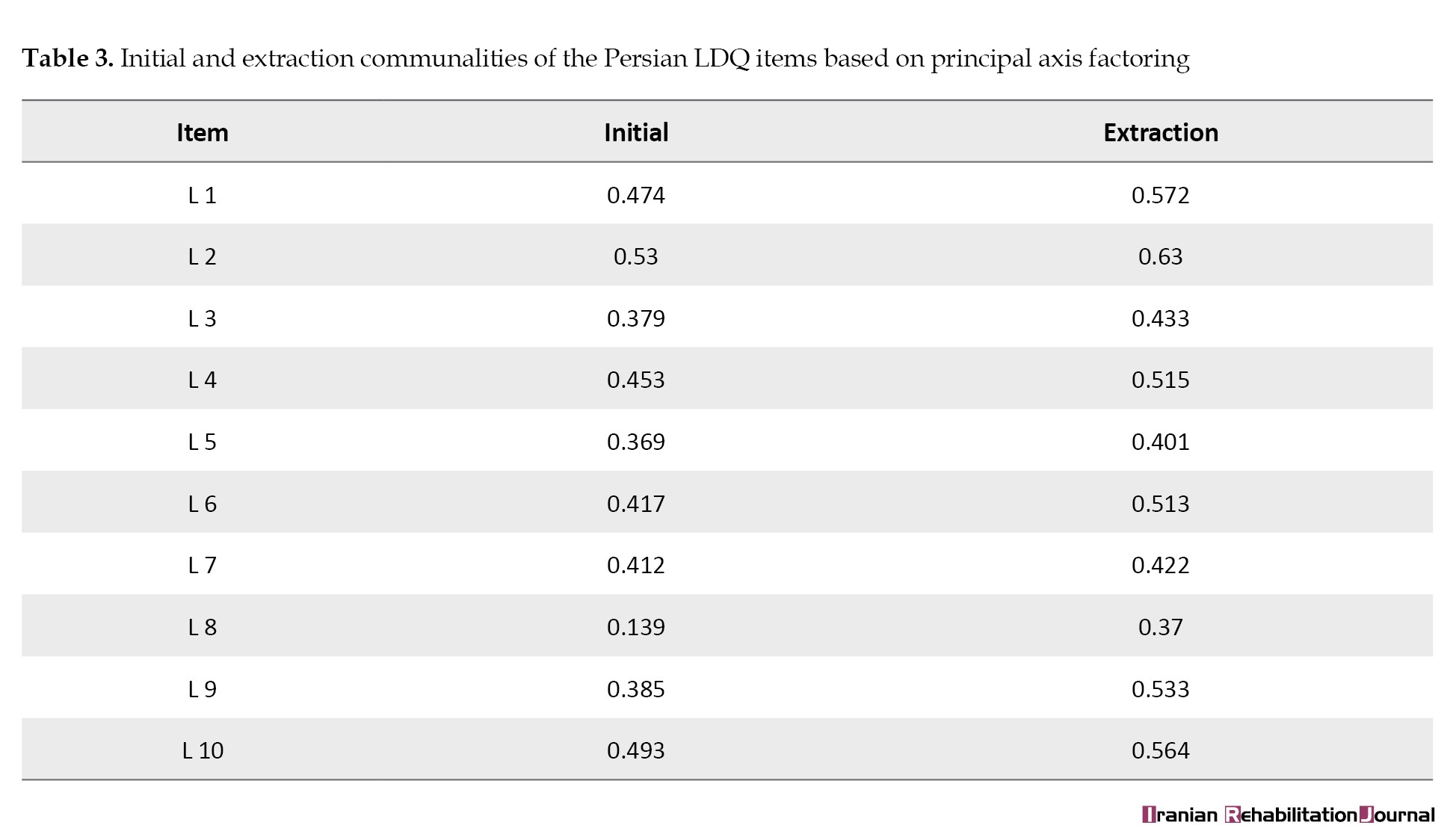
Communalities ranged from 0.370 to 0.630. Item 2 showed the highest communality, whereas item 8 showed the lowest communality, suggesting that item 8 shared the least variance with the latent factor structure (Table 3).
Eigenvalues and factor retention
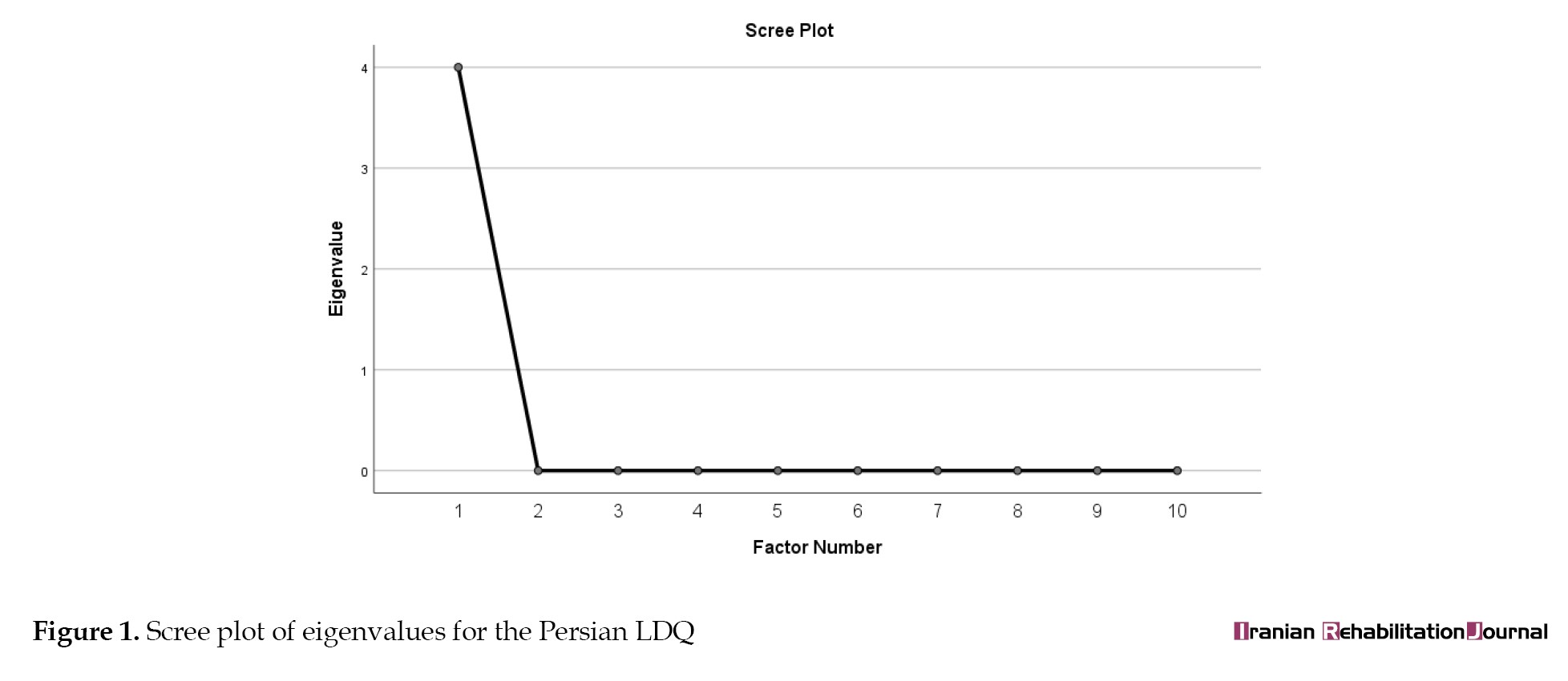
The first eigenvalue was 4.669 and explained 46.687% of the variance. The second and third eigenvalues were 0.969 and 0.863, respectively, both below 1. In the parallel analysis, only the first observed eigenvalue exceeded the corresponding random eigenvalue, supporting retention of a single factor. The scree plot likewise indicated a clear break after the first factor (Table 4).
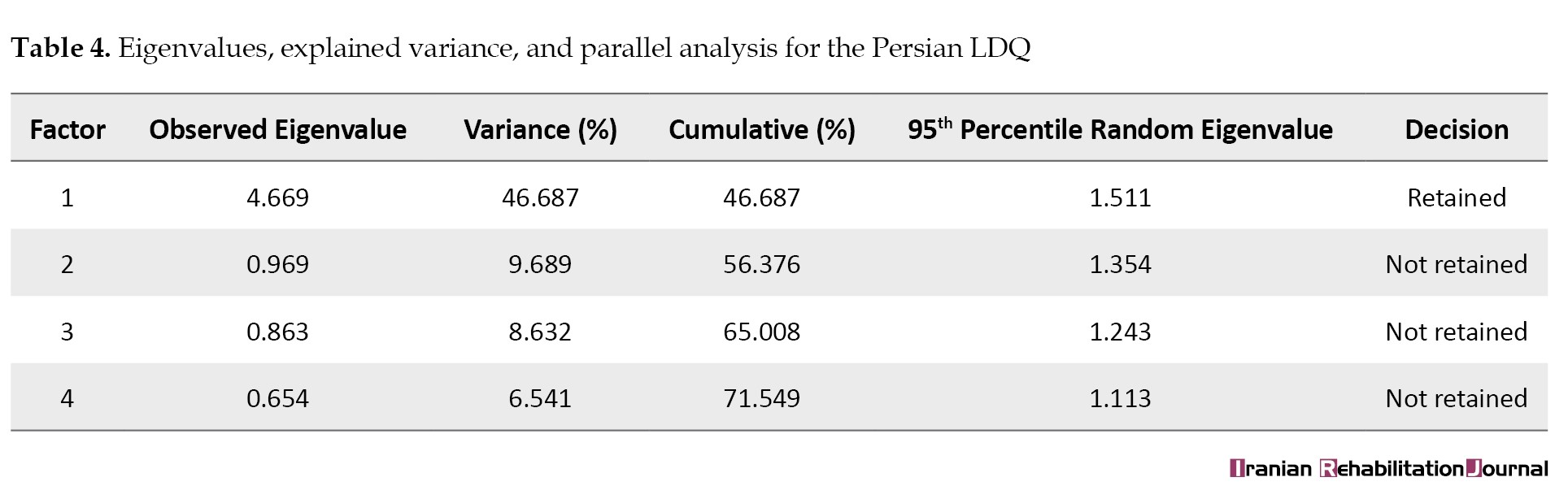
Although a three-factor extraction was initially explored in SPSS for descriptive purposes, the scree plot and parallel analysis supported a unidimensional solution. In the exploratory forced extraction, item 8 showed the most distinct loading pattern and the weakest association with the general factor structure.
As mentioned, parallel analysis further supported a one-factor solution. The first observed eigenvalue (4.669) exceeded the corresponding 95th percentile random eigenvalue (1.511), whereas the second and third observed eigenvalues (0.969 and 0.863) were below their corresponding random eigenvalues (1.354 and 1.243, respectively). These findings indicated that only the first factor should be retained.
In the retained one-factor solution, all LDQ items loaded positively on the general dependence factor. The loading pattern indicated that the items shared a common underlying dimension of psychological dependence. Item 8 showed the weakest association with the general factor, which was consistent with its lower inter-item correlations and lower communality.
Because the eigenvalue distribution, scree plot inspection, and parallel analysis supported a one-factor solution, principal axis factoring was repeated with the number of factors fixed at one and without rotation (Figure 1).
Evaluating the severity of substance dependence is a central task in addiction rehabilitation and research. Rather than a binary determination of substance use, the intensity of dependence informs treatment design, prognosis, and the need for monitoring and rehabilitation planning [1]. In routine clinical settings, lengthy interviews are not always feasible, making brief patient-reported measures especially valuable. For instance, while the addiction severity index (ASI) provides a comprehensive multidimensional profile, its reliance on semi-structured clinical interviews limits feasibility in fast-paced or resource-limited settings [2]. Consequently, brief instruments that can capture the core features of dependence with acceptable psychometric precision have become increasingly important.
To address this gap, Raistrick et al. developed the Leeds dependence questionnaire (LDQ), a 10-item self-report instrument originally designed to evaluate alcohol and opiate dependence within treatment monitoring frameworks [3]. The LDQ focuses on psychological dependence rather than solely physiological withdrawal, and its items reflect key dependence phenomena such as preoccupation with use, salience, compulsion, planning around use, maximization of effect, narrowing of repertoire, and difficulty coping without the substance. Thus, the LDQ captures a common dependence syndrome intended to be applicable across psychoactive substances [3, 4].
Initial psychometric evaluations showed strong content, concurrent, and discriminant validity, together with robust internal consistency [3]. Subsequent work with a large sample of clinic attenders reinforced these findings and suggested that the LDQ primarily measures a single dependence construct rather than multiple independent dimensions [5]. This positioned the LDQ as a brief global measure of dependence severity rather than an instrument tied to a particular substance class or treatment context. A short unidimensional scale has clear practical value for screening, baseline assessment, treatment planning, and longitudinal outcome monitoring [3].
The LDQ has been examined in several additional populations. Ford reported that the instrument was useful among detained psychiatric inpatients, supporting its applicability beyond specialist addiction clinics [6]. Lennings evaluated the LDQ in adolescent and young adult contexts, suggesting broader clinical utility [7]. Kelly et al. later validated the instrument in a young adult clinical sample and found satisfactory measurement properties [8]. Together, these studies indicate that the LDQ is not restricted to one subgroup of substance users but has acceptable cross-sample robustness.
More recent psychometric studies have deepened understanding of the scale’s structure. Galecki et al. applied item response theory, Mokken analysis, and differential item functioning procedures to a large clinical sample and found that the LDQ functions largely as a unidimensional measure of psychological dependence, although some items contribute less information than others and item 7 showed substance-related differential functioning [9]. Similarly, Fairhurst et al. examined the relationship between the LDQ, psychological distress, and social satisfaction in a specialist addiction-service sample and found that LDQ items loaded strongly on a common factor, supporting the interpretation of dependence as a specific psychological construct closely linked to broader distress but still clinically meaningful in its own right [10]. Taken together, these findings suggest that the LDQ has a stable core structure, while certain item-level characteristics may vary across samples and settings.
For Persian-speaking populations, such evidence is especially important because translation alone does not guarantee cross-cultural equivalence. A Persian version of the LDQ was previously translated, back-translated, and evaluated in an Iranian sample of individuals with substance dependence [11]. This study reported acceptable criterion-related validity with the substance dependence severity scale (SDSS), acceptable construct validity with the general health questionnaire, strong internal consistency, and excellent test–retest reliability [11]. These findings established that the Persian LDQ is a reliable and valid measure. However, factorial validity was not independently examined, leaving open the question of whether the translated instrument reproduces the latent structure observed in English-language samples.
This gap matters conceptually and practically. If the Persian LDQ retains the same latent structure as the original scale, it would support the cross-cultural stability of psychological dependence as a construct and justify use of the total score as a summary index of severity. If the structure differs, one or more items may behave differently in the Iranian context and require revision or cautious interpretation. Because the LDQ is used in clinical and research settings to assess dependence severity, explicit examination of its factorial structure in Persian is necessary.
Accordingly, the present study aimed to investigate the factor structure of the Persian version of the LDQ in an Iranian clinical sample of individuals with substance use disorders. By examining the latent organization of the items, this study extends the psychometric evidence base for the Persian LDQ. It evaluates whether it reproduces the essentially unidimensional structure reported in the original instrument and subsequent international studies [3, 5, 9, 10].
Materials and Methods
Study design and participants
This study was a secondary analysis of the dataset used in the initial validation study of the Persian LDQ. This study was a sub-study of a validation research [11]. The sample consisted of 170 treatment-seeking individuals with substance use disorders who completed all 10 items on the questionnaire. Participants were recruited from addiction treatment services in Tehran City, Iran. Most participants were polysubstance users; however, opioids were the primary substance of use for the majority of the sample, followed by methamphetamine. Questionnaires with missing LDQ responses were excluded from the factor analysis.
Instrument
The LDQ is a 10-item self-report instrument designed to assess the severity of psychological dependence on psychoactive substances [3]. Each item is scored on a 4-point Likert scale from 0 to 3, yielding a total score ranging from 0 to 30, with higher scores indicating greater dependence severity. The scale was originally developed to capture core dependence features applicable across substances [3, 5]. In the previous validation study of the Persian LDQ, the instrument showed acceptable criterion-related and construct validity coefficients of 0.773 and 0.780, respectively. Its internal consistency was good (Cronbach’s α=0.809), and test–retest reliability over a two-week interval was excellent, with ICC values of 0.957 for single measures and 0.978 for average measures [11].
Statistical analysis
Descriptive statistics were calculated for each item, including Mean±SD. The correlation matrix was examined for factorability using the Kaiser–Meyer–Olkin (KMO) measure and Bartlett’s test of sphericity. Anti-image correlations and item-level measures of sampling adequacy were also inspected.
Exploratory factor analysis was conducted using IBM SPSS software, version 26. The suitability of the data for factor analysis was examined using the KMO measure of sampling adequacy (MSA) and Bartlett’s test of sphericity. Factor extraction was performed using principal axis factoring. The number of factors to retain was determined using multiple criteria, including eigenvalues greater than 1, visual inspection of the scree plot, theoretical interpretability, and parallel analysis [12].
Parallel analysis was performed in SPSS using O’Connor’s SPSS syntax to determine the number of components and factors by parallel analysis. The procedure generated 1,000 random datasets with the same number of observations and variables as the original dataset. The observed eigenvalues from the empirical data were compared with the 95th percentile of eigenvalues obtained from the randomly generated datasets. Factors were retained only when the observed eigenvalue exceeded the corresponding random eigenvalue. This approach reduced the risk of over-extracting factors based solely on Kaiser’s eigenvalue-greater-than-one criterion or subjective interpretation of the scree plot [13].
Results
Descriptive statistics
The mean item scores ranged from 2.15 to 2.47, indicating generally moderate to high dependence-related endorsement across the sample. Item 1 had the highest mean score, whereas item 5 had the lowest mean score. Item 8 showed the largest standard deviation, suggesting greater response dispersion than the other items (Table 1).
Factorability of the data
The inter-item correlation matrix indicated positive associations among all LDQ items, with most correlations falling in the small-to-moderate range. The determinant of the correlation matrix (0.025) indicated no evidence of severe multicollinearity. Item 8 showed comparatively weaker correlations with the other items, which was consistent with its lower communality and more distinctive loading pattern in the exploratory factor analysis.
The data were suitable for factor analysis. The KMO value was 0.898, indicating excellent sampling adequacy. Bartlett’s test of sphericity was significant (χ²=606.514, df=45, P<0.001), demonstrating that the correlation matrix contained sufficient shared variance for factor extraction. All item-level measures of sampling adequacy were above the commonly accepted threshold (Table 2).
Sampling adequacy
The sample size was considered adequate for the exploratory factor analysis because the LDQ contains only 10 items and the final sample included 170 participants, corresponding to a participant-to-item ratio of 17:1. This exceeded commonly recommended minimum ratios of 5–10 participants per item for exploratory factor analysis. The diagonal values of the anti-image correlation matrix, representing item-level measures of sampling adequacy, ranged from 0.837 to 0.936. All items exceeded the recommended minimum threshold, supporting their inclusion in the exploratory factor analysis. Although item 8 showed weaker inter-item correlations and a lower communality than the other items, its individual MSA remained acceptable (MSA=0.837), and therefore it was retained in the analysis (Table 1).
Communalities
Communalities ranged from 0.370 to 0.630. Item 2 showed the highest communality, whereas item 8 showed the lowest communality, suggesting that item 8 shared the least variance with the latent factor structure (Table 3).
Eigenvalues and factor retention
The first eigenvalue was 4.669 and explained 46.687% of the variance. The second and third eigenvalues were 0.969 and 0.863, respectively, both below 1. In the parallel analysis, only the first observed eigenvalue exceeded the corresponding random eigenvalue, supporting retention of a single factor. The scree plot likewise indicated a clear break after the first factor (Table 4).
Although a three-factor extraction was initially explored in SPSS for descriptive purposes, the scree plot and parallel analysis supported a unidimensional solution. In the exploratory forced extraction, item 8 showed the most distinct loading pattern and the weakest association with the general factor structure.
As mentioned, parallel analysis further supported a one-factor solution. The first observed eigenvalue (4.669) exceeded the corresponding 95th percentile random eigenvalue (1.511), whereas the second and third observed eigenvalues (0.969 and 0.863) were below their corresponding random eigenvalues (1.354 and 1.243, respectively). These findings indicated that only the first factor should be retained.
In the retained one-factor solution, all LDQ items loaded positively on the general dependence factor. The loading pattern indicated that the items shared a common underlying dimension of psychological dependence. Item 8 showed the weakest association with the general factor, which was consistent with its lower inter-item correlations and lower communality.
Because the eigenvalue distribution, scree plot inspection, and parallel analysis supported a one-factor solution, principal axis factoring was repeated with the number of factors fixed at one and without rotation (Figure 1).
The one-factor solution converged in four iterations. As shown in Table 5, nine of the ten LDQ items loaded clearly on the general dependence factor, with factor loadings ranging from 0.588 to 0.737.
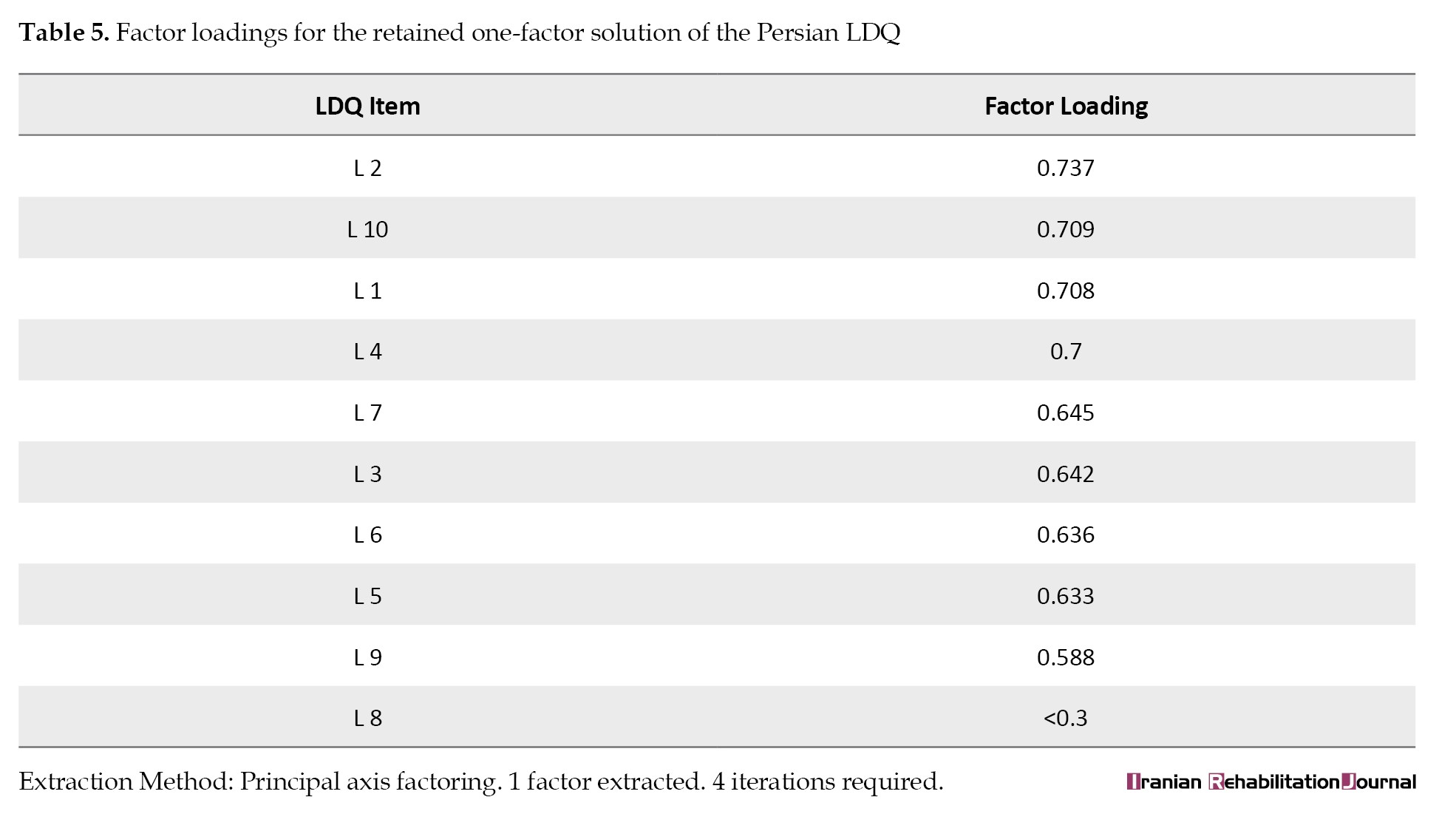
The strongest loading was observed for item 2 (0.737), followed by item 10 (0.709), item 1 (0.708), and item 4 (0.7). Overall, the loading pattern supported the interpretation of the Persian LDQ as an essentially unidimensional measure of psychological dependence severity (Table 5).
Discussion
The present study examined the factor structure of the Persian version of the LDQ in a clinical sample of Iranian individuals with substance-use disorders. Because both the scree plot and parallel analysis supported retention of a single factor, the findings indicate that the Persian LDQ primarily measures one underlying construct: Psychological dependence severity. This is important because it suggests that the Persian translation has retained the core latent structure intended by the original developers and can function as a valid summary measure of dependence severity in Iranian clinical settings [3, 11].
The original LDQ was designed as a brief instrument for assessing dependence across substances, with emphasis on the psychological core of dependence rather than withdrawal symptoms alone. Raistrick et al. conceptualized dependence as a common syndrome characterized by preoccupation, salience, compulsion, planning around use, and impaired control [3]. The present findings are consistent with this conceptualization. A dominant general factor, supported by both the scree plot and parallel analysis, suggests that the Persian LDQ is not fragmenting dependence into unrelated subdomains, but is capturing a single dependence process expressed through multiple item indicators.
This result aligns closely with the large clinic-attender study by Heather et al. who reported that the LDQ behaved as a predominantly single-construct instrument in a large clinical sample [5]. The current findings replicate that broad psychometric message in a different language and healthcare context. This cross-cultural stability is noteworthy because addiction-related cognition and behavior may be shaped by local treatment systems, social norms, and substance-use patterns, yet the same core latent dependence construct appears to emerge in both British and Iranian samples [5, 11].
The earlier Persian validation study by Massah et al. provides the necessary bridge between the original English-language LDQ and the present factor-analytic work [11]. Their study reported acceptable criterion-related validity, construct validity, internal consistency, and test–retest reliability for the Persian version [11]. However, reliability and correlational validity alone do not establish structural equivalence. The present study adds factorial validity, which is a critical step in cross-cultural adaptation. Taken together, the two Persian studies provide a more complete validation story: The first showed that the translated instrument is reliable and valid in the conventional psychometric sense, and the present study shows that it also reproduces the expected latent structure [11].
The current findings are also consistent with later work in different clinical populations. Ford’s evaluation of the LDQ among detained psychiatric inpatients showed that the questionnaire remained useful outside specialist addiction clinics, suggesting that it can function as a meaningful dependence measure in diagnostically complex settings [6]. The Persian data extend that logic: Even in a distinct cultural and service context, the LDQ still appears to measure a coherent dependence construct.
Lennings’ evaluation of the LDQ in younger populations also supports the idea that the instrument has structural robustness across groups that differ in age and clinical profile [7]. Kelly et al. later confirmed the LDQ’s psychometric validity in a young adult clinical sample and found satisfactory measurement properties [8]. These studies suggest that the LDQ is not an age-bound or setting-specific measure, but captures a stable core dependence construct that can travel reasonably well across clinical groups [7, 8]. The Persian findings fit this pattern.
The item-level work of Galecki et al. is especially informative for interpreting the present results [9]. Using principal component analysis, Mokken scaling, and item response theory methods, they showed that the LDQ is essentially unidimensional, while also noting that not every item contributes equally to the latent trait. They further reported that item 7 showed differential functioning by substance in dichotomized responses. This finding matters because it demonstrates that a small amount of item-level irregularity does not undermine the scale’s global interpretation. The same principle is relevant here. In the Persian data, item 8 showed the weakest communality and the most distinctive loading pattern, but this does not necessarily imply a separate substantive factor. In the broader LDQ literature, item-level quirks have been interpreted as measurement noise or content-specific sensitivity rather than as evidence against a general dependence factor [9]. The present pattern is therefore best read as a minor item-level nuance within an otherwise coherent unidimensional structure.
Fairhurst et al. also provide a useful point of comparison. In a specialist addiction-service sample, they found that LDQ items loaded strongly on a common dependence factor and that LDQ scores were meaningfully related to psychological distress and social functioning. Their interpretation was that dependence should be understood as a distinct psychological condition within the addiction domain, not as a process detached from distress or functioning [10]. The present findings are compatible with that view. The Persian LDQ appears to retain a focused dependence dimension while remaining clinically relevant to broader psychosocial recovery processes.
Later outcome-oriented work has also emphasized the LDQ’s role as a treatment-monitoring instrument. Raistrick et al. argued that the LDQ, clinical outcomes in routine evaluation-10 (CORE-10), and social support questionnaire (SSQ) can function as dimensional measures of addiction, distress, and social functioning, respectively, and are useful for clinical monitoring and outcomes assessment. This framing is relevant because it clarifies why unidimensionality matters. If the LDQ is essentially one factor, the total score can be interpreted straightforwardly and used for repeated clinical measurement without requiring subscale interpretation [3, 14]. This is especially valuable in busy services where brief, robust instruments are preferred.
Although the ASI remains one of the classic comprehensive measures in substance-use assessment, it is lengthy and interview-based [2]. By contrast, the LDQ provides a much briefer self-report alternative focused on a core dependence construct. More generally, the importance of measuring severity rather than merely presence of use is supported by the SDSS, which has demonstrated reliability and validity as a clinician-administered dependence measure. The LDQ and SDSS are therefore conceptually aligned: Both capture severity, not just diagnostic status, although they differ in format and administration burden [15, 16]. The LDQ’s advantage is its brevity and ease of use.
The broader conceptual background is also worth noting. The dependence framework defined in ICD-10, which shaped the content of the LDQ items, considers dependence as a syndrome with cognitive, behavioral, and physiological features [17]. National Institute for Health and Care Excellence (NICE) guidance similarly emphasizes comprehensive assessment of dependence, psychological distress, physical health, and social functioning in specialist addiction care [18, 19]. These broader frameworks help explain why the LDQ has remained relevant: It captures a core dependence construct that fits well with modern clinical assessment approaches [17-19]. At the same time, outcome-oriented models of psychotherapy and addiction care emphasize that change should be monitored across domains, not just at the level of symptoms [20, 21]. In that respect, the LDQ is useful precisely because it is brief, targeted, and stable enough to be repeated often.
Another point supporting the present findings is the nature of the broader treatment-package literature. Research on brief measures of distress and social functioning, such as the CORE-10, has shown that brief patient-reported outcomes can be psychometrically sound and clinically practical [22]. The LDQ sits comfortably within this family of instruments. Fairhurst et al. also noted that addiction services often need a parsimonious set of measures rather than a large battery [10]. The present factor-analytic evidence supports keeping the LDQ in that role.
Item 8 showed comparatively weak performance in this study. This should not be overstated. In modern psychometrics, a single item behaving somewhat differently is not unusual and does not necessarily invalidate the entire scale. This may reflect wording, translation nuance, or subtle differences in how Iranian respondents experience and express dependence-related cognitions [9, 14, 23]. Future work using confirmatory factor analysis, item response theory, and differential item functioning would be useful for checking whether that item behaves consistently across sex, substance type, and treatment stage.
This study has some limitations. The sample was drawn from treatment-seeking patients; therefore, the findings may not generalize to community samples. The analysis was exploratory, and although the scree plot and parallel analysis strongly supported the retained factor, confirmatory factor analysis in an independent sample would provide a stronger test of structural validity. Measurement invariance across key subgroups was not examined. Even so, the present results are internally coherent and align with the broader LDQ literature.
Conclusion
The Persian version of the LDQ demonstrates strong evidence of construct validity and appears to retain the essentially unidimensional structure of the original LDQ. The total score can be interpreted as a valid indicator of psychological dependence severity in Iranian clinical populations with substance use disorders. This study adds factorial validity to the earlier Persian validation work, and the instrument is therefore suitable for routine clinical assessment and research use in Persian-speaking settings.
Ethical Considerations
Compliance with ethical guidelines
This study was approved by the Ethics Committee of University of Social Welfare and Rehabilitation Sciences, Tehran, Iran (Code: IR.USWR.REC.1395.329).
Funding
This article was extracted from the main dataset of a research project (Code: 95/1024) and financially supported by University of Social Welfare and Rehabilitation Sciences, Tehran, Iran.
Authors' contributions
Study design: Hassan Rafiey; Literature search, data collection, and analysis: Omid Massah; Writing and final approval: All authors.
Conflict of interest
The authors declared no conflict of interest.
Acknowledgments
The authors acknowledge Schwann Shariatirad, one of the lead authors of the initial validation of the Persian version of the LDQ. They also acknowledge Duncan Raistrick, the developer of the original LDQ, for his approval and guidance in the initial validation of the Persian LDQ.
The strongest loading was observed for item 2 (0.737), followed by item 10 (0.709), item 1 (0.708), and item 4 (0.7). Overall, the loading pattern supported the interpretation of the Persian LDQ as an essentially unidimensional measure of psychological dependence severity (Table 5).
Discussion
The present study examined the factor structure of the Persian version of the LDQ in a clinical sample of Iranian individuals with substance-use disorders. Because both the scree plot and parallel analysis supported retention of a single factor, the findings indicate that the Persian LDQ primarily measures one underlying construct: Psychological dependence severity. This is important because it suggests that the Persian translation has retained the core latent structure intended by the original developers and can function as a valid summary measure of dependence severity in Iranian clinical settings [3, 11].
The original LDQ was designed as a brief instrument for assessing dependence across substances, with emphasis on the psychological core of dependence rather than withdrawal symptoms alone. Raistrick et al. conceptualized dependence as a common syndrome characterized by preoccupation, salience, compulsion, planning around use, and impaired control [3]. The present findings are consistent with this conceptualization. A dominant general factor, supported by both the scree plot and parallel analysis, suggests that the Persian LDQ is not fragmenting dependence into unrelated subdomains, but is capturing a single dependence process expressed through multiple item indicators.
This result aligns closely with the large clinic-attender study by Heather et al. who reported that the LDQ behaved as a predominantly single-construct instrument in a large clinical sample [5]. The current findings replicate that broad psychometric message in a different language and healthcare context. This cross-cultural stability is noteworthy because addiction-related cognition and behavior may be shaped by local treatment systems, social norms, and substance-use patterns, yet the same core latent dependence construct appears to emerge in both British and Iranian samples [5, 11].
The earlier Persian validation study by Massah et al. provides the necessary bridge between the original English-language LDQ and the present factor-analytic work [11]. Their study reported acceptable criterion-related validity, construct validity, internal consistency, and test–retest reliability for the Persian version [11]. However, reliability and correlational validity alone do not establish structural equivalence. The present study adds factorial validity, which is a critical step in cross-cultural adaptation. Taken together, the two Persian studies provide a more complete validation story: The first showed that the translated instrument is reliable and valid in the conventional psychometric sense, and the present study shows that it also reproduces the expected latent structure [11].
The current findings are also consistent with later work in different clinical populations. Ford’s evaluation of the LDQ among detained psychiatric inpatients showed that the questionnaire remained useful outside specialist addiction clinics, suggesting that it can function as a meaningful dependence measure in diagnostically complex settings [6]. The Persian data extend that logic: Even in a distinct cultural and service context, the LDQ still appears to measure a coherent dependence construct.
Lennings’ evaluation of the LDQ in younger populations also supports the idea that the instrument has structural robustness across groups that differ in age and clinical profile [7]. Kelly et al. later confirmed the LDQ’s psychometric validity in a young adult clinical sample and found satisfactory measurement properties [8]. These studies suggest that the LDQ is not an age-bound or setting-specific measure, but captures a stable core dependence construct that can travel reasonably well across clinical groups [7, 8]. The Persian findings fit this pattern.
The item-level work of Galecki et al. is especially informative for interpreting the present results [9]. Using principal component analysis, Mokken scaling, and item response theory methods, they showed that the LDQ is essentially unidimensional, while also noting that not every item contributes equally to the latent trait. They further reported that item 7 showed differential functioning by substance in dichotomized responses. This finding matters because it demonstrates that a small amount of item-level irregularity does not undermine the scale’s global interpretation. The same principle is relevant here. In the Persian data, item 8 showed the weakest communality and the most distinctive loading pattern, but this does not necessarily imply a separate substantive factor. In the broader LDQ literature, item-level quirks have been interpreted as measurement noise or content-specific sensitivity rather than as evidence against a general dependence factor [9]. The present pattern is therefore best read as a minor item-level nuance within an otherwise coherent unidimensional structure.
Fairhurst et al. also provide a useful point of comparison. In a specialist addiction-service sample, they found that LDQ items loaded strongly on a common dependence factor and that LDQ scores were meaningfully related to psychological distress and social functioning. Their interpretation was that dependence should be understood as a distinct psychological condition within the addiction domain, not as a process detached from distress or functioning [10]. The present findings are compatible with that view. The Persian LDQ appears to retain a focused dependence dimension while remaining clinically relevant to broader psychosocial recovery processes.
Later outcome-oriented work has also emphasized the LDQ’s role as a treatment-monitoring instrument. Raistrick et al. argued that the LDQ, clinical outcomes in routine evaluation-10 (CORE-10), and social support questionnaire (SSQ) can function as dimensional measures of addiction, distress, and social functioning, respectively, and are useful for clinical monitoring and outcomes assessment. This framing is relevant because it clarifies why unidimensionality matters. If the LDQ is essentially one factor, the total score can be interpreted straightforwardly and used for repeated clinical measurement without requiring subscale interpretation [3, 14]. This is especially valuable in busy services where brief, robust instruments are preferred.
Although the ASI remains one of the classic comprehensive measures in substance-use assessment, it is lengthy and interview-based [2]. By contrast, the LDQ provides a much briefer self-report alternative focused on a core dependence construct. More generally, the importance of measuring severity rather than merely presence of use is supported by the SDSS, which has demonstrated reliability and validity as a clinician-administered dependence measure. The LDQ and SDSS are therefore conceptually aligned: Both capture severity, not just diagnostic status, although they differ in format and administration burden [15, 16]. The LDQ’s advantage is its brevity and ease of use.
The broader conceptual background is also worth noting. The dependence framework defined in ICD-10, which shaped the content of the LDQ items, considers dependence as a syndrome with cognitive, behavioral, and physiological features [17]. National Institute for Health and Care Excellence (NICE) guidance similarly emphasizes comprehensive assessment of dependence, psychological distress, physical health, and social functioning in specialist addiction care [18, 19]. These broader frameworks help explain why the LDQ has remained relevant: It captures a core dependence construct that fits well with modern clinical assessment approaches [17-19]. At the same time, outcome-oriented models of psychotherapy and addiction care emphasize that change should be monitored across domains, not just at the level of symptoms [20, 21]. In that respect, the LDQ is useful precisely because it is brief, targeted, and stable enough to be repeated often.
Another point supporting the present findings is the nature of the broader treatment-package literature. Research on brief measures of distress and social functioning, such as the CORE-10, has shown that brief patient-reported outcomes can be psychometrically sound and clinically practical [22]. The LDQ sits comfortably within this family of instruments. Fairhurst et al. also noted that addiction services often need a parsimonious set of measures rather than a large battery [10]. The present factor-analytic evidence supports keeping the LDQ in that role.
Item 8 showed comparatively weak performance in this study. This should not be overstated. In modern psychometrics, a single item behaving somewhat differently is not unusual and does not necessarily invalidate the entire scale. This may reflect wording, translation nuance, or subtle differences in how Iranian respondents experience and express dependence-related cognitions [9, 14, 23]. Future work using confirmatory factor analysis, item response theory, and differential item functioning would be useful for checking whether that item behaves consistently across sex, substance type, and treatment stage.
This study has some limitations. The sample was drawn from treatment-seeking patients; therefore, the findings may not generalize to community samples. The analysis was exploratory, and although the scree plot and parallel analysis strongly supported the retained factor, confirmatory factor analysis in an independent sample would provide a stronger test of structural validity. Measurement invariance across key subgroups was not examined. Even so, the present results are internally coherent and align with the broader LDQ literature.
Conclusion
The Persian version of the LDQ demonstrates strong evidence of construct validity and appears to retain the essentially unidimensional structure of the original LDQ. The total score can be interpreted as a valid indicator of psychological dependence severity in Iranian clinical populations with substance use disorders. This study adds factorial validity to the earlier Persian validation work, and the instrument is therefore suitable for routine clinical assessment and research use in Persian-speaking settings.
Ethical Considerations
Compliance with ethical guidelines
This study was approved by the Ethics Committee of University of Social Welfare and Rehabilitation Sciences, Tehran, Iran (Code: IR.USWR.REC.1395.329).
Funding
This article was extracted from the main dataset of a research project (Code: 95/1024) and financially supported by University of Social Welfare and Rehabilitation Sciences, Tehran, Iran.
Authors' contributions
Study design: Hassan Rafiey; Literature search, data collection, and analysis: Omid Massah; Writing and final approval: All authors.
Conflict of interest
The authors declared no conflict of interest.
Acknowledgments
The authors acknowledge Schwann Shariatirad, one of the lead authors of the initial validation of the Persian version of the LDQ. They also acknowledge Duncan Raistrick, the developer of the original LDQ, for his approval and guidance in the initial validation of the Persian LDQ.
References
- McLellan AT, Lewis DC, O’Brien CP, Kleber HD. Drug dependence, a chronic medical illness: Implications for treatment, insurance, and outcomes evaluation. JAMA. 2000; 284(13):1689-95. [DOI:10.1001/jama.284.13.1689] [PMID]
- McLellan AT, Luborsky L, Woody GE, O’Brien CP. An improved diagnostic evaluation instrument for substance abuse patients. The addiction severity index. J Nerv Ment Dis. 1980; 168(1):26-33. [DOI:10.1097/00005053-198001000-00006] [PMID]
- Raistrick D, Bradshaw J, Tober G, Weiner J, Allison J, Healey C. Development of the leeds dependence questionnaire (LDQ): A questionnaire to measure alcohol and opiate dependence in the context of a treatment evaluation package. Addiction. 1994; 89(5):563-72. [DOI:10.1111/j.1360-0443.1994.tb03332.x] [PMID]
- World Health Organization (WHO). Clinical descriptions and diagnostic requirements for ICD-11 mental, behavioural and neurodevelopmental disorders. Geneva: World Health Organization; 2024. [Link]
- Heather N, Raistrick D, Tober G, Godfrey C, Parrott S. Leeds Dependence Questionnaire: New data from a large sample of clinic attenders. Addict Res Theory. 2001; 9(3):253-69. [DOI:10.3109/16066350109141753]
- Ford P. An evaluation of the dartmouth assessment of lifestyle inventory and the Leeds dependence questionnaire for use among detained psychiatric inpatients. Addiction. 2003; 98(1):111-8. [DOI:10.1046/j.1360-0443.2003.00313.x] [PMID]
- Lennings CJ. An evaluation of the Leeds dependence questionnaire. J Child Adolesc Subst Abuse. 1999; 8(3):73-87. [DOI:10.1300/J029v08n03_05]
- Kelly JF, Magill M, Slaymaker V, Kahler C. Psychometric validation of the Leeds dependence questionnaire (LDQ) in a young adult clinical sample. Addict Behav. 2010; 35(4):331-6. [DOI:10.1016/j.addbeh.2009.11.005] [PMID] [PMCID]
- Galecki JM, Sherman MF, Prenoveau JM, Chan KS. Item analysis of the Leeds Dependence questionnaire in community treatment centers. Psychol Assess. 2016; 28(9):1061-73. [DOI:10.1037/pas0000306] [PMID]
- Fairhurst C, Böhnke JR, Gabe R, Croudace TJ, Tober G, Raistrick D. Factor analysis of treatment outcomes from a UK specialist addiction service: Relationship between the Leeds dependence questionnaire, social satisfaction questionnaire and 10-item clinical outcomes in routine evaluation. Drug Alcohol Rev. 2014; 33(6):643-50. [DOI:10.1111/dar.12146] [PMID] [PMCID]
- Massah O, Rafiey H, Shariatirad S, Radfar SR, Ahounbar E, Farhoudian A. The validity and reliability of the Persian version of the Leeds dependence questionnaire. Iran Rehabil J. 2019; 17(2):91-6. [DOI:10.32598/irj.17.2.91]
- Horn JL. A rationale and test for the number of factors in factor analysis. Psychometrika. 1965; 30(2):179-85. [DOI:10.1007/BF02289447] [PMID]
- O’Connor BP. SPSS and SAS programs for determining the number of components using parallel analysis and velicer’s MAP test. Behav Res Methods Instrum Comput. 2000; 32(3):396-402. [DOI:10.3758/bf03200807] [PMID]
- Raistrick D, Tober G, Sweetman J, Unsworth S, Crosby H, Evans T. Measuring clinically significant outcomes-LDQ, CORE-10 and SSQ as dimension measures of addiction. Psychiatr Bull. 2014; 38(3):112-5. [DOI:10.1192/pb.bp.112.041301] [PMID] [PMCID]
- Miele GM, Carpenter KM, Cockerham MS, Trautman KD, Blaine J, Hasin DS. Substance dependence severity scale: Reliability and validity for ICD-10 substance use disorders. Addict Behav. 2001; 26(4):603-12. [DOI:10.1016/s0306-4603(00)00137-4] [PMID]
- Miele GM, Carpenter KM, Smith Cockerham M, Trautman KD, Blaine J, Hasin DS. Substance dependence severity scale (SDSS): Reliability and validity of a clinician-administered interview for DSM-IV substance use disorders. Drug Alcohol Depend. 2000; 59(1):63-75. [DOI:10.1016/s0376-8716(99)00111-8] [PMID]
- World Health Organization (WHO) The ICD-10 classification of mental and behavioural disorders: Clinical descriptions and diagnostic guidelines. Geneva: World Health Organization; 1992. [Link]
- National Institute for Health and Care Excellence (NICE). Alcohol-use disorders: Diagnosis, assessment and management of harmful drinking and alcohol dependence: NICE; 2011. [DOI:10.3109/16066350109141753]
- National Collaborating Centre for Mental Health (Great Britain), National Institute for Health, Clinical Excellence (Great Britain), British Psychological Society, Royal College of Psychiatrists. Alcohol use disorders: The NICE guideline on the diagnosis, assessment and management of harmful drinking and alcohol dependence. London: RCPsych Publication; 2011. [Link]
- Howard KI, Lueger RJ, Maling MS, Martinovich Z. A phase model of psychotherapy outcome: Causal mediation of change. J Consult Clin Psychol. 1993; 61(4):678-85. [DOI:10.1037//0022-006x.61.4.678] [PMID]
- Thomas AC, Staiger PK, McCabe M. Implementation and evaluation of brief depression and anxiety screening in clients contacting a drug and alcohol service. Drug Alcohol Rev. 2012; 31(3):303-10. [DOI:10.1111/j.1465-3362.2011.00323.x] [PMID]
- Barkham M, Bewick B, Mullin T, Gilbody S, Connell J, Cahill J, et al. The CORE-10: A short measure of psychological distress for routine use in the psychological therapies. Couns Psychother Res. 2013; 13(1):3-13. [DOI:10.1080/14733145.2012.729069]
- Paton-Simpson GR, MacKinnon SK. Evaluation of the Leeds dependence questionnaire (LDQ) for New Zealand. Wellington (NZ): Alcohol Advisory Council of New Zealand; 1999.
Article type: Original Research Articles |
Subject:
Addiction
Received: 2026/06/21 | Accepted: 2026/07/22 | Published: 2026/09/26
Received: 2026/06/21 | Accepted: 2026/07/22 | Published: 2026/09/26
Send email to the article author

Copyright © The Author(s);
This is an open access article distributed under the terms of the Creative Commons Attribution-NonCommercial 4.0 (CC-By-NC 4.0), which permits use, distribution, and reproduction in any medium, provided the original work is properly cited and is not used for commercial purposes.
Contact Information
