988368
Mon, Oct 5, 2026

Volume 24, Issue 2 (June 2026)
Iranian Rehabilitation Journal 2026, 24(2): 147-156 |
Back to browse issues page



Download citation:
BibTeX | RIS | EndNote | Medlars | ProCite | Reference Manager | RefWorks
Send citation to:


BibTeX | RIS | EndNote | Medlars | ProCite | Reference Manager | RefWorks
Send citation to:
Chriqui M, Abidli Z, Rami Y, Ait Ali D, Malla R, Aouane M et al . Burnout Among Moroccan Dentists: Exploring Associated Factors. Iranian Rehabilitation Journal 2026; 24 (2) :147-156
URL: http://irj.uswr.ac.ir/article-1-2562-en.html
URL: http://irj.uswr.ac.ir/article-1-2562-en.html
Mouhssine Chriqui *1  , Zakaria Abidli2 , Younes Rami3 , Driss Ait Ali4 , Rajaa Malla4 , Mahjoub Aouane5 , Hicham Khabbache4
, Zakaria Abidli2 , Younes Rami3 , Driss Ait Ali4 , Rajaa Malla4 , Mahjoub Aouane5 , Hicham Khabbache4
1- Laboratory Natural Resources and Sustainable Development, Department of Biology, Faculty of Science, Ibn Tofail University, Kenitra, Morocco.
2- Higher Institute of Nursing and Health Technology Professions, Casablanca, Morocco.
3- Laboratory of Biology and Health, Faculty of Sciences, Ibn Tofaïl University, Kenitra, Morocco. & Laboratory of Morocco: History, Theology and Languages, Department of Psychology, Faculty of Arts and Human Sciences, Fès-Saïss, Sidi Mohamed Ben Abdellah University, Fez, Morocco.
4- Laboratory of Morocco: History, Theology and Languages, Department of Psychology, Faculty of Arts and Human Sciences, Fès-Saïss, Sidi Mohamed Ben Abdellah University, Fez, Morocco.
5- Laboratory Natural Resources and Sustainable Development, Department of Biology, Faculty of Science, Ibn Tofail University, Kenitra, Morocco
2- Higher Institute of Nursing and Health Technology Professions, Casablanca, Morocco.
3- Laboratory of Biology and Health, Faculty of Sciences, Ibn Tofaïl University, Kenitra, Morocco. & Laboratory of Morocco: History, Theology and Languages, Department of Psychology, Faculty of Arts and Human Sciences, Fès-Saïss, Sidi Mohamed Ben Abdellah University, Fez, Morocco.
4- Laboratory of Morocco: History, Theology and Languages, Department of Psychology, Faculty of Arts and Human Sciences, Fès-Saïss, Sidi Mohamed Ben Abdellah University, Fez, Morocco.
5- Laboratory Natural Resources and Sustainable Development, Department of Biology, Faculty of Science, Ibn Tofail University, Kenitra, Morocco
Full-Text [PDF 568 kb]
(213 Downloads)
| Abstract (HTML) (2761 Views)
Full-Text: (122 Views)
Introduction
According to Maslach and Leiter [1], following Freudenberg’s pioneering work [2], burnout is a psychosocial syndrome characterized by physical and emotional exhaustion (EE) that occurs in those engaged in jobs requiring extensive engagement with others. It results in self-devaluation and the formation of unfavorable professional attitudes [3]. Maslach and Leiter define burnout as having three main dimensions: EE, depersonalization or dehumanization of relationships (DP), and a diminished feeling of personal and professional accomplishment (PA) [1].
Physicians are particularly susceptible to burnout due to the high demands of their profession. They face increasing pressure from patients, societal expectations, advanced medical technologies, and their own high standards and critical self-assessment [4]. Burnout syndrome manifests as chronic exposure to substantial and harmful stress at work. Burnout can be triggered by exogenous factors from the external environment or endogenous factors originating from internal factors [5].
In response to rising burnout rates among physicians, a joint statement by the World Health Organization (WHO) and the European Forum of Medical Associations (EFMA) in Berlin in 2003 emphasized the urgent need to address this issue (WHO, 2003). Studies have shown that burnout affects 22-67.3% of general practitioners, 8.6-100% of doctors in other specialties, and 26.0-58.2% of interns and assistants [6]. According to Listopad et al. social, economic, and cultural factors play significant roles in the development and impact of burnout [7].
In Morocco, the ratio of doctors is 7.8 per 10,000 inhabitants, falling short of the WHO standard of 15.3 per 10,000. The country has only 414 public dentists, despite high demand and heavy workloads in both public and private hospitals, which impose a significant psychological burden on health professionals [8]. Despite the prevalence of these issues, few studies have examined the impact of burnout on dentists’ psychological well-being. Therefore, this study aimed to assess the prevalence of burnout among practicing dentists in Morocco and investigate associated factors.
Materials and Methods
Study design
This study used a cross-sectional design to assess burnout among dentists practicing in the public and private sectors in Morocco.
Participants
The target population consisted of dentists currently working in either the public or private sectors across Morocco. Participation was voluntary, and the sampling method allowed for the inclusion of any dentist who wished to participate in the study.
Data collection
Data were collected using a self-administered questionnaire, which included both socio-demographic and professional information (e.g. gender and age). Burnout was measured using the Maslach Burnout Inventory (MBI) developed by Maslach and Leiter [1]. The MBI consists of 22 items evaluated on a 7-point Likert scale ranging from “never” to “always.” These items were grouped into three subscales [1]:
1) EE: the feeling of being overwhelmed or drained by work. 2) DP: Characterized by feelings of detachment and impersonal responses toward patients. 3) Personal Accomplishment (PA): Involves feelings of incompetence and a decline in self- esteem at work
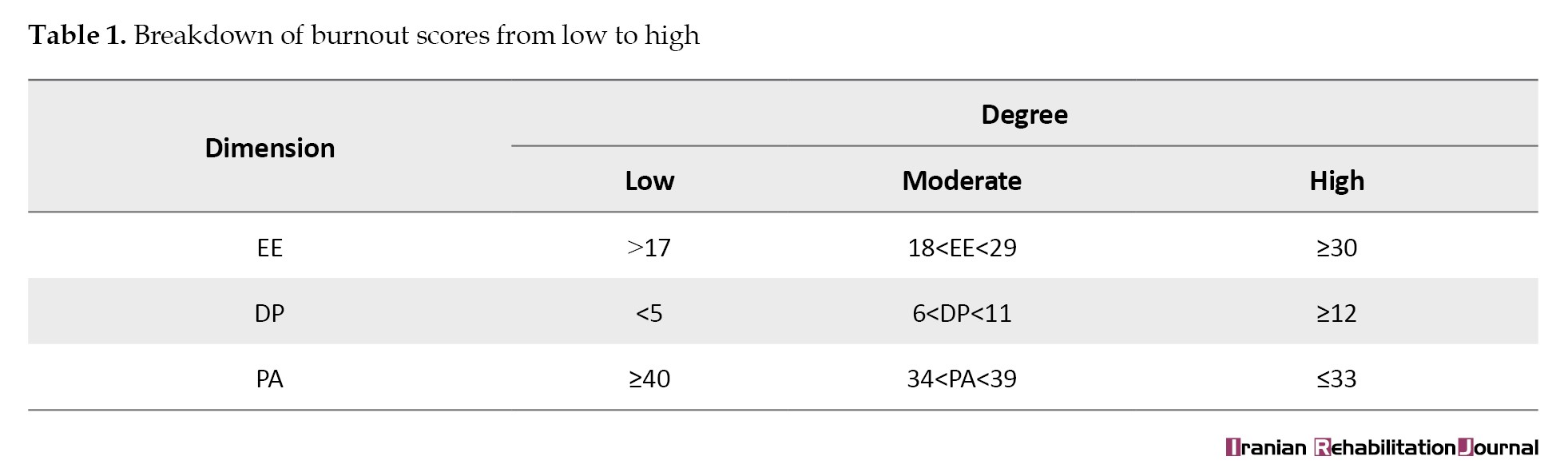
For interpretation of results, the original scoring system established by Maslach and Leiter was used. Burnout scores were categorized into low, moderate, and high levels (Table 1) [1].
Data analysis
The data were entered into Excel for initial processing and then analyzed using SPSS software, version 29.0.1. Descriptive statistics were utilized to summarize the socio-demographic and professional characteristics of the surveyed dentists. Inferential statistics were employed to examine associations between various risk factors and professional EE, categorized as either “pathological” or “non-pathological.” The analysis included independent variables such as gender, marital status, sector of work, work system, socioeconomic status, and the number of assistants. Odds ratios (OR) and 95% confidence intervals (CI) were computed to assess the strength of these associations, and the chi-square test (χ²) was used to evaluate statistical significance, with a threshold of P<0.05.
Results
Table 2 presents the sociodemographic and professional characteristics of the 61 dentists.
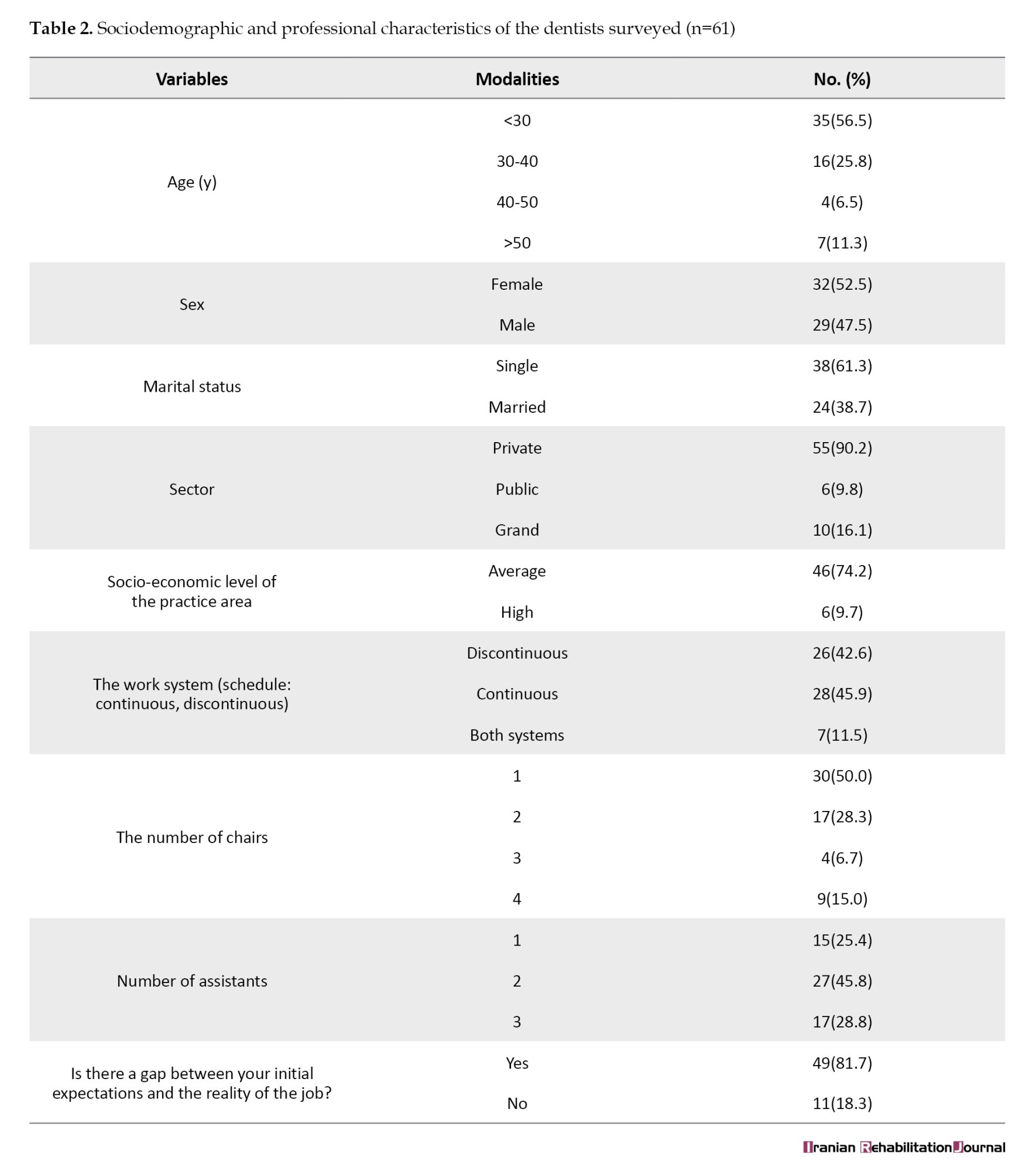
The gender ratio was balanced (P<0.798) with a slight majority of females (52.5%). The average age was 33.13±1.29 years (minimum=21 years; maximum=62 years), with a median age of 30 years. The distribution of our sample showed that 56.5% were under 30 years old. Regarding marital status, 61.3% of the dentists were single. In terms of the sector of practice, 90.2% (n=55) worked in the private sector, and 9.8% (n=6) worked in the public sector. Additionally, 45.9% preferred a continuous work system, 42.6% chose to work in a discontinuous system, and 11.2% alternated between the two. Furthermore, 50% of the interviewed dentists reported having a single dental chair, 28.3% had two chairs, and 21.7% had more than two chairs. Meanwhile, 45.8% had two assistants, 28.8% had three, and 25.4% had one. A total of 74.2% of these dentists confirmed that the socioeconomic level of their practice area was medium, 16.1% stated that the level was low, and 9.7% practiced in an area with a high socioeconomic level.
The internal validity of the MBI was assessed using Cronbach’s alpha coefficients, which demonstrated high reliability: 0.902 for EE, 0.917 for DP, and 0.903 for PA. These coefficients indicate strong internal consistency within the questionnaire. Variance analysis of the average item scores across the dimensions (EE, DP, and PA) revealed a highly significant difference (P=0.005). This suggests that the items within each dimension consistently measure the burnout components. Furthermore, the intra-dimensional dispersion, expressed as a coefficient of variation, indicates significant heterogeneity in response choices, reflecting the diverse experiences of burnout among the surveyed dentists (Table 3).
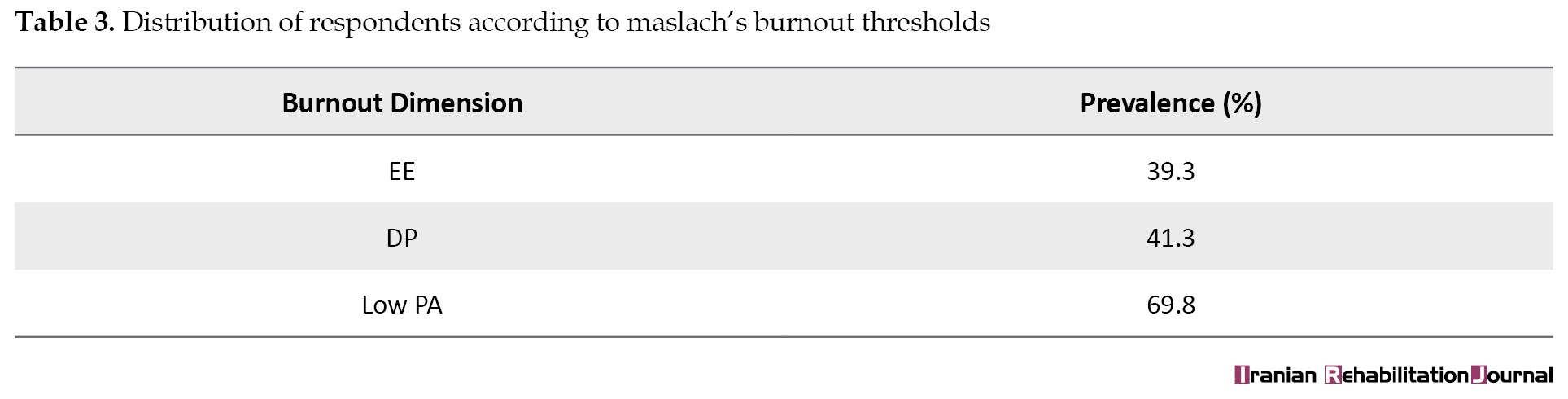
This study revealed significant levels of burnout among dentists in Morocco, as assessed using the MBI dimensions: EE, DP, and PA. EE, affecting 39.3% of dentists surveyed, reflects the intense feelings of being overwhelmed, exhausted, and stressed by their work. This dimension highlights the taxing nature of dental practice, where prolonged exposure to patient care and professional demands can lead to emotional fatigue. DP, reported by 41.3% of dentists, manifests as a detachment or cynicism toward patients and colleagues. Dentists experiencing high DP may exhibit impersonal behaviors and attitudes, potentially impacting patient care and professional relationships. Conversely, a notable 69.8% of dentists perceived low PA in their work. This dimension indicates feelings of inadequacy and a diminished sense of professional achievement. Despite this, it serves as a protective factor, potentially buffering against more severe burnout symptoms, such as EE and DP.
In the results section, we aimed to identify the risk factors associated with professional burnout (EE) among dentists by analyzing various variables. The results showed a significant difference between genders. Female dentists had a much higher risk of professional burnout than male dentists. Among the 24 pathological cases, 18 were women, and 6 were men. The OR of 4.9 (95% CI, 1.5%, 15.3%) indicated that women were approximately five times more likely to suffer from professional burnout. This association was statistically significant with a chi-square of 8.1 and a P=0.01. Marital status appears to influence professional burnout, although this influence is not statistically significant. Married dentists had an OR of 2.9 (95% CI, 1%, 8.4%), indicating that they are nearly three times as likely to be at risk as single dentists. However, the P=0.10 suggests that this difference could be due to chance.
The practice sector was a determining factor. Dentists working in the public sector are much less likely to experience professional burnout than those in the private sector. The odd ratios was 0.1 (95% CI, 0.01%, 1.01%), and the P value was 0.02, indicating a statistically significant difference, and that the private sector was associated with a higher risk of professional burnout.
The type of work system (continuous/mixed vs discontinuous) does not appear to be a significant risk factor for professional burnout. The results show an OR of 1.07 (95% CI, 0.38%, 3.03%) and a P=0.9, suggesting that the work system does not have a notable impact on the risk of burnout. The socioeconomic level is a very significant risk factor. Dentists with a low socioeconomic level are about three times as likely to experience professional burnout as those with a medium or high level. The OR is 3.06 (95% CI, 2.51%, 185.83%), with a P=0.001, indicating strong statistical significance. The number of assistants is also an important risk factor. Dentists with only one assistant are much more likely to suffer from professional burnout than those with multiple assistants, with an OR of 4.29 (95% CI, 1.23%, 14.93%) and a P=0.02, indicating a significant difference. Finally, the perception of a gap between expectations and professional reality does not seem to be a significant risk factor for professional burnout. The OR of 0.48 (95% CI, 0.13%, 1.8%) and the P=0.9 suggest that this variable does not have a notable impact on the risk of burnout. The analysis reveals that gender, practice sector, socioeconomic level, and number of assistants are significant risk factors for professional burnout among dentists. In contrast, marital status, work system, and the perception of a gap between expectations and reality do not show statistical significance in this study. These results can guide targeted interventions to prevent professional burnout in this population.
Discussion
The present study investigated burnout among 61 dentists in Morocco, utilizing the MBI to measure EE, DP, and PA. The findings revealed notable prevalence rates of 39.3% for EE, 41.3% for DP, and 69.8% for low PA. The findings revealed notable prevalence rates of 39.3% for EE, 41.3% for DP, and 69.8% for low PA" (Table 4).
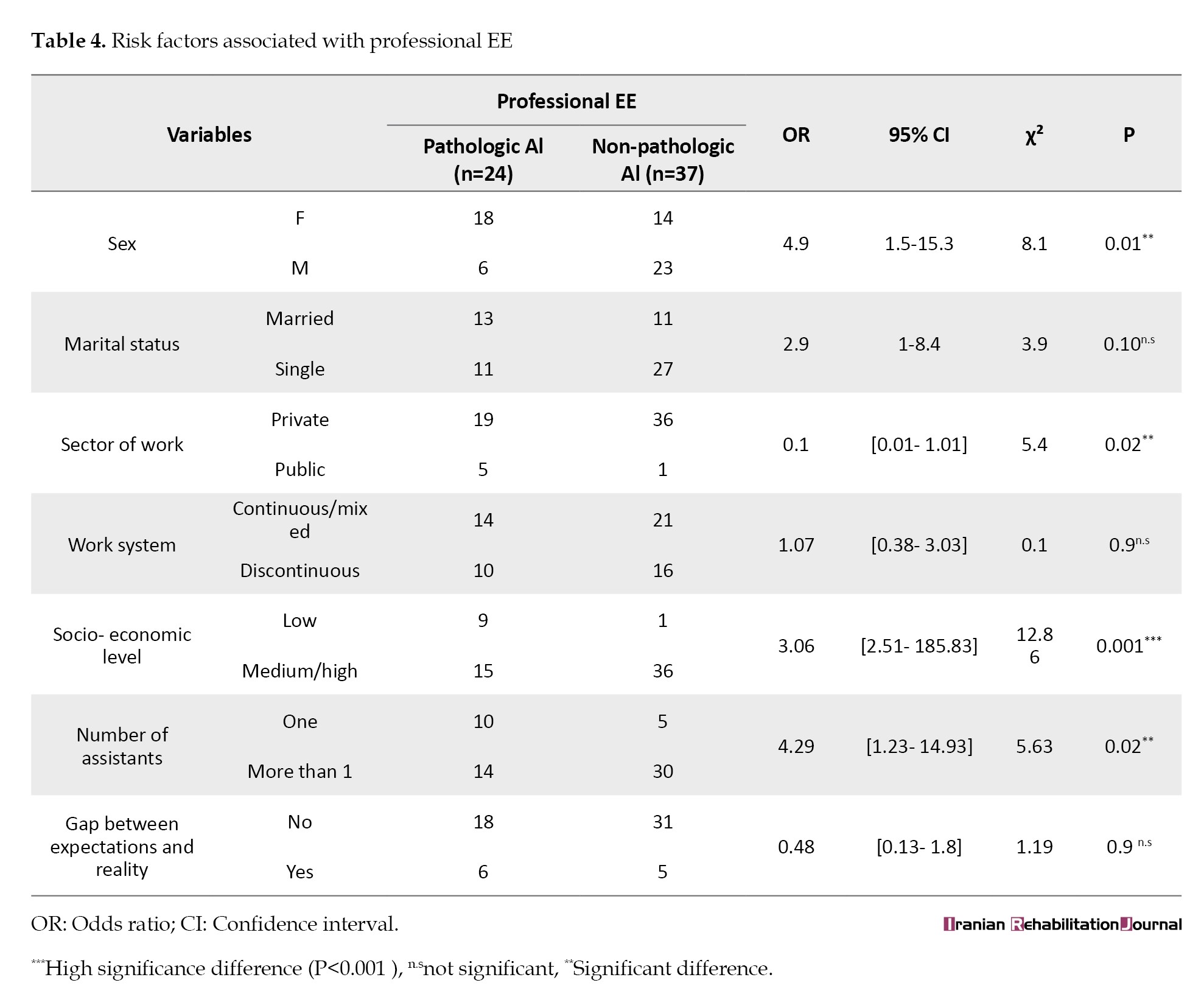
These results align with global trends indicating high levels of burnout among healthcare professionals, including dentists [6]. Comparisons with other studies highlight both similarities and differences. A study on doctors in training at Ibn Rochd University Hospital in Casablanca showed similar EE prevalence but lower rates of DP and low PA compared to our findings [9]. Conversely, research on doctors in Algeria reported a lower overall burnout prevalence of 23.5% [10]. These variations underscore the complex interplay of cultural, organizational, and individual factors influencing burnout across different healthcare settings. Notably, Moroccan medical interns exhibit alarmingly high burnout rates, reaching up to 90% [11], underscoring the urgent need for targeted interventions to support the mental health and well-being of healthcare professionals in the country. Similar international studies, such as those in France [12] and at the Faculty of Medicine in Caen [13], also demonstrated a significant prevalence of burnout among healthcare students and professionals, emphasizing the global scale of this issue.
The debate over which dimension of burnout—EE, DP, or PA—is most critical remains ongoing. Some argue that EE is central and closely linked to depression and anxiety disorders [14], while others contend that DP may be more reflective of burnout in a professional context [15]. Looking forward, the increasing workload and resource scarcity faced by healthcare professionals globally, as observed in Switzerland [16, 17], are likely to exacerbate burnout if not addressed proactively. Efforts to improve working conditions, promote work-life balance, and enhance support systems are crucial for mitigating burnout and preserving the well-being of healthcare providers.
The results of Moro et al. (2022) [6], presenting a meta-analysis on burnout syndrome among dentists globally, offer a compelling comparative perspective. This meta- analysis reveals significant variability in the overall prevalence of burnout syndrome among dentists, depending on the dimensions measured by the MBI.
Compared with our study in the Moroccan context, where we observed prevalence rates of 39.3% for EE, 41.3% for DP, and 69.8% for low PA, Moro’s results show generally lower prevalence: 28% for EE, 18% for DP, and 10% for low PA. However, it is essential to note that confidence intervals and the measure of heterogeneity (I²) indicate substantial variability among the studies included in the meta-analysis, which may reflect cultural, organizational, and methodological differences in how burnout is perceived and measured globally.
This comparison underscores the potential impact of local contextual factors, such as socio- economic conditions, professional expectations, and specific work environments, on the prevalence and manifestation of burnout among dentists.
From this perspective, our analysis of risk factors associated with professional EE among dentists highlights several significant findings. Female dentists are approximately five times more likely to experience burnout than their male counterparts, with a statistically significant OR of 4.9 and a P value of 0.01. This aligns with findings from various studies in which female dentists reported higher levels of EE and DP than males [18–21]. However, other research has found that males may be more susceptible to developing burnout [19, 22]. The increased vulnerability may stem from societal expectations and the dual pressures of professional and personal responsibilities that women often face.
Dentists in the private sector have a significantly higher risk of burnout than their public sector counterparts, with an OR of 0.1 (P=0.02). This finding contrasts with other studies indicating higher levels of burnout among dentists working in the public sector than among those in private practice [23–25]. Low socio-economic status is a crucial factor, with dentists in this category about three times more likely to experience burnout (OR=3.06, P=0.001). Additionally, having only one assistant significantly increases the risk of burnout (OR=4.29, P=0.02). In contrast, factors, such as marital status, work system, and the perceived gap between expectations and reality, do not show statistically significant associations with burnout.
The higher rates observed in our Moroccan study may be attributed to increased professional pressure, heavy workloads, and limited resources, factors that necessitate strategic interventions to support the mental health of healthcare professionals.
In conclusion, this study contributes to the growing body of evidence on burnout among dentists in Morocco, emphasizing its multifaceted nature and the necessity for comprehensive strategies to address this pervasive issue in healthcare settings worldwide.
This study has certain limitations that should be considered. The cross-sectional design limits our ability to establish cause-and-effect relationships between burnout and its associated factors. The use of a self-reported questionnaire may also lead to biases, as participants might respond in ways that reflect social desirability or misinterpret the questions. Additionally, the sample consisted only of dentists working in Morocco, which restricts the applicability of the findings to other professions or regions. Although the MBI is a validated tool, it may not fully capture burnout aspects specific to dentistry. Finally, voluntary participation could have introduced selection bias, as those experiencing high levels of burnout may have been less likely to engage in the study.
Conclusion
This study highlights the prevalence of burnout among dentists in Morocco, providing valuable insights into the factors contributing to EE, DP, and reduced PA in this profession. By using the MBI, we assessed the severity of burnout and identified significant associations with various socio-demographic and professional factors. The findings underscore the need for targeted interventions to reduce burnout, particularly in high-stress environments, such as dentistry. Preventive measures, mental health support, and workplace improvements should be prioritized to moderate the impact of burnout on both dentists’ well-being and the quality of care they provide. Future research is necessary to explore long-term trends and develop strategies for promoting a healthier work-life balance within the profession.
Ethical Considerations
Compliance with ethical guidelines
This study was approved by the Ethics Committee of Department of Applied Psychology, Faculty of Arts and Human Sciences at Sidi Mohamed Ben Abdellah University, Fez, Morocco (Code: 0102023). Participation was voluntary, with participants informed of their right to withdraw at any time. Ethical standards were strictly adhered to, ensuring the confidentiality and anonymity of participants’ data.
Funding
This research was financially supported by the “Lifelong Learning Observatory, Sidi Mohamed Ben Abdellah University, Fez, Morocco.
Authors' contributions
Conceptualization and Writing the original draf: Mouhssine Chriqui; Methodology: Zakaria Abidli and Driss Ait Ali; Software: Zakaria Abidli, Younes Rami, Khalid Ouazizi, and El Mahjoub Aouane; Validation: Hicham Khabbache; Formal analysis: Zakaria Abidli; Investigation: Zakaria Abidli, Mouhssine Chriqui, and Khalid Ouazizi; Resources: El Mahjoub Aouane; Data collection: Zakaria Abidli, and Driss Ait Ali; Project administration and funding acquisition: Hicham Khabbache; Review and editing: All authors.
Conflict of interest
The authors declared no conflicts of interest.
Acknowledgments
The authors sincerely thank all participants who contributed to this study.
According to Maslach and Leiter [1], following Freudenberg’s pioneering work [2], burnout is a psychosocial syndrome characterized by physical and emotional exhaustion (EE) that occurs in those engaged in jobs requiring extensive engagement with others. It results in self-devaluation and the formation of unfavorable professional attitudes [3]. Maslach and Leiter define burnout as having three main dimensions: EE, depersonalization or dehumanization of relationships (DP), and a diminished feeling of personal and professional accomplishment (PA) [1].
Physicians are particularly susceptible to burnout due to the high demands of their profession. They face increasing pressure from patients, societal expectations, advanced medical technologies, and their own high standards and critical self-assessment [4]. Burnout syndrome manifests as chronic exposure to substantial and harmful stress at work. Burnout can be triggered by exogenous factors from the external environment or endogenous factors originating from internal factors [5].
In response to rising burnout rates among physicians, a joint statement by the World Health Organization (WHO) and the European Forum of Medical Associations (EFMA) in Berlin in 2003 emphasized the urgent need to address this issue (WHO, 2003). Studies have shown that burnout affects 22-67.3% of general practitioners, 8.6-100% of doctors in other specialties, and 26.0-58.2% of interns and assistants [6]. According to Listopad et al. social, economic, and cultural factors play significant roles in the development and impact of burnout [7].
In Morocco, the ratio of doctors is 7.8 per 10,000 inhabitants, falling short of the WHO standard of 15.3 per 10,000. The country has only 414 public dentists, despite high demand and heavy workloads in both public and private hospitals, which impose a significant psychological burden on health professionals [8]. Despite the prevalence of these issues, few studies have examined the impact of burnout on dentists’ psychological well-being. Therefore, this study aimed to assess the prevalence of burnout among practicing dentists in Morocco and investigate associated factors.
Materials and Methods
Study design
This study used a cross-sectional design to assess burnout among dentists practicing in the public and private sectors in Morocco.
Participants
The target population consisted of dentists currently working in either the public or private sectors across Morocco. Participation was voluntary, and the sampling method allowed for the inclusion of any dentist who wished to participate in the study.
Data collection
Data were collected using a self-administered questionnaire, which included both socio-demographic and professional information (e.g. gender and age). Burnout was measured using the Maslach Burnout Inventory (MBI) developed by Maslach and Leiter [1]. The MBI consists of 22 items evaluated on a 7-point Likert scale ranging from “never” to “always.” These items were grouped into three subscales [1]:
1) EE: the feeling of being overwhelmed or drained by work. 2) DP: Characterized by feelings of detachment and impersonal responses toward patients. 3) Personal Accomplishment (PA): Involves feelings of incompetence and a decline in self- esteem at work
For interpretation of results, the original scoring system established by Maslach and Leiter was used. Burnout scores were categorized into low, moderate, and high levels (Table 1) [1].
Data analysis
The data were entered into Excel for initial processing and then analyzed using SPSS software, version 29.0.1. Descriptive statistics were utilized to summarize the socio-demographic and professional characteristics of the surveyed dentists. Inferential statistics were employed to examine associations between various risk factors and professional EE, categorized as either “pathological” or “non-pathological.” The analysis included independent variables such as gender, marital status, sector of work, work system, socioeconomic status, and the number of assistants. Odds ratios (OR) and 95% confidence intervals (CI) were computed to assess the strength of these associations, and the chi-square test (χ²) was used to evaluate statistical significance, with a threshold of P<0.05.
Results
Table 2 presents the sociodemographic and professional characteristics of the 61 dentists.
The gender ratio was balanced (P<0.798) with a slight majority of females (52.5%). The average age was 33.13±1.29 years (minimum=21 years; maximum=62 years), with a median age of 30 years. The distribution of our sample showed that 56.5% were under 30 years old. Regarding marital status, 61.3% of the dentists were single. In terms of the sector of practice, 90.2% (n=55) worked in the private sector, and 9.8% (n=6) worked in the public sector. Additionally, 45.9% preferred a continuous work system, 42.6% chose to work in a discontinuous system, and 11.2% alternated between the two. Furthermore, 50% of the interviewed dentists reported having a single dental chair, 28.3% had two chairs, and 21.7% had more than two chairs. Meanwhile, 45.8% had two assistants, 28.8% had three, and 25.4% had one. A total of 74.2% of these dentists confirmed that the socioeconomic level of their practice area was medium, 16.1% stated that the level was low, and 9.7% practiced in an area with a high socioeconomic level.
The internal validity of the MBI was assessed using Cronbach’s alpha coefficients, which demonstrated high reliability: 0.902 for EE, 0.917 for DP, and 0.903 for PA. These coefficients indicate strong internal consistency within the questionnaire. Variance analysis of the average item scores across the dimensions (EE, DP, and PA) revealed a highly significant difference (P=0.005). This suggests that the items within each dimension consistently measure the burnout components. Furthermore, the intra-dimensional dispersion, expressed as a coefficient of variation, indicates significant heterogeneity in response choices, reflecting the diverse experiences of burnout among the surveyed dentists (Table 3).
This study revealed significant levels of burnout among dentists in Morocco, as assessed using the MBI dimensions: EE, DP, and PA. EE, affecting 39.3% of dentists surveyed, reflects the intense feelings of being overwhelmed, exhausted, and stressed by their work. This dimension highlights the taxing nature of dental practice, where prolonged exposure to patient care and professional demands can lead to emotional fatigue. DP, reported by 41.3% of dentists, manifests as a detachment or cynicism toward patients and colleagues. Dentists experiencing high DP may exhibit impersonal behaviors and attitudes, potentially impacting patient care and professional relationships. Conversely, a notable 69.8% of dentists perceived low PA in their work. This dimension indicates feelings of inadequacy and a diminished sense of professional achievement. Despite this, it serves as a protective factor, potentially buffering against more severe burnout symptoms, such as EE and DP.
In the results section, we aimed to identify the risk factors associated with professional burnout (EE) among dentists by analyzing various variables. The results showed a significant difference between genders. Female dentists had a much higher risk of professional burnout than male dentists. Among the 24 pathological cases, 18 were women, and 6 were men. The OR of 4.9 (95% CI, 1.5%, 15.3%) indicated that women were approximately five times more likely to suffer from professional burnout. This association was statistically significant with a chi-square of 8.1 and a P=0.01. Marital status appears to influence professional burnout, although this influence is not statistically significant. Married dentists had an OR of 2.9 (95% CI, 1%, 8.4%), indicating that they are nearly three times as likely to be at risk as single dentists. However, the P=0.10 suggests that this difference could be due to chance.
The practice sector was a determining factor. Dentists working in the public sector are much less likely to experience professional burnout than those in the private sector. The odd ratios was 0.1 (95% CI, 0.01%, 1.01%), and the P value was 0.02, indicating a statistically significant difference, and that the private sector was associated with a higher risk of professional burnout.
The type of work system (continuous/mixed vs discontinuous) does not appear to be a significant risk factor for professional burnout. The results show an OR of 1.07 (95% CI, 0.38%, 3.03%) and a P=0.9, suggesting that the work system does not have a notable impact on the risk of burnout. The socioeconomic level is a very significant risk factor. Dentists with a low socioeconomic level are about three times as likely to experience professional burnout as those with a medium or high level. The OR is 3.06 (95% CI, 2.51%, 185.83%), with a P=0.001, indicating strong statistical significance. The number of assistants is also an important risk factor. Dentists with only one assistant are much more likely to suffer from professional burnout than those with multiple assistants, with an OR of 4.29 (95% CI, 1.23%, 14.93%) and a P=0.02, indicating a significant difference. Finally, the perception of a gap between expectations and professional reality does not seem to be a significant risk factor for professional burnout. The OR of 0.48 (95% CI, 0.13%, 1.8%) and the P=0.9 suggest that this variable does not have a notable impact on the risk of burnout. The analysis reveals that gender, practice sector, socioeconomic level, and number of assistants are significant risk factors for professional burnout among dentists. In contrast, marital status, work system, and the perception of a gap between expectations and reality do not show statistical significance in this study. These results can guide targeted interventions to prevent professional burnout in this population.
Discussion
The present study investigated burnout among 61 dentists in Morocco, utilizing the MBI to measure EE, DP, and PA. The findings revealed notable prevalence rates of 39.3% for EE, 41.3% for DP, and 69.8% for low PA. The findings revealed notable prevalence rates of 39.3% for EE, 41.3% for DP, and 69.8% for low PA" (Table 4).
These results align with global trends indicating high levels of burnout among healthcare professionals, including dentists [6]. Comparisons with other studies highlight both similarities and differences. A study on doctors in training at Ibn Rochd University Hospital in Casablanca showed similar EE prevalence but lower rates of DP and low PA compared to our findings [9]. Conversely, research on doctors in Algeria reported a lower overall burnout prevalence of 23.5% [10]. These variations underscore the complex interplay of cultural, organizational, and individual factors influencing burnout across different healthcare settings. Notably, Moroccan medical interns exhibit alarmingly high burnout rates, reaching up to 90% [11], underscoring the urgent need for targeted interventions to support the mental health and well-being of healthcare professionals in the country. Similar international studies, such as those in France [12] and at the Faculty of Medicine in Caen [13], also demonstrated a significant prevalence of burnout among healthcare students and professionals, emphasizing the global scale of this issue.
The debate over which dimension of burnout—EE, DP, or PA—is most critical remains ongoing. Some argue that EE is central and closely linked to depression and anxiety disorders [14], while others contend that DP may be more reflective of burnout in a professional context [15]. Looking forward, the increasing workload and resource scarcity faced by healthcare professionals globally, as observed in Switzerland [16, 17], are likely to exacerbate burnout if not addressed proactively. Efforts to improve working conditions, promote work-life balance, and enhance support systems are crucial for mitigating burnout and preserving the well-being of healthcare providers.
The results of Moro et al. (2022) [6], presenting a meta-analysis on burnout syndrome among dentists globally, offer a compelling comparative perspective. This meta- analysis reveals significant variability in the overall prevalence of burnout syndrome among dentists, depending on the dimensions measured by the MBI.
Compared with our study in the Moroccan context, where we observed prevalence rates of 39.3% for EE, 41.3% for DP, and 69.8% for low PA, Moro’s results show generally lower prevalence: 28% for EE, 18% for DP, and 10% for low PA. However, it is essential to note that confidence intervals and the measure of heterogeneity (I²) indicate substantial variability among the studies included in the meta-analysis, which may reflect cultural, organizational, and methodological differences in how burnout is perceived and measured globally.
This comparison underscores the potential impact of local contextual factors, such as socio- economic conditions, professional expectations, and specific work environments, on the prevalence and manifestation of burnout among dentists.
From this perspective, our analysis of risk factors associated with professional EE among dentists highlights several significant findings. Female dentists are approximately five times more likely to experience burnout than their male counterparts, with a statistically significant OR of 4.9 and a P value of 0.01. This aligns with findings from various studies in which female dentists reported higher levels of EE and DP than males [18–21]. However, other research has found that males may be more susceptible to developing burnout [19, 22]. The increased vulnerability may stem from societal expectations and the dual pressures of professional and personal responsibilities that women often face.
Dentists in the private sector have a significantly higher risk of burnout than their public sector counterparts, with an OR of 0.1 (P=0.02). This finding contrasts with other studies indicating higher levels of burnout among dentists working in the public sector than among those in private practice [23–25]. Low socio-economic status is a crucial factor, with dentists in this category about three times more likely to experience burnout (OR=3.06, P=0.001). Additionally, having only one assistant significantly increases the risk of burnout (OR=4.29, P=0.02). In contrast, factors, such as marital status, work system, and the perceived gap between expectations and reality, do not show statistically significant associations with burnout.
The higher rates observed in our Moroccan study may be attributed to increased professional pressure, heavy workloads, and limited resources, factors that necessitate strategic interventions to support the mental health of healthcare professionals.
In conclusion, this study contributes to the growing body of evidence on burnout among dentists in Morocco, emphasizing its multifaceted nature and the necessity for comprehensive strategies to address this pervasive issue in healthcare settings worldwide.
This study has certain limitations that should be considered. The cross-sectional design limits our ability to establish cause-and-effect relationships between burnout and its associated factors. The use of a self-reported questionnaire may also lead to biases, as participants might respond in ways that reflect social desirability or misinterpret the questions. Additionally, the sample consisted only of dentists working in Morocco, which restricts the applicability of the findings to other professions or regions. Although the MBI is a validated tool, it may not fully capture burnout aspects specific to dentistry. Finally, voluntary participation could have introduced selection bias, as those experiencing high levels of burnout may have been less likely to engage in the study.
Conclusion
This study highlights the prevalence of burnout among dentists in Morocco, providing valuable insights into the factors contributing to EE, DP, and reduced PA in this profession. By using the MBI, we assessed the severity of burnout and identified significant associations with various socio-demographic and professional factors. The findings underscore the need for targeted interventions to reduce burnout, particularly in high-stress environments, such as dentistry. Preventive measures, mental health support, and workplace improvements should be prioritized to moderate the impact of burnout on both dentists’ well-being and the quality of care they provide. Future research is necessary to explore long-term trends and develop strategies for promoting a healthier work-life balance within the profession.
Ethical Considerations
Compliance with ethical guidelines
This study was approved by the Ethics Committee of Department of Applied Psychology, Faculty of Arts and Human Sciences at Sidi Mohamed Ben Abdellah University, Fez, Morocco (Code: 0102023). Participation was voluntary, with participants informed of their right to withdraw at any time. Ethical standards were strictly adhered to, ensuring the confidentiality and anonymity of participants’ data.
Funding
This research was financially supported by the “Lifelong Learning Observatory, Sidi Mohamed Ben Abdellah University, Fez, Morocco.
Authors' contributions
Conceptualization and Writing the original draf: Mouhssine Chriqui; Methodology: Zakaria Abidli and Driss Ait Ali; Software: Zakaria Abidli, Younes Rami, Khalid Ouazizi, and El Mahjoub Aouane; Validation: Hicham Khabbache; Formal analysis: Zakaria Abidli; Investigation: Zakaria Abidli, Mouhssine Chriqui, and Khalid Ouazizi; Resources: El Mahjoub Aouane; Data collection: Zakaria Abidli, and Driss Ait Ali; Project administration and funding acquisition: Hicham Khabbache; Review and editing: All authors.
Conflict of interest
The authors declared no conflicts of interest.
Acknowledgments
The authors sincerely thank all participants who contributed to this study.
References
- Maslach C, Leiter MP. Understanding the burnout experience: recent research and its implications for psychiatry. World Psychiatry. 2016; 15(2):103-11. [DOI:10.1002/wps.20311] [PMID]
- Freudenberger HJ. The issues of staff burnout in therapeutic communities. Journal of Psychoactive Drugs. 1986; 18(3):247-51. [DOI:10.1080/02791072.1986.10472354] [PMID]
- Edú-Valsania S, Laguía A, Moriano JA. Burnout: A Review of Theory and Measurement. International Journal of Environmental Research and Public Health. 2022; 19(3):1780. [DOI:10.3390/ijerph19031780] [PMID]
- Patel RS, Bachu R, Adikey A, Malik M, Shah M. Factors related to physician burnout and its consequences: A review. Behavioral Sciences. 2018; 8(11):98. [DOI:10.3390/bs8110098] [PMID]
- Shin P, Desai V, Conte AH, Qiu C. Time out: The impact of physician burnout on patient care quality and safety in perioperative medicine. The Permanente Journal. 2023; 27(2):160-8. [DOI:10.7812/TPP/23.015] [PMID]
- Moro JDS, Soares JP, Massignan C, Oliveira LB, Ribeiro DM, Cardoso M, et al. Burnout syndrome among dentists: A systematic review and meta-analysis. The Journal of Evidence-Based Dental Practice. 2022; 22(3):101724. [DOI:10.1016/j.jebdp.2022.101724] [PMID]
- Listopad IW, Michaelsen MM, Werdecker L, Esch T. Bio-psycho-socio-Spirito-cultural factors of burnout: A systematic narrative review of the literature. Frontiers in Psychology. 2021; 12:722862. [DOI:10.3389/fpsyg.2021.722862] [PMID]
- Jallal M, Serhier Z, Berrami H, Othmani MB. Current State and Prospects of Telemedicine in Morocco: Analysis of Challenges, Initiatives, and Regulatory Framework. Cureus. 2023; 15(12):e50963. [DOI:10.7759/cureus.50963]
- El Kettani A, Serhier Z, Othmani MB, Agoub M, Battas O. Evaluation of burnout syndrome among doctors in training at the Ibn Rochd University Hospital, Casablanca. Pan African Medical Journal. 2017; 27:243. [DOI:10.11604/pamj.2017.27.243.6257]
- Boussouf N, Boudrioua D, Khalfi S, Leila B, Zoughailech D. Stress et burn-out chez les étudiants en médecine à Constantine, Algérie. Revue d'Épidémiologie et de Santé Publique. 2016; 64(Supplement 3):S142. [DOI:10.1016/j.respe.2016.03.069]
- El Bouri H, Benslimane I, Nani S. Burnout syndrome chez les internes en médecine marocains. Sante Publique (Vandoeuvre-les-Nancy, France). 2022; 34(3):415-23. [DOI:10.3917/spub.223.0415] [PMID]
- Moukarzel A, Michelet P, Durand AC, Sebbane M, Bourgeois S, Markarian T, et al. Burnout syndrome among emergency department staff: Prevalence and associated factors. BioMed Research International. 2019; 2019:6462472.[DOI:10.1155/2019/6462472] [PMID]
- Breton P, Morello R, Chaussarot P, Delamillieure P, Le Coutour X. [Burnout syndrome among third year medical students in Caen: Prevalence and associated factors (French)]. Revue D'epidemiologie et de Sante Publique. 2019; 67(2):85-91. [DOI:10.1016/j.respe.2019.01.119] [PMID]
- Alwhaibi M, Alhawassi TM, Balkhi B, Al Aloola N, Almomen AA, Alhossan A, et al. Burnout and depressive symptoms in healthcare professionals: A cross-sectional study in Saudi Arabia. Healthcare. 2022; 10(12):2447. [DOI:10.3390/healthcare10122447] [PMID]
- Dall’Ora C, Ball J, Reinius M, Griffiths P. Burnout in nursing: A theoretical review. Human Resources for Health. 2020; 18(1):41. [DOI:10.1186/s12960-020-00469-9] [PMID]
- Athimni Z, Chouchen A, Kalboussi H, Nsiri L, Ferhi F, Aloui A, et al. Burnout Syndrome and its associated factors among anesthesia technicians in a Teaching Hospital in the central region of Tunisia. European Psychiatry. 2023; 66(1):S462–3. [DOI:10.1192/j.eurpsy.2023.992] [PMCID]
- Shanafelt TD, Sloan JA, Habermann TM. The Well-Being of Physicians. The American Journal of Medicine. 2003; 114(6):513-9. [PMID]
- Singh P, Aulak DS, Mangat SS, Aulak MS. Systematic review: Factors contributing to burnout in dentistry. Occupational Medicine. 2016 ;66(1):27-31. [DOI:10.1093/occmed/kqv119] [PMID]
- Kulkarni S, Dagli N, Duraiswamy P, Desai H, Vyas H, Baroudi K. Stress and professional burnout among newly graduated dentists. Journal of International Society of Preventive & Community Dentistry. 2016; 6(6):535-41. [DOI:10.4103/2231-0762.195509] [PMID]
- Ciğerim L, Orhan ZD, Doğru İ, Kahraman NH, Hussein A, Baş H. Factors Influencing Burnout Syndrome and Depression in Dentists across Various Institutions. Medicina. 2024; 60(3):517. [DOI:10.3390/medicina60030517] [PMID]
- Slabšinskienė E, Gorelik A, Kavaliauskienė A, Zaborskis A. Burnout and its relationship with demographic and job-related variables among dentists in lithuania: A cross-sectional study. International Journal of Environmental Research and Public Health. 2021; 18(8):3968. [DOI:10.3390/ijerph18083968] [PMID]
- Arora S, Knight A. Questionnaire Survey of Burnout Amongst Dentists in Singapore. International Dental Journal. 2022; 72(2):161-8. [DOI:10.1016/j.identj.2021.08.054] [PMID]
- Huri M, Bağış N, Eren H, Umaroğlu M, Orhan K. Association between burnout and depressive symptoms among Turkish dentists. Journal of Dental Sciences. 2016; 11(4):353-9. [DOI:10.1016/j.jds.2016.03.006] [PMID]
- Vered Y, Zaken Y, Ovadia-Gonen H, Mann J, Zini A. Professional burnout: Its relevance and implications for the general dental community. Quintessence International. 2014; 45(1):87-90. [DOI:10.3290/j.qi.a30763] [PMID]
- Zini A, Zaken Y, Ovadia-Gonen H, Mann J, Vered Y. Burnout level among general and specialist dentists: A global manpower concern. Occupational Medicine and Health Affairs. 2013; 1(128):e31. [Link]
Article type: Original Research Articles |
Subject:
Social work
Received: 2025/06/3 | Accepted: 2025/11/22 | Published: 2026/04/1
Received: 2025/06/3 | Accepted: 2025/11/22 | Published: 2026/04/1
Send email to the article author

Copyright © The Author(s);
This is an open access article distributed under the terms of the Creative Commons Attribution-NonCommercial 4.0 (CC-By-NC 4.0), which permits use, distribution, and reproduction in any medium, provided the original work is properly cited and is not used for commercial purposes.
Contact Information
