
988368
Sun, Oct 18, 2026

Volume 24, Issue 2 (June 2026)
Iranian Rehabilitation Journal 2026, 24(2): 167-176 |
Back to browse issues page



Download citation:
BibTeX | RIS | EndNote | Medlars | ProCite | Reference Manager | RefWorks
Send citation to:


BibTeX | RIS | EndNote | Medlars | ProCite | Reference Manager | RefWorks
Send citation to:
Taheri P, Hoseinzade F, Maghroori R. Mesotherapy vs Transcutaneous Electrical Nerve Stimulation for Chronic Low Back Pain in Patients With Radiculopathy. Iranian Rehabilitation Journal 2026; 24 (2) :167-176
URL: http://irj.uswr.ac.ir/article-1-2592-en.html
URL: http://irj.uswr.ac.ir/article-1-2592-en.html

1- Department of Physical Medicine and Rehabilitation, Isfahan University of Medical Science, Isfahan, Iran.
Keywords: Herniated disc, Radiculopathy, Chronic low back pain (CLBP), Transcutaneous electrical nerve stimulation (TENS), Mesotherapy
Full-Text [PDF 504 kb]
(282 Downloads)
| Abstract (HTML) (2679 Views)
Full-Text: (204 Views)
Introduction
Low back pain (LBP) is a pervasive and disabling global health condition, representing a major socioeconomic challenge due to its high associated healthcare costs and impact on work disability [1, 2]. Its lifetime prevalence in the adult population is estimated to be as high as 80%, with many individuals transitioning to chronic low back pain (CLBP), defined as pain persisting beyond 12 weeks [3, 4]. Although most cases are nonspecific, a substantial portion arises from specific spinal pathologies [4]. Lumbar radiculopathy due to nerve root compression is a common presentation of specific LBP, most frequently caused by a herniated intervertebral disc or spinal stenosis [4, 5]. Risk factors for LBP are multifactorial and include age, occupational exposures, such as heavy lifting, and various psychosocial factors [2, 5].
The management of CLBP with radiculopathy is centered on a multimodal, conservative-first paradigm that combines patient education, physical therapy, and pharmacologic interventions [3, 5]. Clinical practice guidelines commonly endorse non-pharmacologic strategies such as supervised exercise and manual therapy as foundational treatments, alongside education on maintaining activity and a favorable prognosis [4, 6]. These are often supplemented with pharmacologic agents, including nonsteroidal anti-inflammatory drugs, and, for neuropathic components, medications, such as gabapentin. For refractory symptoms, interventional procedures such as epidural steroid injections are frequently employed, though their efficacy is often temporary [3, 7]. Despite this array of options, many interventions have failed to consistently provide lasting pain relief, with numerous modalities supported by low-certainty evidence, rendering their outcomes unpredictable for a significant subset of patients [1, 4].
Among conservative modalities for managing CLBP, transcutaneous electrical nerve stimulation (TENS) is a widely employed, non-invasive, and safe method with a low side-effect profile [8]. TENS involves the pulsatile stimulation of sensory fibers and is primarily theorized to reduce pain via the 'gate control' mechanism, where the stimulation of large-diameter A-β sensory afferents inhibits the transmission of nociceptive signals from smaller A-δ and C fibers [8, 9]. However, despite its frequent use, evidence for the efficacy of TENS is conflicting, with some studies showing only slight reductions in pain and no effect on functional disability [9]. Separately, mesotherapy, which involves intradermal micro-injections of therapeutic agents, has emerged as another promising treatment for localized musculoskeletal pain [10, 11]. This technique facilitates slower drug diffusion, allowing for a localized therapeutic effect with a lower risk of systemic complications [11]. Reviews suggest it is a well-tolerated and effective option for reducing both acute and chronic musculoskeletal vertebral pain [10]. In this study, mesotherapy was injected using a new combination of acupuncture points to investigate the effectiveness of the new injection point compared to previous studies.
Despite the promise of symptomatic resolution with newly incorporated non-invasive therapeutic modalities such as TENS and mesotherapy, quality evidence is lacking to formulate robust recommendations. Accordingly, this study aimed to compare TENS and mesotherapy in a cohort of patients with CLBP due to magnetic resonance imaging (MRI)-confirmed herniated disc in an open-label randomized trial.
Materials and Methods
Study design and patient enrollment
Our study was designed as an open-label randomized clinical trial containing two treatment arms with blinded outcome evaluation. Patients who presented to the physical medicine and rehabilitation outpatient clinics affiliated with Isfahan University of Medical Sciences during 2023-2024 were assessed according to the eligibility criteria and enrolled in the study accordingly.
Eligibility criteria
The inclusion criteria were aged >18 years, a diagnosis of radicular CLBP due to disc herniation confirmed in an MRI study examined by a physical medicine specialist, and moderate to severe pain intensity (i.e. six and above on the visual analog scale [VAS]). Patients with a history of surgery within the preceding three months, rheumatological disease, neurological disease (e.g. multiple sclerosis, central or peripheral neuropathy), other systemic diseases (e.g., diabetes mellitus, chronic kidney disease), structural spinal pathologies (e.g. spondylolysis, spondylolisthesis, vertebral fracture, scoliosis), metabolic diseases of bone (e.g. Paget’s disease), coagulopathy including primary (e.g. hemophilia) or secondary (e.g. warfarin use) conditions, illicit drug abuse, infection at the site of planned mesotherapy injection, sacroiliac inflammation detected in physical examination, use of complementary treatment modalities, including acupuncture, herbal medication, TENS, or mesotherapy, within the preceding 4 weeks, or allergy to mesotherapy medications, including lidocaine and piroxicam, or neoplastic disorders were excluded from the study.
Patient randomization and allocation
Eligible patients were randomly allocated to either the TENS group or mesotherapy group in a 1:1 ratio. A computer-generated random number sequence was used, employing a permuted block randomization design with randomly varying block sizes of 4 and 6, including six of 4 (24 patients) and six blocks of 6 (36 patients). This method ensures that the number of participants in each treatment arm remains closely balanced throughout the enrollment period.
The randomization list was generated using The R Project for Statistical Computing by a study statistician with no clinical involvement in the trial. To ensure allocation concealment, the treatment arms were placed in sequentially numbered, sealed, opaque envelopes. After a participant was enrolled, the next available envelope in the sequence was opened by a study coordinator to reveal the group assignment. Given the nature of the therapeutic procedures, patients and the treating therapists could not be blinded.
Treatment arms
The two treatment arms of our study included the mesotherapy and TENS groups. All patients, regardless of their allocated treatment group, received baseline treatment comprising baclofen (10 mg daily) and Williams Flexion Exercises [12] for five sets three times daily.
Mesotherapy group
The mesotherapy solution comprised 1 mL of 2% lidocaine and 1 mL of 20 mg/mL piroxicam. Patients in the mesotherapy group received subcutaneous mesotherapy injection at 10 acupuncture points associated with LBP, including BL22, BL23, BL24, BL25, BL51, BL52, BL40, BL36, GB30, and K3. Mesotherapy treatment was conducted twice weekly for three consecutive weeks, for a total of six sessions.
TENS group
Patients in the TENS group received an electrical current of 100 Hz with a pulse width of 200-300 microseconds for 20 minutes through four electrodes every other day for a total of 10 sessions. TENS currents were produced using a Novin Multi Stim 735X (Novin Medical Engineering Company, No. 510, Parsian Complex, Charbagh Bala, Isfahan, Iran) device. The TENS pads were placed paraspinally over the lumbar region, targeting the areas of pain in the lower back.
Harms monitoring
Patients were actively monitored during each treatment session and at all follow-up visits for adverse events, including hematoma, infection, allergic reactions, neurological symptoms, and TENS-related skin irritation or burns. Participants were also instructed to report any delayed adverse effects by telephone. No adverse events were identified during active surveillance.
Treatment fidelity
All mesotherapy injections and TENS applications were administered by a board-certified physical medicine and rehabilitation specialist with >10 years of clinical experience. The intervention protocol was standardized, and the treating physicians adhered to a predefined procedural checklist to ensure fidelity across participants.
Outcome measures
The outcomes of our study were assessed using a VAS on a discrete scale of 0 (no pain) to 10 (worst possible pain), classified as mild (1-3), moderate (4-7), and severe (8-10), and the Roland-Morris disability questionnaire (RMDQ) [13]. Both outcome measures were assessed before the treatment initiation, immediately after completion of the treatment courses, and one month and two months after treatment termination. The researcher in charge of patient handling during the acquisition of outcome measures was blinded to the allocated treatment groups.
Statistical analysis
Categorical and continuous variables were described as frequency (percentage of relative frequency) and Mean±SD. Independent samples t-test and chi-square or Fisher’s exact test were used to assess differences in continuous and categorical variables, respectively, among the two groups. Analysis of covariance (ANCOVA) was used to adjust for baseline VAS and RMDQ because it improves precision by accounting for initial differences. Repeated-measures ANCOVA was used to compare outcomes while adjusting for baseline values. This approach provided unbiased estimates of treatment effects when baseline imbalance exists.
Results
Table 1 presents the results of the comparison of demographic characteristics, pain scores, and RMDQ scores in the two groups: TENS and mesotherapy (MESO).
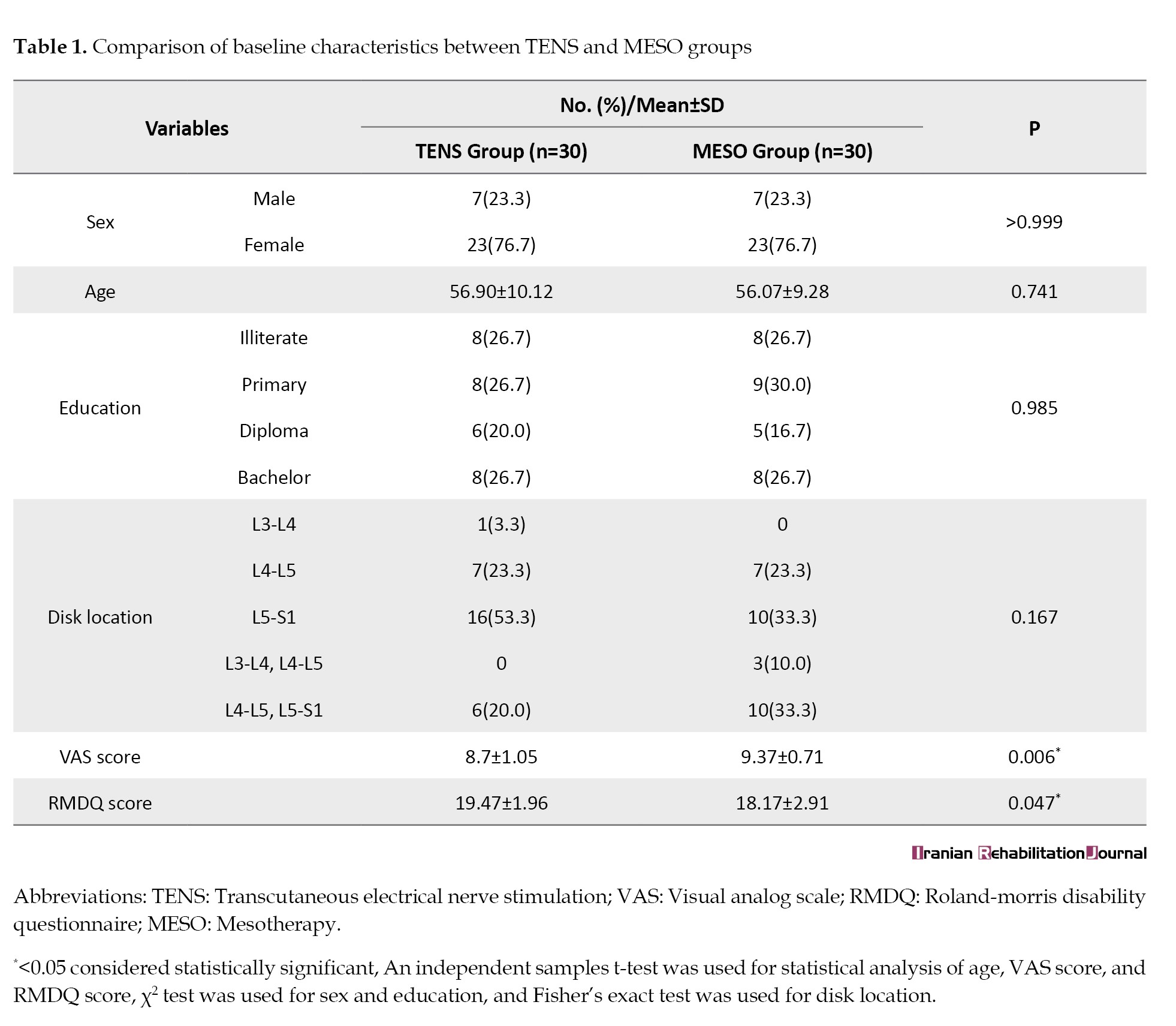
The results indicated no significant difference in the frequency distribution of gender, education level, and disk location, or the average age between the two study groups (P>0.05). However, the pain score and RMDQ score at baseline showed significant differences between the two groups (P<0.05) (Table 1).
Table 2 presents the results of the comparison of the average pain and RMDQ scores over time (before, immediately after, one month later, and two months after the intervention).
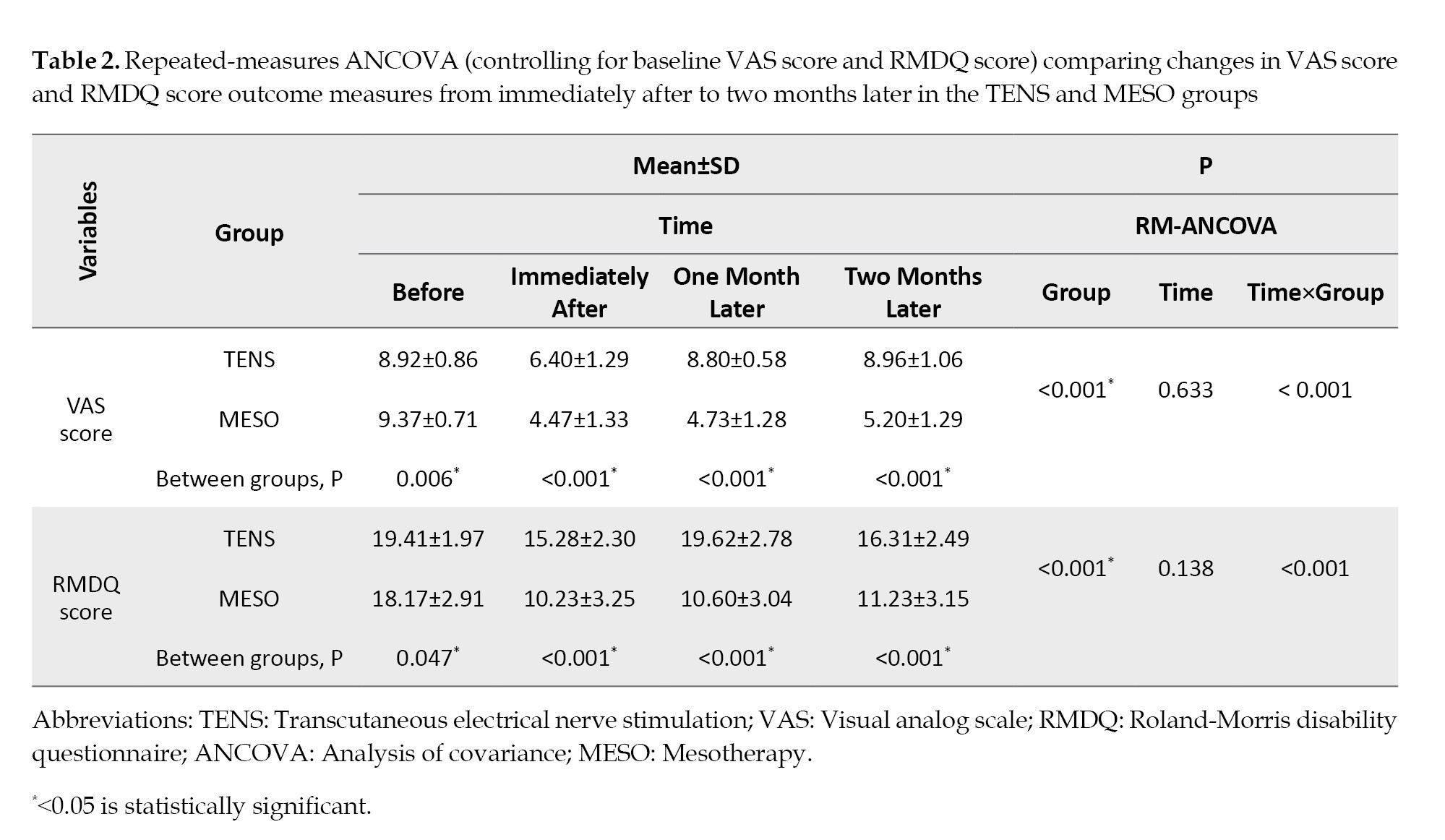
The results obtained from the independent t-test indicated a statistically significant difference between the average pain scores in the two groups, TENS and MESO, at the time before the intervention (P=0.006), immediately after the intervention (P<0.001), one month after the intervention (P<0.001), and two months after the intervention (P<0.001) (Table 1).
The results obtained from the independent t-test indicated a statistically significant difference between the average RMDQ scores in the two groups, TENS and MESO, at the time before the intervention (P=0.047), immediately after the intervention (P<0.001), one month after the intervention (P<0.001), and two months after the intervention (P<0.001) (Table 1).
The results obtained from the repeated-measures ANCOVA, controlling for the baseline pain score, showed that the main effect of the group on pain score was significant (P<0.001). In other words, a significant difference in pain scores was observed between the two groups, TENS and MESO. Additionally, the main effect of the interaction between time and group was significant on the average pain score (P<0.001). In other words, a significant difference in pain scores was observed between the two groups, TENS and MESO, at different time points.
The main effect of time on pain score was not significant (P=0.633); in other words, no significant difference was observed in pain scores across different time levels.
The results obtained from the repeated-measures ANCOVA, controlling for the baseline RMDQ score, indicated that the main effect of the group on the RMDQ score was significant (P<0.001). In other words, a significant difference in RMDQ scores was observed between the two groups, TENS and MESO. Additionally, the main effect of the interaction of time and group was significant on the average RMDQ score (P<0.001). In other words, a significant difference in RMDQ scores was observed between the two groups, TENS and MESO, at different time points.
The main effect of time on the RMDQ score was not significant (P=0.138); in other words, no significant difference in RMDQ scores was observed across different time levels.
Based on the results of the Bonferroni post hoc test, the average pain score in the MESO groups showed a significant reduction at the times immediately after, one month after, and two months after the intervention compared to the baseline, while no statistically significant differences were observed between other time points.
However, in the TENS group, only the pain score obtained immediately after treatment was significantly different from the baseline score (P<0.001), while one (P=0.478) and two months (P=0.802) after, pain scores did not significantly differ from the initial pain score. Additionally, pain scores at one month and two months after the treatment did not show any significant difference (P=0.738).
Based on the results of the Bonferroni post hoc test, the average RMDQ score in the MESO group showed a significant reduction at the times immediately after, one month after, and two months after the intervention compared to the baseline, while no statistically significant differences were observed between other time points.
However, in the TENS group, only the RMDQ score obtained immediately after treatment was significantly different from the baseline score (P<0.001), while one month (P=0.711) and two months (P=0.804) after, RMDQ scores did not significantly differ from the initial RMDQ score. Additionally, RMDQ scores at one month and two months after the treatment did not show any significant difference (P=0.605).
Discussion
This open-label randomized clinical trial was designed to compare the efficacy of TENS versus mesotherapy in patients with CLBP secondary to MRI-confirmed radiculopathy. The primary findings demonstrated that while both treatment modalities led to a significant improvement in pain and functional disability compared to their respective baselines, mesotherapy resulted in statistically superior outcomes at all post-treatment time points. Specifically, the mesotherapy group experienced a significant and sustained reduction in both VAS and RMDQ scores that persisted through the two-month follow-up. In stark contrast, the therapeutic benefit in the TENS group was transient, with pain and disability scores returning to levels not significantly different from baseline by the one-month mark. These results contribute to the ongoing search for effective, minimally invasive treatments for a condition that often responds poorly to conventional therapies [15, 16].
The robust and sustained effect observed in our mesotherapy group aligns with its proposed mechanism of action, which involves the injection of active substances into the superficial layers of the skin to achieve a high local concentration and prolonged therapeutic effect [17]. This technique aims to maximize the local pharmacological effect—in our case, the anti-inflammatory action of piroxicam and the anesthetic effect of lidocaine—while minimizing systemic exposure and associated adverse events [18]. Our findings are consistent with multiple reviews and trials that have established mesotherapy as a well-tolerated and effective option for reducing both acute and chronic musculoskeletal pain [17, 19]. The choice of injection site may also be a critical factor; a study by Di Cesare et al. found that injecting into acupuncture points, as was done in our study, yielded more effective pain relief for CLBP than injections into trigger points [20], suggesting a potential synergistic effect between the pharmacological action and the stimulation of specific neurovascular nodes.
The performance of the TENS group in our study accurately reflected the complex and often conflicting evidence base for this modality. We observed a statistically significant improvement in pain and disability immediately after treatment, which is consistent with the ‘gate control theory’ of pain, in which electrical stimulation of large-diameter afferent nerve fibers is thought to inhibit the transmission of pain signals from smaller nociceptive fibers [21, 22]. However, the evidence for TENS remains contested. The meta-analysis by Resende et al. found that TENS was superior to placebo only during therapy, with the effect disappearing at follow-up, a pattern that mirrors our findings precisely [23]. The initial benefit in our TENS group waned significantly at one and two months. This transient effect is a well-documented limitation, with other studies on radiculopathy also reporting a lack of sustained benefit [24, 25]. Furthermore, the wide variability in TENS protocols across studies—including differences in frequency, pulse width, and electrode placement—contributes to the heterogeneous results in the literature, making definitive conclusions about its efficacy challenging [26, 27].
The sustained superiority of mesotherapy over TENS in our trial is a key finding. We attribute this significant difference primarily to the distinct therapeutic mechanisms and the specific pathology of our patient cohort. Chronic radiculopathy secondary to a herniated disc is characterized by both mechanical nerve root compression and significant chemical irritation from inflammatory mediators released by the nucleus pulposus [5]. Mesotherapy, with its direct delivery of an anti-inflammatory agent (piroxicam), directly addresses this underlying inflammatory pathophysiology. TENS, in contrast, provides only symptomatic neuromodulation of pain perception without altering the local inflammatory environment [23]. Therefore, it is logical that the direct pharmacological intervention of mesotherapy produced a more profound and, crucially, more durable effect than the symptomatic modulation of TENS.
From a clinical perspective, these findings suggest that for patients with moderate-to-severe chronic radicular pain from a herniated disc, mesotherapy may be a more robust treatment option than TENS. The ability of mesotherapy to provide significant and lasting relief for at least two months could be instrumental in breaking the cycle of pain and inactivity, thereby creating a “therapeutic window” for patients to engage more fully in the active components of rehabilitation, such as the prescribed Williams Flexion Exercises. This aligns with the consensus that CLBP is a heterogeneous condition that is best managed with a multimodal approach, where passive treatments facilitate active participation [16]. Clinical practice guidelines consistently endorse a combination of education, exercise, and manual therapies, with pharmacology as an adjunct [28, 29]. Our findings suggest mesotherapy may be a particularly effective adjunct for this patient population.
Several limitations of our study must be acknowledged. First, the open-label design means that patient and therapist expectations could have influenced the results. Although the outcome assessor was blinded, performance bias cannot be fully excluded. Second, our trial began with a statistically significant difference in baseline VAS and RMDQ scores between the groups. We adjusted for this covariable in our statistical analysis (ANCOVA), which is the appropriate method to account for such differences; however, this initial imbalance remains a limitation. Third, our sample size of 60 patients, while sufficient to detect the large differences observed, may have been underpowered to detect smaller but still clinically relevant differences at longer follow-up intervals. Finally, our study population was highly specific, and the findings may not be generalizable to patients with nonspecific LBP or radiculopathy from other causes, such as spinal stenosis.
In this study, none of the patients experienced treatment complications, including hematoma, injection site ulcers, allergies, drug side effects, or burns from TENS.
Conclusion
In conclusion, this study demonstrates that while both mesotherapy and TENS are effective in the short term for chronic radicular LBP, mesotherapy provides a significantly greater and more durable reduction in both pain and disability that is sustained for at least two months. In contrast, the effect of TENS was transient. Based on these results, mesotherapy appears to be a more effective therapeutic option for this specific condition. Future research should focus on larger, sham-controlled trials with longer follow-up periods to confirm these findings and to explore the long-term role of mesotherapy within a comprehensive rehabilitation program for patients with chronic radiculopathy.
Ethical Considerations
Compliance with ethical guidelines
This study was approved by the Ethics Committee of Isfahan University of Medical Sciences, Isfahan, Iran (Code: IR.MUI.MED.REC.1402.263), was explained to eligible patients, and written informed consent was obtained before patient allocation.
Funding
This research was supported by the research project (Code: 3402289) and financially supported by Isfahan University of Medical Sciences, Isfahan, Iran.
Authors' contributions
All authors contributed equally to the conception and design of the study, data collection and analysis, interpretation of the results, and drafting of the manuscript. Each author approved the final version of the manuscript for submission.
Conflict of interest
The authors declared no conflicts of interest.
Low back pain (LBP) is a pervasive and disabling global health condition, representing a major socioeconomic challenge due to its high associated healthcare costs and impact on work disability [1, 2]. Its lifetime prevalence in the adult population is estimated to be as high as 80%, with many individuals transitioning to chronic low back pain (CLBP), defined as pain persisting beyond 12 weeks [3, 4]. Although most cases are nonspecific, a substantial portion arises from specific spinal pathologies [4]. Lumbar radiculopathy due to nerve root compression is a common presentation of specific LBP, most frequently caused by a herniated intervertebral disc or spinal stenosis [4, 5]. Risk factors for LBP are multifactorial and include age, occupational exposures, such as heavy lifting, and various psychosocial factors [2, 5].
The management of CLBP with radiculopathy is centered on a multimodal, conservative-first paradigm that combines patient education, physical therapy, and pharmacologic interventions [3, 5]. Clinical practice guidelines commonly endorse non-pharmacologic strategies such as supervised exercise and manual therapy as foundational treatments, alongside education on maintaining activity and a favorable prognosis [4, 6]. These are often supplemented with pharmacologic agents, including nonsteroidal anti-inflammatory drugs, and, for neuropathic components, medications, such as gabapentin. For refractory symptoms, interventional procedures such as epidural steroid injections are frequently employed, though their efficacy is often temporary [3, 7]. Despite this array of options, many interventions have failed to consistently provide lasting pain relief, with numerous modalities supported by low-certainty evidence, rendering their outcomes unpredictable for a significant subset of patients [1, 4].
Among conservative modalities for managing CLBP, transcutaneous electrical nerve stimulation (TENS) is a widely employed, non-invasive, and safe method with a low side-effect profile [8]. TENS involves the pulsatile stimulation of sensory fibers and is primarily theorized to reduce pain via the 'gate control' mechanism, where the stimulation of large-diameter A-β sensory afferents inhibits the transmission of nociceptive signals from smaller A-δ and C fibers [8, 9]. However, despite its frequent use, evidence for the efficacy of TENS is conflicting, with some studies showing only slight reductions in pain and no effect on functional disability [9]. Separately, mesotherapy, which involves intradermal micro-injections of therapeutic agents, has emerged as another promising treatment for localized musculoskeletal pain [10, 11]. This technique facilitates slower drug diffusion, allowing for a localized therapeutic effect with a lower risk of systemic complications [11]. Reviews suggest it is a well-tolerated and effective option for reducing both acute and chronic musculoskeletal vertebral pain [10]. In this study, mesotherapy was injected using a new combination of acupuncture points to investigate the effectiveness of the new injection point compared to previous studies.
Despite the promise of symptomatic resolution with newly incorporated non-invasive therapeutic modalities such as TENS and mesotherapy, quality evidence is lacking to formulate robust recommendations. Accordingly, this study aimed to compare TENS and mesotherapy in a cohort of patients with CLBP due to magnetic resonance imaging (MRI)-confirmed herniated disc in an open-label randomized trial.
Materials and Methods
Study design and patient enrollment
Our study was designed as an open-label randomized clinical trial containing two treatment arms with blinded outcome evaluation. Patients who presented to the physical medicine and rehabilitation outpatient clinics affiliated with Isfahan University of Medical Sciences during 2023-2024 were assessed according to the eligibility criteria and enrolled in the study accordingly.
Eligibility criteria
The inclusion criteria were aged >18 years, a diagnosis of radicular CLBP due to disc herniation confirmed in an MRI study examined by a physical medicine specialist, and moderate to severe pain intensity (i.e. six and above on the visual analog scale [VAS]). Patients with a history of surgery within the preceding three months, rheumatological disease, neurological disease (e.g. multiple sclerosis, central or peripheral neuropathy), other systemic diseases (e.g., diabetes mellitus, chronic kidney disease), structural spinal pathologies (e.g. spondylolysis, spondylolisthesis, vertebral fracture, scoliosis), metabolic diseases of bone (e.g. Paget’s disease), coagulopathy including primary (e.g. hemophilia) or secondary (e.g. warfarin use) conditions, illicit drug abuse, infection at the site of planned mesotherapy injection, sacroiliac inflammation detected in physical examination, use of complementary treatment modalities, including acupuncture, herbal medication, TENS, or mesotherapy, within the preceding 4 weeks, or allergy to mesotherapy medications, including lidocaine and piroxicam, or neoplastic disorders were excluded from the study.
Patient randomization and allocation
Eligible patients were randomly allocated to either the TENS group or mesotherapy group in a 1:1 ratio. A computer-generated random number sequence was used, employing a permuted block randomization design with randomly varying block sizes of 4 and 6, including six of 4 (24 patients) and six blocks of 6 (36 patients). This method ensures that the number of participants in each treatment arm remains closely balanced throughout the enrollment period.
The randomization list was generated using The R Project for Statistical Computing by a study statistician with no clinical involvement in the trial. To ensure allocation concealment, the treatment arms were placed in sequentially numbered, sealed, opaque envelopes. After a participant was enrolled, the next available envelope in the sequence was opened by a study coordinator to reveal the group assignment. Given the nature of the therapeutic procedures, patients and the treating therapists could not be blinded.
Treatment arms
The two treatment arms of our study included the mesotherapy and TENS groups. All patients, regardless of their allocated treatment group, received baseline treatment comprising baclofen (10 mg daily) and Williams Flexion Exercises [12] for five sets three times daily.
Mesotherapy group
The mesotherapy solution comprised 1 mL of 2% lidocaine and 1 mL of 20 mg/mL piroxicam. Patients in the mesotherapy group received subcutaneous mesotherapy injection at 10 acupuncture points associated with LBP, including BL22, BL23, BL24, BL25, BL51, BL52, BL40, BL36, GB30, and K3. Mesotherapy treatment was conducted twice weekly for three consecutive weeks, for a total of six sessions.
TENS group
Patients in the TENS group received an electrical current of 100 Hz with a pulse width of 200-300 microseconds for 20 minutes through four electrodes every other day for a total of 10 sessions. TENS currents were produced using a Novin Multi Stim 735X (Novin Medical Engineering Company, No. 510, Parsian Complex, Charbagh Bala, Isfahan, Iran) device. The TENS pads were placed paraspinally over the lumbar region, targeting the areas of pain in the lower back.
Harms monitoring
Patients were actively monitored during each treatment session and at all follow-up visits for adverse events, including hematoma, infection, allergic reactions, neurological symptoms, and TENS-related skin irritation or burns. Participants were also instructed to report any delayed adverse effects by telephone. No adverse events were identified during active surveillance.
Treatment fidelity
All mesotherapy injections and TENS applications were administered by a board-certified physical medicine and rehabilitation specialist with >10 years of clinical experience. The intervention protocol was standardized, and the treating physicians adhered to a predefined procedural checklist to ensure fidelity across participants.
Outcome measures
The outcomes of our study were assessed using a VAS on a discrete scale of 0 (no pain) to 10 (worst possible pain), classified as mild (1-3), moderate (4-7), and severe (8-10), and the Roland-Morris disability questionnaire (RMDQ) [13]. Both outcome measures were assessed before the treatment initiation, immediately after completion of the treatment courses, and one month and two months after treatment termination. The researcher in charge of patient handling during the acquisition of outcome measures was blinded to the allocated treatment groups.
Statistical analysis
Categorical and continuous variables were described as frequency (percentage of relative frequency) and Mean±SD. Independent samples t-test and chi-square or Fisher’s exact test were used to assess differences in continuous and categorical variables, respectively, among the two groups. Analysis of covariance (ANCOVA) was used to adjust for baseline VAS and RMDQ because it improves precision by accounting for initial differences. Repeated-measures ANCOVA was used to compare outcomes while adjusting for baseline values. This approach provided unbiased estimates of treatment effects when baseline imbalance exists.
Results
Table 1 presents the results of the comparison of demographic characteristics, pain scores, and RMDQ scores in the two groups: TENS and mesotherapy (MESO).
The results indicated no significant difference in the frequency distribution of gender, education level, and disk location, or the average age between the two study groups (P>0.05). However, the pain score and RMDQ score at baseline showed significant differences between the two groups (P<0.05) (Table 1).
Table 2 presents the results of the comparison of the average pain and RMDQ scores over time (before, immediately after, one month later, and two months after the intervention).
The results obtained from the independent t-test indicated a statistically significant difference between the average pain scores in the two groups, TENS and MESO, at the time before the intervention (P=0.006), immediately after the intervention (P<0.001), one month after the intervention (P<0.001), and two months after the intervention (P<0.001) (Table 1).
The results obtained from the independent t-test indicated a statistically significant difference between the average RMDQ scores in the two groups, TENS and MESO, at the time before the intervention (P=0.047), immediately after the intervention (P<0.001), one month after the intervention (P<0.001), and two months after the intervention (P<0.001) (Table 1).
The results obtained from the repeated-measures ANCOVA, controlling for the baseline pain score, showed that the main effect of the group on pain score was significant (P<0.001). In other words, a significant difference in pain scores was observed between the two groups, TENS and MESO. Additionally, the main effect of the interaction between time and group was significant on the average pain score (P<0.001). In other words, a significant difference in pain scores was observed between the two groups, TENS and MESO, at different time points.
The main effect of time on pain score was not significant (P=0.633); in other words, no significant difference was observed in pain scores across different time levels.
The results obtained from the repeated-measures ANCOVA, controlling for the baseline RMDQ score, indicated that the main effect of the group on the RMDQ score was significant (P<0.001). In other words, a significant difference in RMDQ scores was observed between the two groups, TENS and MESO. Additionally, the main effect of the interaction of time and group was significant on the average RMDQ score (P<0.001). In other words, a significant difference in RMDQ scores was observed between the two groups, TENS and MESO, at different time points.
The main effect of time on the RMDQ score was not significant (P=0.138); in other words, no significant difference in RMDQ scores was observed across different time levels.
Based on the results of the Bonferroni post hoc test, the average pain score in the MESO groups showed a significant reduction at the times immediately after, one month after, and two months after the intervention compared to the baseline, while no statistically significant differences were observed between other time points.
However, in the TENS group, only the pain score obtained immediately after treatment was significantly different from the baseline score (P<0.001), while one (P=0.478) and two months (P=0.802) after, pain scores did not significantly differ from the initial pain score. Additionally, pain scores at one month and two months after the treatment did not show any significant difference (P=0.738).
Based on the results of the Bonferroni post hoc test, the average RMDQ score in the MESO group showed a significant reduction at the times immediately after, one month after, and two months after the intervention compared to the baseline, while no statistically significant differences were observed between other time points.
However, in the TENS group, only the RMDQ score obtained immediately after treatment was significantly different from the baseline score (P<0.001), while one month (P=0.711) and two months (P=0.804) after, RMDQ scores did not significantly differ from the initial RMDQ score. Additionally, RMDQ scores at one month and two months after the treatment did not show any significant difference (P=0.605).
Discussion
This open-label randomized clinical trial was designed to compare the efficacy of TENS versus mesotherapy in patients with CLBP secondary to MRI-confirmed radiculopathy. The primary findings demonstrated that while both treatment modalities led to a significant improvement in pain and functional disability compared to their respective baselines, mesotherapy resulted in statistically superior outcomes at all post-treatment time points. Specifically, the mesotherapy group experienced a significant and sustained reduction in both VAS and RMDQ scores that persisted through the two-month follow-up. In stark contrast, the therapeutic benefit in the TENS group was transient, with pain and disability scores returning to levels not significantly different from baseline by the one-month mark. These results contribute to the ongoing search for effective, minimally invasive treatments for a condition that often responds poorly to conventional therapies [15, 16].
The robust and sustained effect observed in our mesotherapy group aligns with its proposed mechanism of action, which involves the injection of active substances into the superficial layers of the skin to achieve a high local concentration and prolonged therapeutic effect [17]. This technique aims to maximize the local pharmacological effect—in our case, the anti-inflammatory action of piroxicam and the anesthetic effect of lidocaine—while minimizing systemic exposure and associated adverse events [18]. Our findings are consistent with multiple reviews and trials that have established mesotherapy as a well-tolerated and effective option for reducing both acute and chronic musculoskeletal pain [17, 19]. The choice of injection site may also be a critical factor; a study by Di Cesare et al. found that injecting into acupuncture points, as was done in our study, yielded more effective pain relief for CLBP than injections into trigger points [20], suggesting a potential synergistic effect between the pharmacological action and the stimulation of specific neurovascular nodes.
The performance of the TENS group in our study accurately reflected the complex and often conflicting evidence base for this modality. We observed a statistically significant improvement in pain and disability immediately after treatment, which is consistent with the ‘gate control theory’ of pain, in which electrical stimulation of large-diameter afferent nerve fibers is thought to inhibit the transmission of pain signals from smaller nociceptive fibers [21, 22]. However, the evidence for TENS remains contested. The meta-analysis by Resende et al. found that TENS was superior to placebo only during therapy, with the effect disappearing at follow-up, a pattern that mirrors our findings precisely [23]. The initial benefit in our TENS group waned significantly at one and two months. This transient effect is a well-documented limitation, with other studies on radiculopathy also reporting a lack of sustained benefit [24, 25]. Furthermore, the wide variability in TENS protocols across studies—including differences in frequency, pulse width, and electrode placement—contributes to the heterogeneous results in the literature, making definitive conclusions about its efficacy challenging [26, 27].
The sustained superiority of mesotherapy over TENS in our trial is a key finding. We attribute this significant difference primarily to the distinct therapeutic mechanisms and the specific pathology of our patient cohort. Chronic radiculopathy secondary to a herniated disc is characterized by both mechanical nerve root compression and significant chemical irritation from inflammatory mediators released by the nucleus pulposus [5]. Mesotherapy, with its direct delivery of an anti-inflammatory agent (piroxicam), directly addresses this underlying inflammatory pathophysiology. TENS, in contrast, provides only symptomatic neuromodulation of pain perception without altering the local inflammatory environment [23]. Therefore, it is logical that the direct pharmacological intervention of mesotherapy produced a more profound and, crucially, more durable effect than the symptomatic modulation of TENS.
From a clinical perspective, these findings suggest that for patients with moderate-to-severe chronic radicular pain from a herniated disc, mesotherapy may be a more robust treatment option than TENS. The ability of mesotherapy to provide significant and lasting relief for at least two months could be instrumental in breaking the cycle of pain and inactivity, thereby creating a “therapeutic window” for patients to engage more fully in the active components of rehabilitation, such as the prescribed Williams Flexion Exercises. This aligns with the consensus that CLBP is a heterogeneous condition that is best managed with a multimodal approach, where passive treatments facilitate active participation [16]. Clinical practice guidelines consistently endorse a combination of education, exercise, and manual therapies, with pharmacology as an adjunct [28, 29]. Our findings suggest mesotherapy may be a particularly effective adjunct for this patient population.
Several limitations of our study must be acknowledged. First, the open-label design means that patient and therapist expectations could have influenced the results. Although the outcome assessor was blinded, performance bias cannot be fully excluded. Second, our trial began with a statistically significant difference in baseline VAS and RMDQ scores between the groups. We adjusted for this covariable in our statistical analysis (ANCOVA), which is the appropriate method to account for such differences; however, this initial imbalance remains a limitation. Third, our sample size of 60 patients, while sufficient to detect the large differences observed, may have been underpowered to detect smaller but still clinically relevant differences at longer follow-up intervals. Finally, our study population was highly specific, and the findings may not be generalizable to patients with nonspecific LBP or radiculopathy from other causes, such as spinal stenosis.
In this study, none of the patients experienced treatment complications, including hematoma, injection site ulcers, allergies, drug side effects, or burns from TENS.
Conclusion
In conclusion, this study demonstrates that while both mesotherapy and TENS are effective in the short term for chronic radicular LBP, mesotherapy provides a significantly greater and more durable reduction in both pain and disability that is sustained for at least two months. In contrast, the effect of TENS was transient. Based on these results, mesotherapy appears to be a more effective therapeutic option for this specific condition. Future research should focus on larger, sham-controlled trials with longer follow-up periods to confirm these findings and to explore the long-term role of mesotherapy within a comprehensive rehabilitation program for patients with chronic radiculopathy.
Ethical Considerations
Compliance with ethical guidelines
This study was approved by the Ethics Committee of Isfahan University of Medical Sciences, Isfahan, Iran (Code: IR.MUI.MED.REC.1402.263), was explained to eligible patients, and written informed consent was obtained before patient allocation.
Funding
This research was supported by the research project (Code: 3402289) and financially supported by Isfahan University of Medical Sciences, Isfahan, Iran.
Authors' contributions
All authors contributed equally to the conception and design of the study, data collection and analysis, interpretation of the results, and drafting of the manuscript. Each author approved the final version of the manuscript for submission.
Conflict of interest
The authors declared no conflicts of interest.
References
- Fourney DR, Andersson G, Arnold PM, Dettori J, Cahana A, Fehlings MG, et al. Chronic low back pain: A heterogeneous condition with challenges for an evidence-based approach. Spine (Phila Pa 1976). 2011; 36(21 Suppl):S1-9. [DOI:10.1097/BRS.0b013e31822f0a0d] [PMID]
- van Tulder M, Koes B, Bombardier C. Low back pain. Best Practice & Research. Clinical Rheumatology. 2002; 16(5):761-75. [DOI:10.1053/berh.2002.0267] [PMID]
- Urits I, Burshtein A, Sharma M, Testa L, Gold PA, Orhurhu V, et al. Low Back Pain, a Comprehensive Review: Pathophysiology, Diagnosis, and Treatment. Current Pain and Headache Reports. 2019; 23(3):23. [DOI:10.1007/s11916-019-0757-1] [PMID]
- Chiarotto A, Koes BW. Nonspecific Low Back Pain. Reply. The New England Journal of Medicine. 2022; 387(5):479-80. [DOI:10.1056/NEJMc2207597]
- Berry JA, Elia C, Saini HS, Miulli DE. A Review of Lumbar Radiculopathy, Diagnosis, and Treatment. Cureus. 2019; 11(10): e5934. [DOI:10.7759/cureus.5934]
- Oliveira CB, Maher CG, Pinto RZ, Traeger AC, Lin CC, Chenot JF, et al. Clinical practice guidelines for the management of non-specific low back pain in primary care: An updated overview. European Spine Journal. 2018; 27(11):2791-803. [DOI:10.1007/s00586-018-5673-2] [PMID]
- Rogerson A, Aidlen J, Jenis LG. Persistent radiculopathy after surgical treatment for lumbar disc herniation: Causes and treatment options. International Orthopaedics. 2019; 43(4):969-73. [DOI:10.1007/s00264-018-4246-7] [PMID]
- Yakşi E, Ketenci A, Baslo MB, Orhan EK. Does transcutaneous electrical nerve stimulation affect pain, neuropathic pain, and sympathetic skin responses in the treatment of chronic low back pain? A randomized, placebo-controlled study. The Korean Journal of Pain. 2021; 34(2):217-28. [DOI:10.3344/kjp.2021.34.2.217] [PMID]
- França FJR, Callegari B, Ramos LAV, Burke TN, Magalhães MO, Comachio J, et al. Motor control training compared with transcutaneous electrical nerve stimulation in patients with disc herniation with associated radiculopathy: A randomized controlled trial. American Journal of Physical Medicine & Rehabilitation. 2019; 98(3):207-14. [DOI:10.1097/PHM.0000000000001048] [PMID]
- Paolucci T, Bellomo RG, Centra MA, Giannandrea N, Pezzi L, Saggini R. Mesotherapy in the treatment of musculoskeletal pain in rehabilitation: the state of the art. Journal of Pain Research. 2019; 12:2391-401. [DOI:10.2147/JPR.S209610] [PMID]
- Farpour H, Sheybani E, Keshavarzi E. Comparative Effectiveness of Caudal Epidural Steroid Injection Versus Mesotherapy of Calcitonin on Pain Reduction and Improving Function in Patients with Lumbosacral Canal Stenosis: A Randomized Control Trial. Journal of Rehabilitation Sciences & Research. 2022; 9(1):23-9. [Link]
- Dydyk AM, Hu Y, Stretanski MF. Williams Back Exercises. In: StatPearls [Internet]. Treasure Island (FL): StatPearls Publishing; 2026 Jan. [Link]
- Stevens ML, Lin CC, Maher CG. The Roland Morris Disability Questionnaire. Journal of Physiotherapy. 2016; 62(2):116. [DOI:10.1016/j.jphys.2015.10.003] [PMID]
- General Assembly of the World Medical Association. World Medical Association Declaration of Helsinki: Ethical principles for medical research involving human subjects. The Journal of the American College of Dentists. 2014; 81(3):14-8. [PMID]
- Pacella G, Natella R, Bruno F, Fischetti M, Bruno M, Brunese MC, et al. Subacute and chronic low-back pain: From MRI phenotype to imaging-guided interventions. Diagnostics. 2026; 16(2):240. [DOI:10.3390/diagnostics16020240]
- Diniz LS, de Souza Mousinho RR, Cavalcante LL, dos Santos Andrade SM, dos Santos HH, de Andrade PR. Effects of TDCS and TENS on chronic low back pain: A randomized controlled clinical trial. Journal of Bodywork and Movement Therapies. 2026; 46:267-73. [DOI:10.1016/j.jbmt.2025.10.044]
- Faetani L, Ghizzoni D, Ammendolia A, Costantino C. Safety and efficacy of mesotherapy in musculoskeletal disorders: A systematic review of randomized controlled trials with meta-analysis. Journal of Rehabilitation Medicine. 2021; 53(4):jrm00182. [DOI:10.2340/16501977-2817] [PMID]
- Mammucari M, Maggiori E, Antonaci L, Gallo A, Russo D, Koszela K. Mesotherapy in pain management in primary care: a narrative review and practice-oriented appraisal. Clinica Terapeutica. 2026; 177(4):934. [DOI:10.7417/CT.2026.2088]
- Jakšić M, Ilić I, Milićević S, Petrović D, Jovanović S, Spasojević A, Macut ĐN, Popivoda L, Mihajlović N. Therapeutic effect of mesotherapy on pain in patients with knee osteoarthritis. Srpski Arhiv za Celokupno Lekarstvo. 2026(00):33. [DOI:10.2298/SARH251119033J]
- Di Cesare A, Giombini A, Di Cesare M, Ripani M, Vulpiani MC, Saraceni VM. Comparison between the effects of trigger point mesotherapy versus acupuncture points mesotherapy in the treatment of chronic low back pain: A short term randomized controlled trial. Complementary Therapies in Medicine. 2011; 19(1):19-26. [DOI:10.1016/j.ctim.2010.11.002] [PMID]
- Amer-Cuenca JJ, Lisón JF, Ferrer-Sargues FJ, Biviá-Roig G, Baños RM, Badenes-Ribera L, et al. Dose–response effects of transcutaneous electrical nerve stimulation for chronic low back pain: A systematic review and meta-analysis. Eur J Pain. 2026; 30(2):e70222. [DOI:10.1002/ejp.70222]
- Ahmed AR, Ahmed GM, Gohary AM, Shaker E. The immediate effects of transcutaneous electrical nerve stimulation on pain intensity and H-reflex in patients with lumbosacral radiculopathy. The Egyptian Journal of Neurology, Psychiatry and Neurosurgery. 2010; 47(1):361-6. [Link]
- Resende L, Merriwether E, Rampazo ÉP, Dailey D, Embree J, Deberg J, et al. Meta-analysis of transcutaneous electrical nerve stimulation for relief of spinal pain. European Journal of Pain. 2018; 22(4):663-78. [DOI:10.1002/ejp.1168] [PMID]
- Karagül S, Kibar S, Ay S, Evcik D, Ergin S. Comparison of the Effectiveness of TENS and Low-Level Laser Therapy Applied to the Sciatic Nerve Region in Chronic Lumbar Radiculopathy. Journal of Lasers in Medical Sciences. 2024; 15:e13. [DOI:10.34172/jlms.2024.13] [PMID]
- Wang JJ, Kang YN, Kvasnička T, Hou WH. Frequencies of transcutaneous electrical nerve stimulation and interferential current for chronic low back pain: a network meta-analysis. Annals of Physical and Rehabilitation Medicine. 2026; 69(3):102056. [DOI:10.1016/j.rehab.2025.102056]
- Kolu E, Buyukavci R, Akturk S, Eren F, Ersoy Y. Comparison of high-intensity laser therapy and combination of transcutaneous nerve stimulation and ultrasound treatment in patients with chronic lumbar radiculopathy: A randomized single-blind study. Pakistan Journal of Medical Sciences. 2018; 34(3):530-4. [DOI:10.12669/pjms.343.14345] [PMID]
- Dohnert MB, Bauer JP, Pavão TS. Study of the effectiveness of interferential current as compared to transcutaneous electrical nerve stimulation in reducing chronic low back pain. Revista Dor. 2015; 16(1):27-31. [DOI:10.5935/1806-0013.20150006]
- Roth IJ, Harr ED, Lathren CR, Barnhill JL, Rodriguez RD, Baez JE, Morone NE. A protocol for using rapid qualitative techniques to incorporate multi-level stakeholder feedback in a pragmatic clinical trial of mindfulness for chronic low back pain. PLoS One. 2026; 21(1):e0338304. [DOI:10.1371/journal.pone.0338304]
- Stochkendahl MJ, Kjaer P, Hartvigsen J, Kongsted A, Aaboe J, Andersen M, et al. National Clinical Guidelines for non-surgical treatment of patients with recent onset low back pain or lumbar radiculopathy. European Spine Journal. 2018; 27(1):60-75. [DOI:10.1007/s00586-017-5099-2] [PMID]
Article type: Original Research Articles |
Subject:
Physical Medicine and Rehabilitation
Received: 2025/08/2 | Accepted: 2025/12/9 | Published: 2026/04/1
Received: 2025/08/2 | Accepted: 2025/12/9 | Published: 2026/04/1
Send email to the article author

Copyright © The Author(s);
This is an open access article distributed under the terms of the Creative Commons Attribution-NonCommercial 4.0 (CC-By-NC 4.0), which permits use, distribution, and reproduction in any medium, provided the original work is properly cited and is not used for commercial purposes.
Contact Information
